
June 17, 2026 - by Manoj Nair
86% of CFOs report that legacy ERP systems limit their organization’s AI readiness, not because AI tools are inadequate, but because fragmented ERP data gives AI agents inconsistent inputs to work from. A modern AI-ready ERP, built on platforms like Microsoft Dynamics 365 and Microsoft Fabric, enables agentic AI to operate reliably across manufacturing workflows rather than amplifying existing data fragmentation.
During a recent webinar, “Becoming a Frontier Firm with Microsoft AI,” we polled participants on what was holding them back from scaling AI across the enterprise. The answers were similar: data readiness, legacy systems, governance, and security. What stood out wasn’t what was selected, but what wasn’t: ERP.
Not a single participant saw their ERP as a blocker to enterprise AI adoption, despite 86% of CFOs citing legacy systems as a constraint on AI readiness. After two decades working with manufacturers on enterprise systems, I’ve learned this: ERP isn’t “solved”; it’s just become invisible. When discussing ERP modernization for AI, invisible is dangerous, because the system everyone assumes is fine quietly becomes the ceiling on how far AI can actually go.
That blind spot rests on three myths I hear in nearly every conversation with manufacturing leaders. Let’s unpack them one by one.
Myth 1: “Our ERP Is Stable, So It Isn’t the Problem”
Stable and AI-ready are not the same thing. An ERP can post every transaction reliably and still be the single biggest constraint on an AI program. Stability is measured in uptime, while AI readiness is measured in whether the data the ERP produces is connected, current, and trusted.
Look underneath the “stable” label in most manufacturing organizations, and the same patterns appear.
- Finance closes the books weeks after the month-end and makes decisions on numbers that are already outdated.
- Operations teams run spreadsheets alongside the ERP they invested heavily in, because the system alone doesn’t give them the flexibility or visibility they need.
- Warehouse and fulfillment data rarely aligns cleanly with what finance reports, so reconciliation cycles stretch across days. ERP, MES, CRM, and warehouse systems each hold a piece of the truth, loosely stitched together with manual workarounds.
On a day-to-day basis, nothing feels like a crisis; the ERP is “working.” But feed an AI agent data from that landscape, and the cracks start to emerge. People spend more time validating data than using it, leaders get a different version of the truth depending on which system they open, and decisions are consistently made after the fact rather than in the moment.
Myth 2: “Data Governance Can Wait Until After the AI Project”
Governance is usually treated as a compliance checkbox; something to tidy up once the exciting AI work is underway. In practice, it’s the other way around: every Copilot, every agent, and every model inherits the data your ERP and surrounding systems produce. If item masters vary by plant, units of measure don’t convert consistently, and “net revenue” means something different to finance than it does to operations, an AI agent doesn’t resolve those conflicts. It amplifies them, faster and at scale, with authoritative confidence.
This is why governance must be designed into the foundation rather than bolted on later. In the Microsoft ecosystem, that foundation is Microsoft Fabric: one governed data estate (OneLake) instead of redundant copies, lineage and security baked in from the start, and semantic models that give every report, every dashboard, and every AI agent a single authoritative definition of each business metric. One metric, one truth that means the same thing to everybody, including the agents. Organizations that skip this step end up with AI pilots that demo well and then die the moment someone asks, “Can we trust this number?”
Myth 3: “ERP Modernization, Data, and AI Are Separate Initiatives”
This is the most expensive myth of the three, because it’s baked into how organizations structure budgets and teams. The ERP upgrade belongs to the applications team, the data platform belongs to BI, and Copilot belongs to workplace productivity; three parallel programs, three roadmaps, three business cases, none of them designed to work together. The result is patchwork automation: AI layered onto disconnected tools, producing isolated wins that never compound.
The alternative is what we call the digital core: a unified operating model where business operations, data, workflows, and intelligence run from the same foundation. Within the Microsoft ecosystem, that looks like:
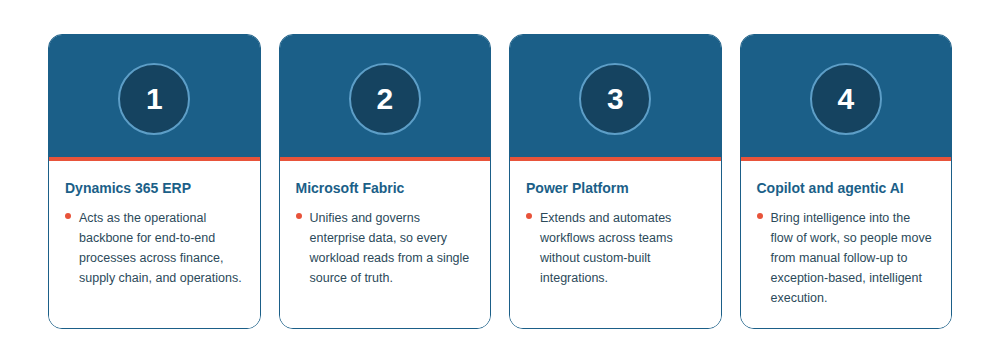
When these layers operate in alignment, the digital core behaves less like a collection of systems and more like a connected operating model. Instead of reconciling across tools, the organization works from one version of truth. Instead of reacting to reports, it acts on what the system already knows.
What This Looks Like in Manufacturing: A Real-World Example
A chemical manufacturer we worked with, running both process and discrete manufacturing, illustrates all three myths converging. Their challenge wasn’t growth; it was sustained growth through acquisitions. Each acquisition brought new processes, new operating models, and new master data structures. Over time, the complexity compounded: more than 30 warehouse operations running variations of the same process, warehouse data loosely connected to the ERP, largely manual exception handling, and reconciliation cycles stretching across multiple days. Teams were spending more time keeping systems aligned than improving performance, and leadership couldn’t get a consistent view of the business without significant manual effort.
Our first step was not AI. It was strengthening the digital core. We consolidated those 30-plus warehouse operations into a standardized operating model on Dynamics 365, integrated the surrounding systems, and put master data governance in place: stabilize first, then modernize, then add intelligence.
Only once that foundation was solid did we layer in AI. One example: an agentic AI assistant embedded in warehouse and inventory management. Where planners and inventory teams previously extracted data into Excel and reconciled it manually, they now ask questions in plain English, about sales orders, inventory positions, replenishment, and get governed answers in about a minute, without navigating menus or handheld devices. The agent works because the data underneath it is connected and trusted. The same agent on the old foundation would simply have delivered wrong answers faster.
The results were measurable:
- 15% revenue improvement through faster, more accurate fulfillment.
- Reconciliation reduced from multiple days to one with AI-assisted matching.
- 15% inventory optimization from faster counting and smarter replenishment.
- 20% lower operational overhead across warehouse operations.
The warehouse stopped being a bottleneck and started being a lever for growth. But the sequence is the lesson: foundation first, governance woven in, AI last, and because of that order, AI actually stuck.
Where to Start: Next Steps
ERP systems are crucial for effective AI utilization, yet 56% of manufacturers feel uncertain about their ERP’s readiness for AI integration.
When manufacturing leaders ask where to begin with ERP modernization for AI, I always come back to the same starting point: a clear, grounded assessment, not of the ERP in isolation, but of the digital core as a whole. That means looking at four things together:
- Core operations: How your processes actually run today, including the spreadsheets and workarounds that have quietly replaced the intended design.
- Data: Where data breaks down between ERP, warehouse, MES, and finance, and what governance exists (or doesn’t).
- Platform: How your current landscape maps to a connected ecosystem, ERP, data platform, automation, and AI layers.
- Business objectives: Which outcomes matter, fulfillment speed, close cycles, inventory accuracy, so the roadmap is tied to measurable results, not technology for its own sake.
Done well, that assessment produces a solution blueprint and a three-to-four-year roadmap that answers the questions your CFO and CEO will ask first:
- What’s the ROI?
- What’s the TCO?
- When do we see it?
That’s what turns modernization from an IT-driven project into a business-driven decision. It’s what separates organizations that pilot AI from the ones that operationalize it.
Your ERP may be stable. The question worth asking is whether it’s AI-ready, because the organizations pulling ahead aren’t the ones with the most AI pilots. They’re the ones whose digital core was built for AI to land on.
About the Author

Manoj Nair is Practice Director, Business Applications at Synoptek. With more than 22 years of experience in Software Consultancy, ERP Implementation, Testing, and ISV Development, Manoj possesses a powerful combination of Functional, Technical, People Management, and Client Management skills. His areas of expertise include Program Management, Team Building, ERP Implementation and Integration, Quality Assurance and Control, Practice Building and Management, Security and Process Audit, Business Development, and Problem Solving and Analysis. At Synoptek, he manages various software programs through cross-functional coordination including: reporting on project progress and ensuring audit and quality control of project deliverables.