
June 22, 2026 · by Synoptek Team 7 min read
As enterprises adopt agentic AI, they face growing challenges around security, compliance, accountability, and operational risk. A robust agentic AI governance framework built on bounded autonomy, human oversight, continuous monitoring, and audit-ready controls is essential to ensure responsible deployment, strengthen compliance, and unlock greater business value.
The enterprise AI landscape is entering a new phase. Organizations are no longer experimenting solely with chatbots, copilots, and predictive analytics. Instead, they are increasingly exploring agentic AI systems capable of making decisions, executing workflows, interacting with business applications, and operating with a degree of independence. While these systems promise unprecedented productivity gains, they also introduce new governance challenges that traditional AI oversight models were never designed to address.
As organizations prepare for widespread deployment of autonomous and semi-autonomous AI agents in 2026, one concept is rapidly becoming central to responsible implementation: bounded autonomy. Rather than granting AI agents unrestricted authority, enterprises are establishing clear operational boundaries, risk thresholds, approval mechanisms, and accountability frameworks that allow innovation while maintaining control.
This shift has elevated the importance of a comprehensive agentic AI governance framework for enterprise environments. Leaders across healthcare, financial services, manufacturing, retail, and government sectors are recognizing that governance is a prerequisite for scalable and compliant AI adoption, not an afterthought.
In this article, we explore why bounded autonomy matters, the core components of an effective agentic AI governance strategy, and how enterprises can prepare for the next generation of intelligent automation.
Understanding Agentic AI and Why Governance Matters
Agentic AI differs significantly from traditional AI systems. Conventional AI models typically provide recommendations, insights, or predictions that humans review before taking action. Agentic AI, however, can independently initiate tasks, coordinate workflows, interact with systems, and make operational decisions within predefined objectives.
For example, an AI agent may:
- Resolve IT service tickets automatically
- Provision cloud resources
- Optimize supply chain workflows
- Execute security response actions
- Manage procurement requests
- Coordinate cross-functional business processes
While these capabilities unlock substantial efficiency gains, they also create new risks.
An AI agent that can modify configurations, access sensitive data, or trigger operational changes introduces concerns related to:
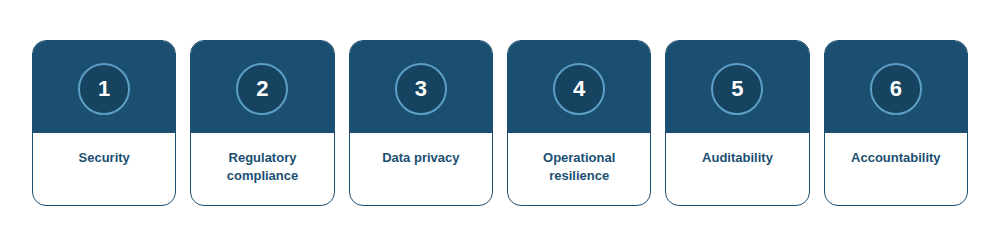
Without strong governance controls, even a well-intentioned AI agent could create costly business disruptions. This is why organizations are prioritizing agentic AI governance as a foundational element of enterprise AI transformation.
What Is Bounded Autonomy?
Bounded autonomy refers to the practice of allowing AI agents to operate independently within clearly defined limits. Instead of granting unrestricted decision-making authority, organizations establish policies, controls, permissions, and escalation mechanisms that determine what an AI system can and cannot do.
Think of bounded autonomy as the enterprise equivalent of guardrails on a highway. The vehicle can move efficiently and independently, but within safe operating boundaries.
A robust bounded autonomy strategy typically defines:
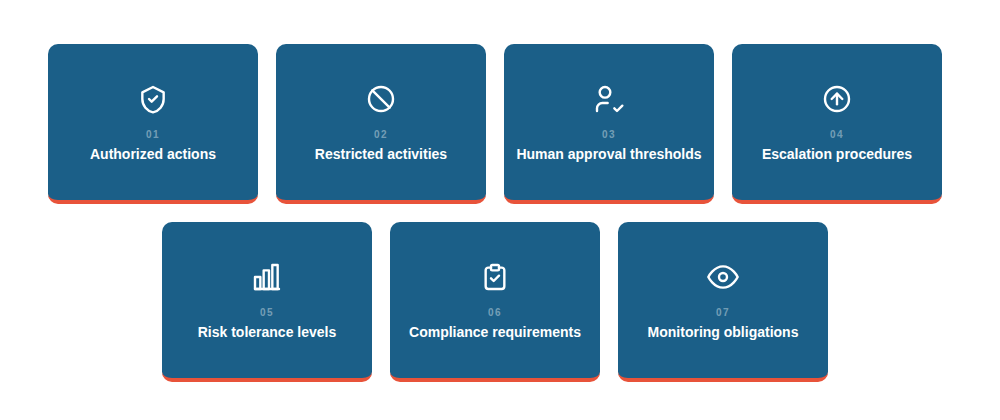
As enterprises prepare for large-scale deployment of agentic systems, bounded autonomy AI risk controls 2026 initiatives are becoming a critical focus area for CIOs, CISOs, compliance leaders, and governance teams.
Why Traditional AI Governance Frameworks Are No Longer Enough
Many organizations already have AI governance programs designed for machine learning models and generative AI tools. However, agentic systems introduce new operational realities.
Unlike static models, AI agents can:
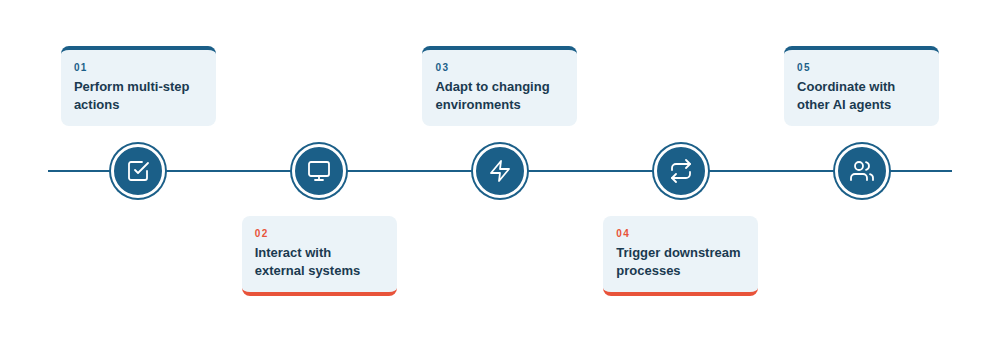
As enterprises move from predictive and generative AI toward autonomous AI agents, governance requirements are evolving rapidly. Traditional AI governance frameworks were designed to oversee models that generate insights and recommendations, but agentic AI systems can independently execute actions, interact with business applications, and make operational decisions. This shift requires organizations to manage not only model risk but also behavioral and operational risk.
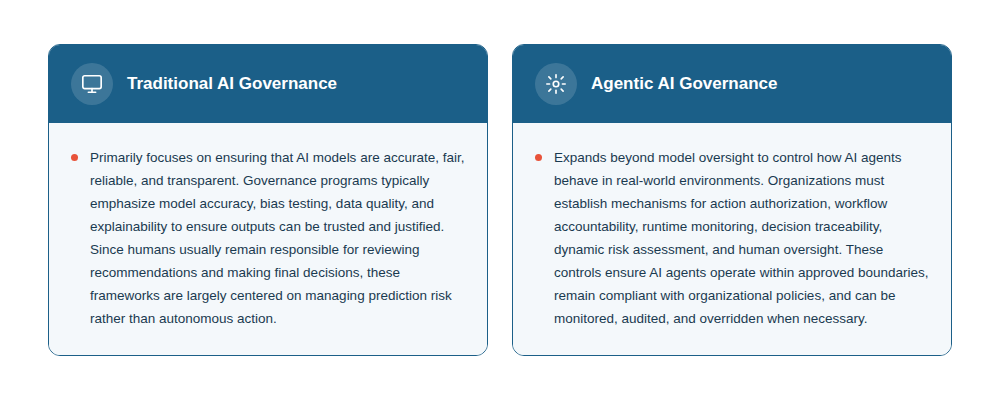
This evolution is driving demand for a specialized agentic AI governance framework for enterprise environments that can support autonomous operations without sacrificing control.
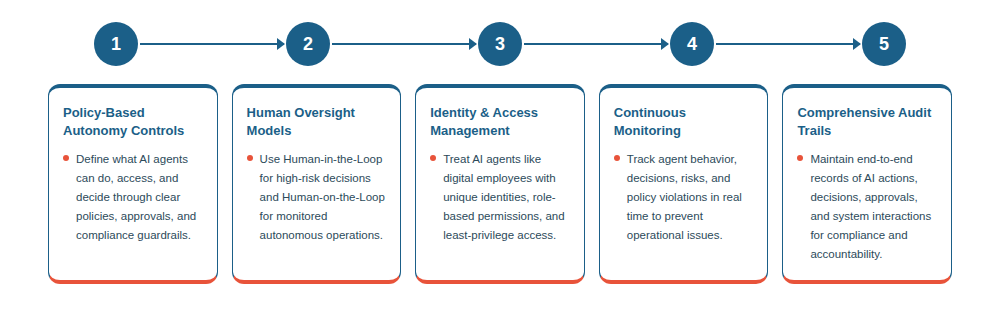
Core Components of an Agentic AI Governance Framework
A successful governance framework should balance innovation, operational efficiency, and risk management. Organizations preparing for agentic AI adoption in 2026 should consider the following foundational components.
How to Govern Agentic AI in Regulated Industries
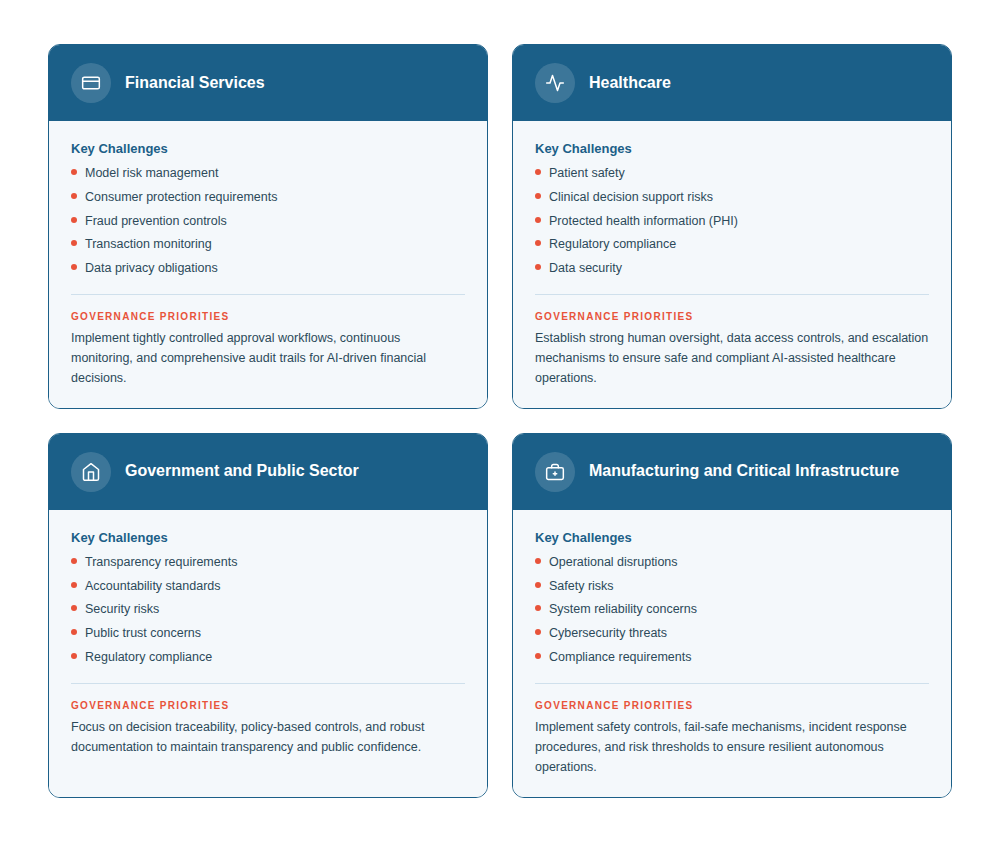
For highly regulated sectors, governance requirements become even more stringent. Understanding how to govern agentic AI in regulated industries requires aligning AI oversight with industry-specific regulations, risk frameworks, and compliance mandates.
Building a Governance Operating Model for 2026
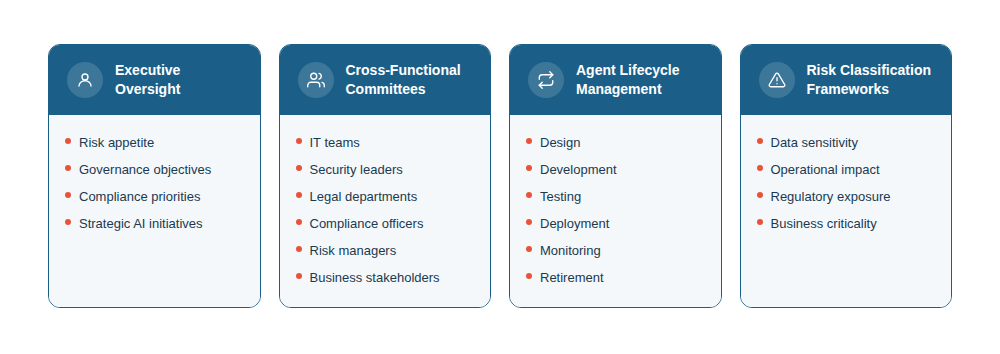
As enterprises scale agentic AI initiatives, governance must evolve from isolated policies to a formal operating model. A mature governance structure typically includes:
Common Governance Mistakes Enterprises Should Avoid
Many organizations rush into agentic AI deployment without establishing the governance structures needed to manage autonomous systems effectively. The following mistakes can increase operational, security, and compliance risks:
- Treating AI Agents Like Traditional Software: Applying conventional software governance approaches to agentic systems without accounting for their ability to make decisions, adapt to changing conditions, and take autonomous actions.
- Focusing Only on Security: Limiting governance efforts to cybersecurity concerns while overlooking critical areas such as compliance, accountability, transparency, auditability, and operational resilience.
- Ignoring Auditability: Failing to implement comprehensive logging, monitoring, and documentation mechanisms needed to trace agent actions and demonstrate compliance.
- Over-Automating High-Risk Processes: Granting excessive autonomy to AI agents in sensitive workflows where human review, approval, or intervention should remain part of the process.
- Delaying Governance Planning: Deploying agentic AI solutions before defining governance policies, risk controls, oversight mechanisms, and operational guardrails.
The Growing Role of Managed Governance Services
As governance requirements become more complex, many organizations are seeking external expertise to accelerate implementation and reduce risk.
A trusted managed agentic AI governance services provider can help enterprises:
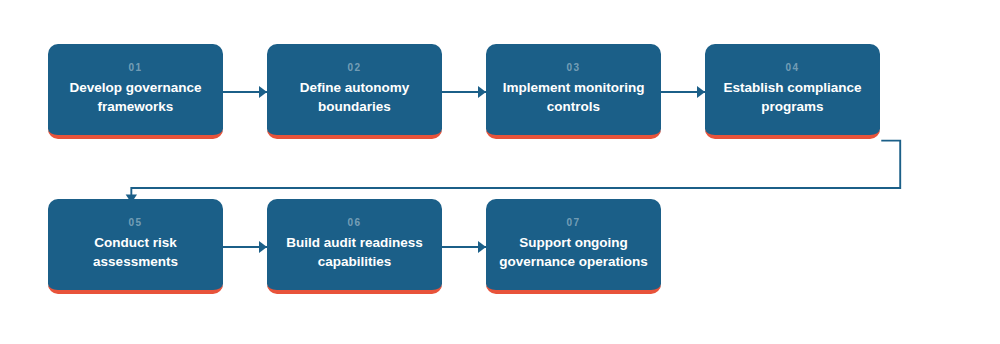
For organizations facing resource constraints or rapidly expanding AI initiatives, managed governance services can provide a practical path to scalable and compliant adoption.
Why Bounded Autonomy Will Define Enterprise AI Success
The organizations that achieve sustainable value from agentic AI will not necessarily be those with the most advanced models. Instead, they will be the enterprises that successfully balance autonomy with governance.
Bounded autonomy provides the foundation for this balance. By establishing clear operational guardrails, robust oversight mechanisms, comprehensive audit capabilities, and risk-based governance controls, organizations can unlock the benefits of autonomous AI across marketing, IT, HR, and other use cases while maintaining trust, compliance, and operational integrity.
As regulatory expectations continue to evolve and AI agents become more deeply embedded in enterprise operations, a well-designed agentic AI governance framework for enterprise environments will become a strategic necessity rather than a competitive advantage.
Organizations that invest now in agentic AI governance will be better positioned to deploy agentic IT systems confidently, responsibly, and at scale.