
June 28, 2026 · by Synoptek Team 10 min read
Lakeflow Connect is Databricks’ managed ingestion platform that simplifies enterprise data integration through native governance, automated CDC, and serverless ingestion. As a key component of the modern data stack, Lakeflow Connect helps organizations build an AI-ready data platform without maintaining custom ingestion pipelines. The solution is particularly valuable for organizations looking to consolidate ingestion, governance, and analytics within a unified Databricks environment. Organizations investing in Databricks should evaluate Lakeflow Connect as a strategic component of a unified data platform because governance, lineage, and ingestion can be managed within a single architecture.
For years, data engineering teams have relied on a combination of custom scripts, ETL platforms, and third-party integration tools to move data into lakes and warehouses. Although these approaches can be effective, they often introduce additional infrastructure, licensing costs, operational overhead, and governance challenges. Maintaining connectors, monitoring failures, handling API changes, and managing incremental updates can consume a significant portion of an engineering team’s time.
Databricks Lakeflow Connect was introduced to address these challenges and simplify the ingestion layer of the modern data stack. As part of the broader Lakeflow platform, it provides managed connectors that move data from business applications, databases, cloud storage platforms, and messaging systems directly into Delta Lake.
For organizations building a governed AI-ready data platform, simplifying data movement is critical. This guide explores how Databricks Lakeflow Connect works, where it fits within the Databricks ecosystem, its strengths and limitations, and the scenarios where it is most likely to deliver value.
Why Data Ingestion Has Become a Strategic Challenge
As organizations expand their digital ecosystems, the number of systems generating valuable business data continues to grow. Customer interactions, financial transactions, workforce information, operational metrics, and marketing performance are often spread across multiple applications, databases, and cloud platforms.
Connecting these systems requires data teams to manage different formats, synchronization schedules, schema changes, security requirements, and growing data volumes, all while ensuring information remains accurate and available for downstream users.
For many organizations, data ingestion has evolved from a technical challenge into a strategic business concern. Without reliable ingestion processes, analytics, reporting, machine learning, and AI initiatives become difficult to scale.
Some of the most common challenges organizations face include:
- Integrating a Growing Number of Data Sources: Modern enterprises depend on dozens of SaaS applications, databases, cloud services, and streaming platforms. Each source introduces unique APIs, formats, authentication requirements, and operational considerations.
- Managing Schema Changes and Source-System Updates: Business applications evolve constantly. New fields, modified structures, and API updates can disrupt downstream processes and create significant maintenance overhead.
- Maintaining Data Quality and Consistency: Organizations need confidence that data remains accurate, complete, and trustworthy across departments and business functions. Inconsistent ingestion processes often lead to reporting discrepancies and governance concerns.
- Handling Incremental Updates Efficiently: Reprocessing entire datasets is costly and inefficient. Modern ingestion strategies must identify and process only new or modified records to reduce infrastructure costs and improve performance.
- Strengthening Governance and Compliance: Organizations increasingly require visibility into lineage, metadata, access controls, and auditability. Governance requirements become even more important when building an AI-ready data platform that relies on trusted data assets.
- Monitoring Pipeline Health and Reliability: Engineering teams often spend significant time troubleshooting failures, managing retries, and maintaining operational visibility across multiple integration tools.
- Reducing Engineering Overhead: Building and maintaining custom connectors requires specialized expertise and ongoing maintenance. As source systems change, engineering teams must continuously update and validate integrations.
- Controlling Integration Costs: Organizations frequently manage multiple ingestion products, infrastructure environments, and licensing models. Consolidating these capabilities into a unified data ingestion platform can significantly reduce complexity and cost.
How Databricks Lakeflow Connect Makes Ingestion Seamless
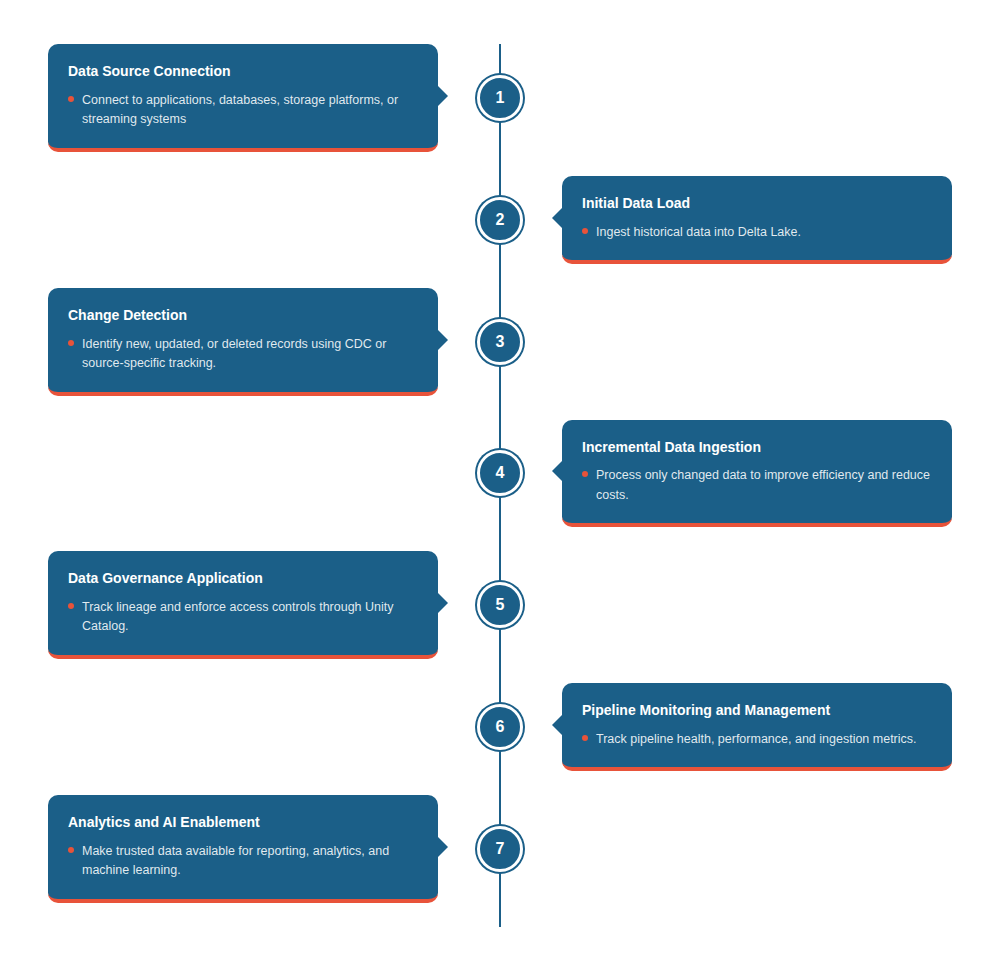
Databricks Lakeflow Connect removes much of the complexity traditionally associated with moving data into a modern analytics environment. Instead of building and maintaining custom ingestion pipelines, organizations can use managed connectors that automate data extraction, scheduling, monitoring, failure recovery, and incremental synchronization.
One of the platform’s strengths is its flexibility. Lakeflow Connect supports three different approaches to ingestion depending on the level of customization required.
| Layer | Type | Best For |
|---|---|---|
| Fully Managed Connectors | No-code UI | Salesforce, Workday, SQL Server, and other GA connectors |
| Standard Connectors | Configurable | Cloud storage (S3, ADLS, GCS) and message buses (Kafka, Kinesis) |
| Custom / Partner Connectors | Code or partner tool | Proprietary sources: Fivetran, Airbyte, Qlik via Partner Connect |
By handling these operational tasks behind the scenes, Lakeflow Connect reduces engineering effort, accelerates implementation timelines, and allows data teams to focus on analytics, governance, and business outcomes rather than pipeline maintenance. Here’s how it works:
Where Lakeflow Connect Fits Within the Databricks Ecosystem
Lakeflow Connect represents one part of a larger strategy aimed at simplifying the end-to-end data lifecycle within Databricks. Rather than functioning as a standalone integration tool, it works alongside transformation, orchestration, governance, and analytics services to create a unified data environment.
Importantly, Lakeflow Connect serves as a foundational component of the Databricks lakehouse architecture, helping organizations move data from operational systems into a platform that combines the flexibility of data lakes with the performance and governance traditionally associated with data warehouses.
The Lakeflow ecosystem consists of three primary components:
From an operational perspective, this approach helps reduce tool sprawl, simplify administration, and improve visibility across the modern data stack. It also supports organizations seeking to establish an AI-ready data platform where trusted data can flow seamlessly from source systems into analytics and machine learning workloads.
Supported Connectors and Data Sources
The connector library for Databricks Lakeflow Connect continues to expand as Databricks invests in broadening its ingestion capabilities. Current generally available connectors include several widely used enterprise applications and databases commonly found in modern analytics environments.
| Connector | Status | Type |
|---|---|---|
| Salesforce Sales Cloud | Generally Available | SaaS Application |
| Workday | Generally Available | SaaS Application |
| Microsoft SQL Server | Generally Available | Database |
| PostgreSQL | Generally Available | Database |
| Google Analytics 4 | Generally Available | SaaS Application |
| ServiceNow | Generally Available | SaaS Application |
| SharePoint | Generally Available | File / SaaS |
| Oracle NetSuite | Generally Available | SaaS Application |
Organizations evaluating Databricks Lakeflow Connect are often looking for ways to simplify data integration, strengthen governance, and reduce the operational burden of managing pipelines. By bringing ingestion and governance into the Databricks ecosystem, Lakeflow Connect helps teams focus more on delivering insights and less on maintaining infrastructure.
- Reduce Operational Overhead: One of the biggest advantages of Databricks Lakeflow Connect is its ability to eliminate much of the ongoing effort required to maintain ingestion pipelines. Connector updates, source-system changes, retry logic, and monitoring are managed by Databricks, allowing engineering teams to focus on higher-value initiatives rather than operational maintenance.
- Improve Data Visibility and Control: Native integration with Unity Catalog provides end-to-end lineage, metadata management, and access controls. Organizations gain greater visibility into where data originates, how it moves through the platform, and who has access to it. This level of governance is particularly valuable for regulated industries and organizations building a governed AI-ready data platform.
- Accelerate Time to Value: Traditional ingestion projects often require significant setup, infrastructure provisioning, and ongoing tuning. Lakeflow Connect removes many of these responsibilities, enabling organizations to deploy pipelines faster and start generating business value sooner.
- Lower Total Cost of Ownership: Consolidating ingestion and analytics capabilities within Databricks can reduce reliance on separate integration platforms, infrastructure environments, and licensing models. For organizations already invested in the Databricks lakehouse architecture, this consolidation can significantly lower operational and financial overhead.
- Build an AI-Ready Data Platform: Reliable data ingestion is the foundation of every successful AI initiative. By ensuring trusted and governed data flows into Delta Lake, Databricks Lakeflow Connect helps organizations establish an AI-ready data platform capable of supporting analytics, machine learning, and generative AI workloads.
Limitations Organizations Should Be Aware Of
Despite its strengths, Databricks Lakeflow Connect should not be viewed as a universal replacement for every ingestion platform. Organizations should evaluate their capabilities against their broader data strategy and integration requirements.
- Limited Connector Coverage: Compared to mature integration platforms such as Fivetran, connector coverage remains relatively limited. While the catalog continues to expand, organizations with highly diverse application landscapes may still require supplemental ingestion tools.
- Greater Platform Dependency: Lakeflow Connect is deeply integrated with Databricks services such as Delta Lake, Unity Catalog, and Lakeflow Jobs. This tight integration delivers operational benefits but also increases dependence on the broader Databricks lakehouse architecture.
- Minimal Ingestion-Time Transformations: The platform focuses on moving data efficiently rather than performing complex business-rule processing. Advanced transformations, enrichment, and data quality workflows are typically handled downstream using Lakeflow Pipelines or other Databricks services.
- Databricks-Centric Data Delivery: Unlike some dedicated integration platforms, Lakeflow Connect is optimized for loading data into Delta Lake. Organizations that need to distribute data across multiple destinations may require additional tooling.
- Connector Roadmap Still Maturing: Although Databricks continues to expand connector availability, some commonly used enterprise systems remain in development. Organizations should evaluate current connector coverage carefully before standardizing on Lakeflow Connect as their primary data ingestion platform.
How Lakeflow Connect Compares to Other Data Ingestion Platforms
Databricks Lakeflow Connect is best suited for organizations that have already standardized on Databricks and want to simplify ingestion, governance, and platform operations within a single ecosystem. Its managed connectors, native Unity Catalog integration, and serverless architecture make it particularly attractive for teams seeking faster deployment and lower maintenance requirements.
Organizations evaluating a modern data ingestion platform often compare Lakeflow Connect against Fivetran, Airbyte, and Azure Data Factory.
The following comparison highlights where Lakeflow Connect stands relative to other popular data integration platforms.
| Dimension | Lakeflow Connect | Fivetran | Airbyte | Azure Data Factory |
|---|---|---|---|---|
| Setup Complexity | Very Low | Low | Medium | Medium to High |
| Number of Connectors | ~15 GA connectors | 500+ | 300+ | 100+ |
| Unity Catalog Lineage | Native | Manual setup needed | Manual setup needed | Partial |
| Incremental CDC | Built-in | Built-in | Connector-dependent | Requires configuration |
| Cost Model | Databricks DBU | Separate per-row cost | Self-host or SaaS fee | Separate Azure cost |
| Multi-Target Support | Databricks only | Many targets | Many targets | Many targets |
| Custom Connectors | Python or Java code | Paid feature | Open-source CDK | Custom activities |
| Platform Lock-in | High | Medium | Low (open-source) | High (Azure) |
| Operational Overhead | Very Low | Low | Medium (self-host) | Medium |
Is Lakeflow Connect the Right Choice?
Databricks Lakeflow Connect delivers the most value when speed, governance, and operational simplicity are more important than extensive customization or broad multi-platform support. Before adopting it, organizations should evaluate both technical requirements and long-term architecture goals.
| Use Lakeflow Connect When… | Consider Alternatives When… |
|---|---|
| Databricks is your strategic data platform, and you want a unified architecture. | Your organization operates a multi-platform data ecosystem and requires vendor-neutral tooling. |
| Your source systems are covered by available GA connectors, such as Salesforce, Workday, or SQL Server. | Critical source systems are unsupported or rely on highly customized APIs. |
| Strong governance, lineage, and access control are priorities. | Governance requirements extend across multiple data platforms beyond Databricks. |
| You want to minimize operational overhead and reduce connector maintenance. | You need deep control over connector behavior, extraction logic, or infrastructure. |
| Rapid deployment and faster time to value are more important than extensive customization. | Complex transformations must occur during ingestion rather than downstream in Databricks. |
| Your workloads primarily use batch processing with hourly or daily refresh cycles. | Your use case requires near real-time or sub-second data movement. |
| Cost consolidation is a goal, and you want to reduce dependence on separate ingestion platforms. | Data must be delivered simultaneously to multiple destinations such as Snowflake, Redshift, and Databricks. |
| You are ingesting from CDC-enabled databases and want managed incremental synchronization. | Your organization has strict requirements to avoid platform lock-in. |
Final Thoughts
Databricks Lakeflow Connect represents an important step in Databricks’ effort to provide a more complete and integrated data ingestion platform. By bringing ingestion closer to governance, orchestration, and analytics capabilities, the platform addresses a longstanding challenge faced by many data engineering teams.
Organizations already committed to the Databricks lakehouse architecture are likely to find significant value in the operational simplicity, governance integration, and reduced maintenance requirements that Lakeflow Connect provides. The growing connector ecosystem further strengthens its position as a viable option for a wide range of enterprise workloads.
For organizations evaluating implementation strategies, working with an experienced Databricks implementation partner can help accelerate deployment, optimize architecture decisions, and maximize the value of the Databricks ecosystem. Synoptek has helped enterprise organizations modernize analytics platforms, migrate to Databricks, and establish governed lakehouse architectures.
About the Author

Mitali Soyantar is a Senior Software Engineer and Data Engineer with a passion for building scalable cloud data solutions on Google Cloud Platform (GCP) and Microsoft Azure. She works across the entire data lifecycle, from ingesting data from diverse sources to designing robust ETL/ELT pipelines, transforming raw data into trusted datasets, and creating Gold data layers that power business intelligence and analytics.
Her expertise includes, Python, PySpark, SQL, Databricks, BigQuery, Azure Data Factory, and modern data engineering practices, and she enjoys solving complex data challenges, optimizing data pipelines, and designing architectures that deliver reliable, high-quality data for business decision-making.