
June 24, 2026 - by Bhavin Sankhat
Enterprise AI governance is the operating framework that allows organizations to deploy, monitor, and control AI tools including unapproved employee-adopted AI (shadow AI) within defined security, compliance, and identity boundaries. In 2026, only 37% of organizations have formal AI governance policies (IBM), yet 67% of employees use AI tools at work. Without governance, organizations risk data exposure, compliance failure, and fragmented AI outcomes. Effective governance combines a managed AI platform such as Microsoft 365 Copilot, an AI Center of Excellence operating model, and defined responsible AI policies from day one.
I used to believe that AI adoption inside enterprises would be a structured decision driven through leadership alignment, formal strategy workshops, and carefully sequenced technology roadmaps. But the reality I now see across organizations is very different.
Employees are already experimenting with AI tools in ways that were never formally approved. An article by Forbes puts the employee AI adoption at 67%. But by the time leaders recognize the scale of usage, AI has already become embedded in how work gets done. This often surfaces as fragmented workflows, inconsistent outputs, compliance concerns, and governance gaps that are already affecting day-to-day operations.
These themes were reinforced during Synoptek’s recent webinar, “Becoming a Frontier Firm with Microsoft AI,” where we discussed how organizations are navigating the realities of AI adoption, governance, and scale. Read to learn how organizations building robust AI governance and operating models are the ones creating the most value.
The Enterprise Risk Hidden in Everyday AI Use
One of the most important and rapidly growing challenges I see across organizations today is the emergence of what is commonly referred to as shadow AI, which essentially refers to employees using public or unapproved AI tools outside of governed enterprise environments.
Employees are actively adopting AI tools because they are seeing immediate and tangible benefits in terms of productivity, speed, and reduced effort, which naturally makes them gravitate toward solutions that are not always part of the official enterprise stack.
While they are not intentionally creating risk when they use these tools, sensitive organizational data can unintentionally be exposed outside controlled environments, especially as work begins to diverge across tools, data becomes inconsistent, and organizational visibility starts to weaken without anyone explicitly noticing it.
Making AI Official Through a Governed Enterprise Platform
One of the most common requests I hear from leadership teams is surprisingly simple:
“Help us make generative AI safe and official first.”
This is where enterprise platforms such as Microsoft 365 Copilot and Agentic AI become important. Rather than relying on unmanaged tools, organizations can provide employees with approved AI capabilities operating within existing security, compliance, identity, and governance frameworks.
What makes this approach effective is that governance is built into the platform itself rather than added later. Identity management, access controls, compliance requirements, and responsible AI practices operate alongside copilots and agents from the beginning. Organizations are not simply deploying another productivity tool; they are establishing a governed AI operating environment that can scale across the enterprise.
Why an AI Center of Excellence Becomes the Real Turning Point
The most successful organizations I work with do not treat AI as a collection of disconnected projects. Instead, they establish an AI Center of Excellence (AICOE) that serves as the operating function connecting strategy, governance, delivery, adoption, and measurement.
An effective AICOE provides a repeatable framework that helps organizations move from experimentation to enterprise value. Rather than managing dozens of isolated pilots, organizations create a structured approach that aligns business priorities, governance requirements, implementation practices, and measurable outcomes.
At Synoptek, we typically help organizations establish this through a five-stage operating model:
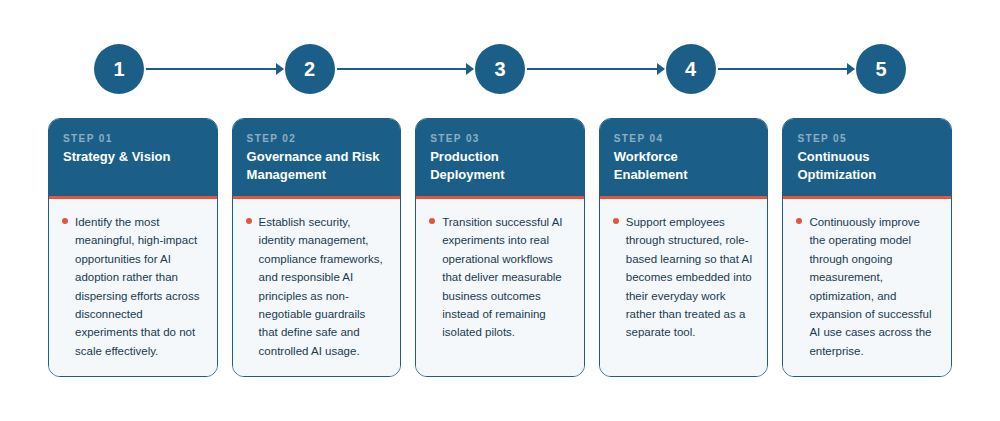
Together, these stages provide a practical framework for scaling AI responsibly across the enterprise.
From Governance to Business Outcomes: A Real-World Example
One global manufacturer we worked with faced a challenge that is becoming increasingly common. Employees had already begun exploring public AI tools, while leadership wanted a safe and structured way to adopt generative AI across the business.
Using the AI Center of Excellence framework, we implemented a six-month transformation program that began with readiness assessments and governance foundations before expanding into Microsoft 365 Copilot and AI agents. The organization established stronger controls around data access, reduced reliance on shadow AI tools, and created a scalable foundation for future AI initiatives.
The outcomes were measurable.
More importantly, it created a governed AI environment capable of supporting future agent-based automation without needing to restart its transformation journey.
The Future Belongs to Organizations That Govern AI Well
While AI experimentation is often successful, scaling those initiatives into sustainable enterprise value is significantly more challenging. This is because most organizations lack a unified operating model that connects governance, adoption, and measurable outcomes, leaving AI deployed in isolated pockets rather than embedded within core business processes.
To transform AI adoption into a lasting business impact, leaders must rethink how work is performed. Allow your employees to focus on judgment, creativity, and decision-making while AI handles routine tasks, information processing, and workflow orchestration. A mature governance strategy provides the structure needed to convert user-driven AI enthusiasm into long-term enterprise growth.
About the Author

Bhavin Sankhat is the Practice Director of Workforce Productivity at Synoptek. He has a proven track record in optimizing organizational efficiency and elevating employee productivity and a rich background in technology integration, low-code, no-code, robotic process automation, and intelligent process automation.