
May 20, 2026 - by Ajinkya Gokhale
ServiceNow Retail Service Management (RSM) is a purpose-built platform that unifies store operations, IT, facilities, and vendor workflows into a single system of action. Built on the Now Platform, it automates incident routing, enforces SLAs, enables real-time multi-store visibility, and uses Now Assist GenAI to accelerate case resolution, replacing phone calls, emails, and spreadsheets with one connected workflow.
If you’ve ever worked in retail IT or operations, you already know the reality. Something breaks in a store and suddenly everyone is scrambling. A POS machine goes down, a scanner stops working, or the AC fails on a busy weekend. Instead of fixing the problem quickly, people spend more time figuring out who should fix it.
That’s exactly the gap ServiceNow Retail Service Management (RSM) is designed to close. As a modern retail store incident management software, it helps retailers streamline issue resolution across stores, IT teams, facilities, and vendors. Built natively on the ServiceNow platform, ServiceNow retail service management connects store teams, IT, facilities, and external vendors into one unified system, eliminating the operational chaos caused by disconnected calls, emails, and spreadsheets.
This blog explores how ServiceNow RSM helps retail teams streamline incident resolution, reduce store downtime, improve operational visibility, and support retail IT operations automation across multiple store locations.
RSM isn’t just another IT tool. Think of it as the central nervous system of your store operations, quietly routing the right problem to the right person, every single time.
How ServiceNow RSM Is Structured
ServiceNow removes the operational confusion that usually comes with store incidents. Store employees don’t have to figure out which team to contact, whether IT or facilities owns the issue, or how to escalate it. They simply report the problem, and the system handles the rest.
Behind the scenes, ServiceNow Retail Service Management works through a connected set of layers that automate workflows, improve coordination, and simplify support operations for the ServiceNow for retail industry ecosystem.
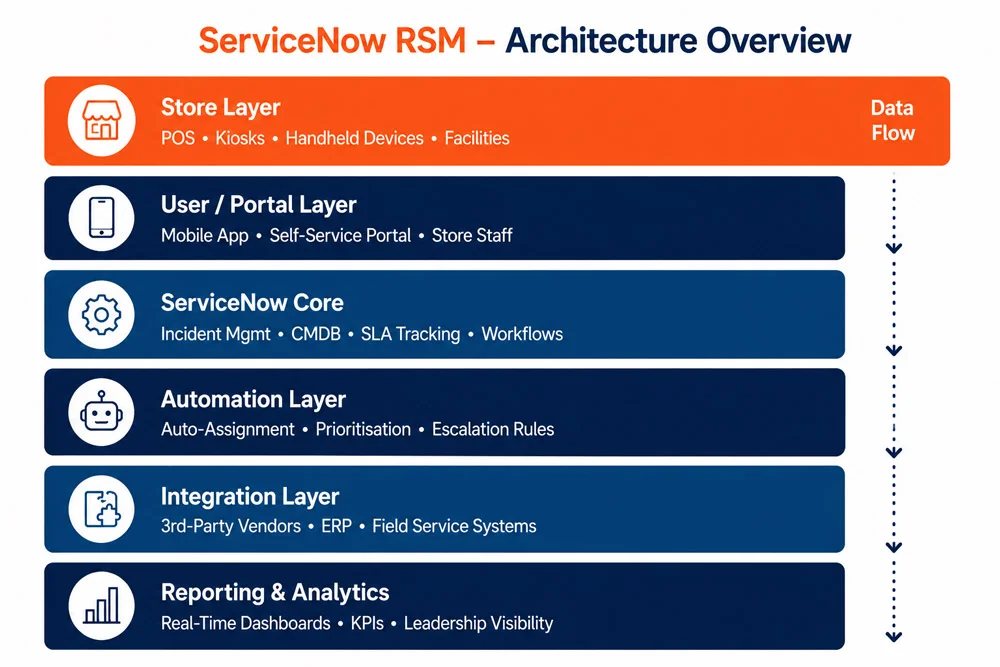
ServiceNow RSM Architecture: Six layers, one connected flow
- Store Layer: This layer captures issues directly from store operations, including problems with POS systems, kiosks, handheld scanners, HVAC units, and other in-store assets that require support or maintenance.
- User / Portal Layer: Store associates can report issues quickly through a mobile app or web portal without wasting time on calls, emails, or figuring out whom to contact.
- ServiceNow Core: This acts as the central engine of ServiceNow Retail Service Management, where incidents are automatically created, categorized, prioritized, and monitored against service-level agreements (SLAs).
- Automation Layer: The platform supports retail IT operations automation by automatically routing tickets to the right team based on issue type, store location, and business priority.
- Integration Layer: External vendors, ERP systems, and field service platforms are connected directly into the workflow to reduce manual coordination and delays.
- Reporting & Analytics Layer: Retail operations and leadership teams get real-time visibility into store incidents, resolution timelines, and performance trends across locations.
From Logged to Resolved – The ServiceNow RSM Ticket Lifecycle
Once a store associate raises an issue, ServiceNow Retail Service Management takes over. Here’s what that looks like from start to finish:
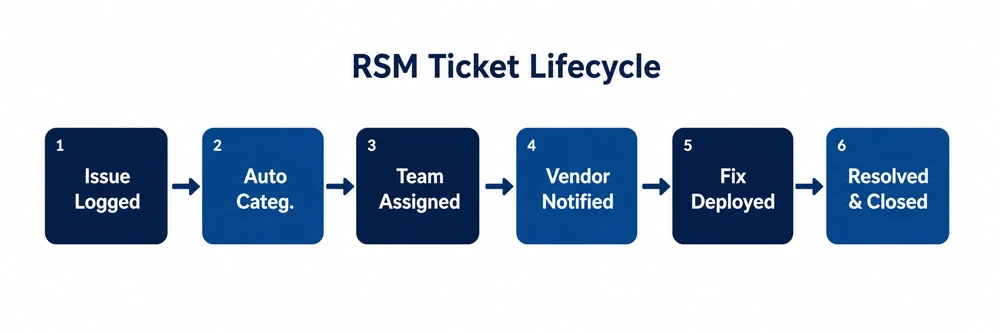
RSM Ticket Lifecycle: Six steps from issue to resolution
Each step is automated through ServiceNow RSM, reducing manual handoffs and making the entire support process faster, more consistent, and easier to manage across retail locations. The workflow fires on its own, and every stakeholder, from the associate on the floor to the IT lead at HQ, stays in the loop.
A Real-World Scenario: A Large Retail Chain in Texas
Let’s take an example. A large retail chain operating 100+ stores across Texas was dealing with the kind of operational noise that’s completely normal in retail, and completely avoidable with the right tooling. This is where ServiceNow for retail industry becomes especially valuable, helping large retail chains standardize incident handling across multiple stores and support teams.
The Problem Before RSM
When the billing system or POS went down, the sequence was painfully familiar:
- The store called IT directly
- IT logged a ticket by hand, sometimes with the wrong priority or team
- Assignment errors caused delays, especially when vendors needed to be involved
- The store manager had no visibility and chased updates constantly
- Business was lost while the store waited
What Changed After RSM
When the POS system goes down during store hours, with ServiceNow RSM in place, the response is faster, more organized, and far less chaotic.
- The associate logs the issue on a mobile app in under a minute
- RSM automatically marks it as a critical POS incident
- The right IT team is notified and assigned immediately
- If vendor involvement is needed, they’re contacted automatically
- A technician is dispatched, all trackable in real time
- The store manager monitors status without making a single call
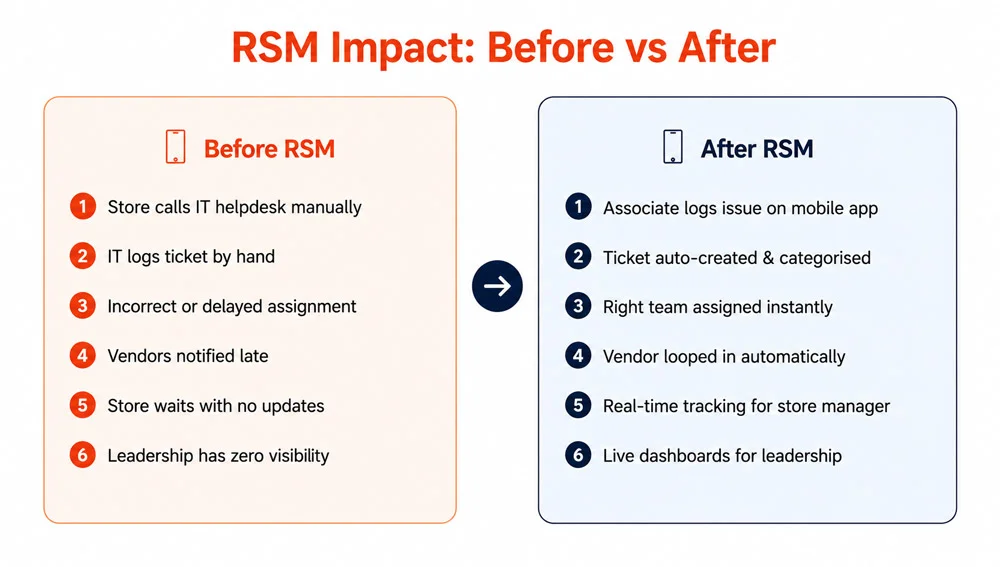
Before vs After RSM: The same incident, a completely different experience
These improvements highlight why many retailers are investing in retail store incident management software to reduce downtime, improve accountability, and support frontline teams more effectively.
What Actually Improved – The Outcomes
After rolling out ServiceNow RSM across its store network, the Texas chain tracked several meaningful shifts. The improvements weren’t just about speed; they changed how store teams felt about raising issues in the first place.
| Outcome Area | What Improved |
|---|---|
| Incident Resolution Time | Significantly faster, especially critical P1s |
| Store Downtime During Peak Hours | Reduced noticeably |
| Escalations from Store Managers | Fewer; teams act before managers escalate |
| IT–Facilities–Vendor Coordination | Streamlined, fewer handoff delays |
| Store Team Confidence | Higher; staff know issues are tracked |
Perhaps the most telling signal: store teams stopped feeling ‘stuck’ when something broke. When people trust that logging into an issue will actually lead to a fix, they log more, and leadership gets better data as a result.
The Bottom Line
As retail environments become more technology-driven, retail IT operations automation is becoming essential for maintaining store uptime, improving customer experience, and supporting frontline employees at scale.
Since retail operations move fast, and even small disruptions can quickly affect customer experience, store revenue, and employee productivity, platforms like ServiceNow help manage multiple stores, systems, and support teams.
Instead of relying on disconnected emails, calls, and manual follow-ups, ServiceNow Retail Service Management gives retailers a centralized way to manage incidents, automate workflows, and improve coordination across IT, facilities, vendors, and field service teams.
With capabilities like AI-powered recommendations and Now Assist retail service management, retailers can also improve ticket handling efficiency and accelerate issue resolution across stores.
About the Author

Ajinkya Avinash Gokhale is a seasoned Certified ServiceNow specialist with over 15 years of experience in IT service management and enterprise solutions. He is recognized for his strategic leadership and ability to drive digital transformation initiatives, leveraging the ServiceNow platform to streamline business processes and enhance operational efficiencies.