
December 31, 2025 · by Ujaval Patel 5 min read
In today’s data-driven world, organizations generate and consume information at an unprecedented scale. While Microsoft Fabric unifies data engineering, data science, real-time analytics, and business intelligence into a single platform, it is the semantic model that holds everything together.

As the decision layer, it gives data meaning, enforces shared business logic, and ensures consistency of metrics across teams and analytical use cases. This blog explains why semantic models sit at the core of Microsoft Fabric and how they transform shared data into consistent, trusted business decisions.
What Makes Semantic Models the Backbone of Microsoft Fabric
Semantic models (formerly referred to as Tabular Models, Cubes, or Power BI datasets) represent a foundational component of Azure Data Fabric. They encapsulate business logic and calculations essential for cross-functional teams and stakeholders. Beyond supporting technical assets for reporting and analytics, semantic models play a pivotal role in driving business-critical decision-making and operational actions.
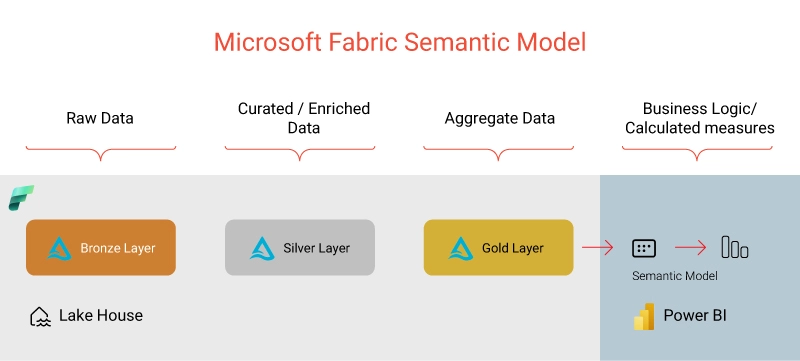
A semantic model consistently delivers a business-user-friendly view of organizational data. Defined at an abstract level, it:
- Incorporates a semantic description, logical structure, and business representation of data, ultimately elevating the user’s understanding and analysis of information.
- Works as a translator between the data warehouse and business users, concealing the complex setup of tables and joins and presenting the data in a manner that aligns with business needs.
Understanding the Benefits of Semantic Models
Semantic models transform fragmented data into a governed system, where metrics stay consistent, logic is reused, and insights travel faster than confusion. Here’s why the semantic model consistently outperforms layers of dashboards in Microsoft Fabric:
- Single Source of Truth (SSOT)
- Centralizes measures, KPIs, and calculations.
- Ensures everyone in the organization is using consistent definitions (e.g., revenue, margin, etc.).
- Reusability Across Reports
- Can be leveraged across multiple reports and dashboards.
- Eliminates the redundancy of logic across teams.
- Scalability
- Enables self-service BI by allowing business users to connect to the semantic model rather than directly to raw databases.
- Is readily extensible with additional measures, dimensions, or data sources to accommodate evolving analytical requirements and integration needs.
- Business-friendly Layer
- Translates complex technical data into precise, business-relevant terminology.
- Provides a simplified, business-focused view of data, eliminating the need for users to know SQL, table joins, or complex database structures.
Semantic Models Use Cases
Different departments, such as marketing and sales, can utilize dedicated semantic models in Azure Data Fabric designed for their unique requirements and datasets, ensuring more accurate and contextually relevant analysis.
Marketing Semantic Model
Purpose: Track and analyze campaign performance, customer engagement, and brand metrics.
Main Entities: Campaign, channel, customer segment, and lead source.
Measures: Click-through rate, conversion rate, cost per acquisition, and social media engagement.
Dimensions: Time (by week/month), region, target demographic.
Usage: The marketing team uses this model to evaluate which campaigns are most effective and refine their targeting strategies.
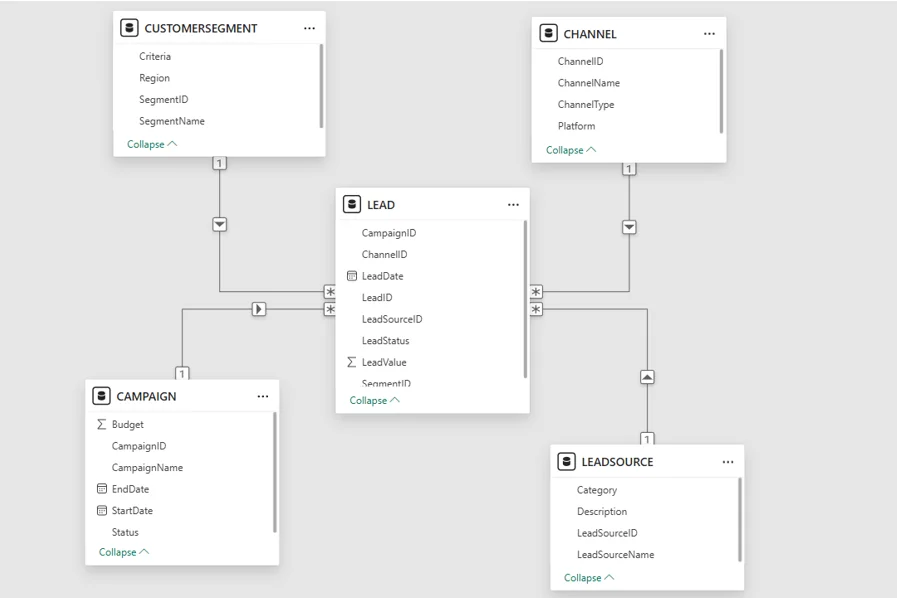
Sales Semantic Model
Purpose: Monitor product sales, track pipeline stages, and measure sales effectiveness.
Main Entities: Customer, product, order, sales rep, and opportunity.
Dimensions: Product category, region, sales stage, time.
Usage: The sales team leverages this model to track performance, forecast results, and analyze key sales metrics.
Measures: Total revenue, units sold, average deal size, and win rate.
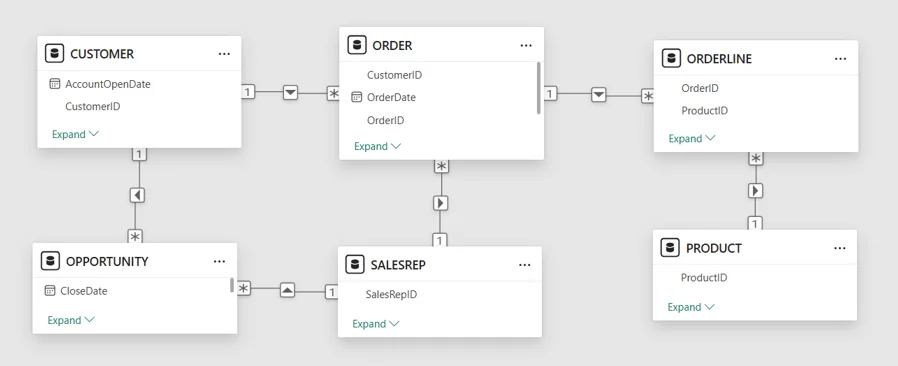
This enables both teams to work from the same data but analyzing it in their own way. For example, marketing evaluates campaign-generated leads , while sales measures how those leads convert into pipeline and deals.
Separate semantic models help teams by providing them with their own setup, calculations, and rules tailored to specific needs. This enables focused, role-specific insights while still operating on the same shared data sources.
Wrapping Up
Semantic models are not an optional optimization within Microsoft Fabric; they are the foundation that enables analytics to scale without losing trust.
They keep metrics consistent, enables efficient reuse of business logic , and allow teams to explore data independently without creating conflicting interpretations. They can be reused and act as key tools to help you scale analytics, support business processes, answer questions, and solve problems.
As analytics increasingly supports daily operations, forecasting, and executive decisions, the quality of semantic models directly impacts business outcomes. Since it bridges raw data with meaningful insights, organizations that invest in governed, high-quality semantic models transform Azure Data Fabric from a reporting platform into a dependable decision-making engine.
About the Author

Ujaval Patel is a Project Manager at Synoptek with strong specialization in Business Intelligence (BI) technologies, bringing extensive experience in end-to-end project delivery. He plays a key role in defining enterprise data architecture strategy and roadmap, designing end-to-end data solutions across ingestion, storage, processing, and consumption layers. His expertise includes establishing data modeling standards, implementing data governance, security, and compliance frameworks, and ensuring data platforms are scalable, high-performing, and cost-efficient.