
July 8, 2026 · by Synoptek Team 8 min read
Finance teams continue to struggle with manual invoice reviews, approval bottlenecks, exception handling, and growing AP workloads despite years of automation investments. Dynamics 365 Business Central’s Payables Agent moves beyond traditional automation by enabling agentic ERP, where AI agents execute routine accounts payable tasks while maintaining governance and human oversight. It enables organizations to improve efficiency, visibility, and control, and build a more scalable finance function.
Finance leaders have spent years investing in automation to improve accounts payable (AP) efficiency. Yet, many AP teams continue to face the same operational challenges: manual reviews, approval delays, exception handling, and constant coordination across departments.
This is because legacy NAV systems and traditional invoice processing automation were designed to make individual tasks faster, not to transform how work gets done. Employees still need to monitor workflows, resolve discrepancies, and ensure every invoice progresses through the process. As invoice volumes increase and businesses expect finance teams to do more with fewer resources, this operating model is becoming increasingly difficult to sustain.
Microsoft is introducing a new approach with the Payables Agent in Dynamics 365 Business Central. Rather than acting as another invoice processing automation tool, the Payables Agent executes routine AP activities autonomously while keeping finance teams firmly in control. This generally available AI capability in Microsoft Dynamics 365 Business Central autonomously reads vendor invoices, matches them to purchase orders, and prepares approval-ready entries, while keeping finance teams in control of every decision. It represents a shift toward agentic ERP, where AI agents actively execute routine financial work rather than simply assisting with it.
Learn how Business Central’s Payables Agent is redefining finance operations.
Why Traditional AP Automation Has Reached Its Limits
For years, ERP platforms have focused on recording financial transactions after business activities occur. Even as accounts payable automation capabilities have evolved, the fundamental operating model has remained largely unchanged.
-
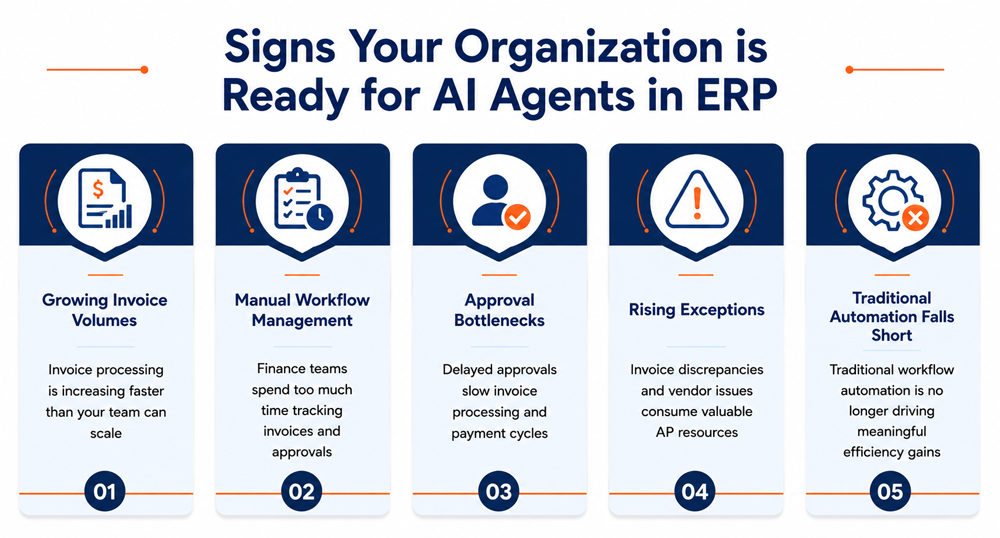
- Invoice processing still requires human oversight: Technology like OCR can extract invoice information, but finance professionals must often verify data accuracy, review coding, and resolve inconsistencies before invoices can move forward.
- Approvals remain dependent on manual follow-ups: Finance teams frequently spend valuable time sending reminders, escalating pending approvals, and tracking bottlenecks.
- Exception handling interrupts productivity: Missing purchase orders, pricing discrepancies, duplicate invoices, and vendor mismatches continue to demand manual investigation, preventing truly hands-free processing.
- Growth increases operational complexity: As organizations expand, invoice volumes rise, and compliance requirements become more demanding. Traditional invoice processing automation often struggles to scale efficiently alongside this growth.
How Better Invoice Processing Delivers Broader Business Value
The value of intelligent accounts payable extends well beyond processing invoices more quickly. Every invoice influences financial reporting, vendor relationships, procurement performance, and compliance activities across the organization.
When invoice processing becomes more consistent, downstream financial operations improve as well. Cleaner vendor data leads to more accurate reporting. Better invoice matching reduces duplicate payments and reconciliation effort. Standardized processing minimizes operational risk while improving financial visibility.
Over time, these improvements contribute to stronger financial decision-making across the business.
- Improved financial data quality: Consistent invoice processing produces cleaner accounting records, making reporting, forecasting, and financial analysis significantly more reliable.
- Reduced operational risk: By identifying inconsistencies earlier in the process, organizations can minimize duplicate payments, coding errors, and inaccurate vendor information before they affect downstream operations.
- Better support for compliance activities: While the Payables Agent is not designed as a compliance solution, standardized invoice processing helps reduce many of the operational issues that often create compliance challenges later.
- Greater visibility across finance operations: Real-time insight into invoice status, approvals, and exceptions enables finance leaders to monitor operational performance more effectively and respond to issues proactively.
Introducing Agentic ERP: The Next Evolution of Finance Operations
Artificial intelligence is changing enterprise software in ways that extend far beyond workflow automation. Instead of waiting for employees to trigger every action, AI agents can now understand context, complete routine work, identify issues, and prepare outcomes that require only targeted human review.
Within Business Central, the Payables Agent represents this shift by actively participating in accounts payable operations. Rather than simply routing invoices through a workflow, it helps complete the work itself. The result is a finance function that spends less time coordinating administrative tasks and more time making business decisions.
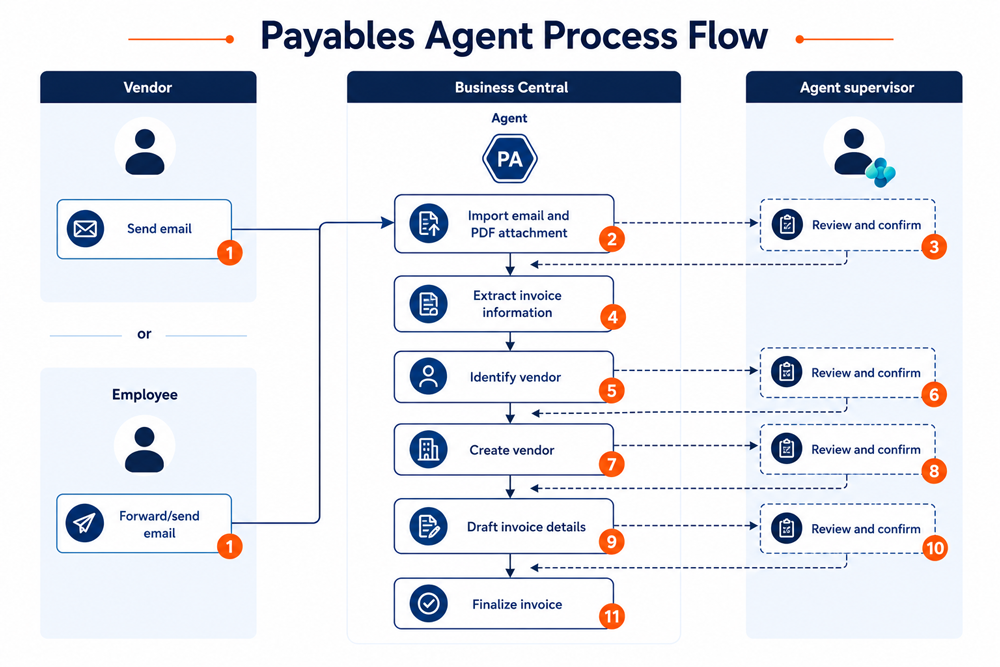
Here’s how the Payables Agent transforms AP operations in Microsoft Dynamics 365 Business Central:
- Automatically interprets incoming invoices: The Payables Agent reviews incoming invoices as they arrive, extracts relevant information, and prepares them for processing without requiring manual document handling.
- Matches invoices with purchase orders: Instead of relying on employees to compare supporting documents, the agent performs purchase order matching automatically, reducing repetitive validation work.
- Prepares approval-ready transactions: By organizing invoice information before it reaches approvers, the Payables Agent enables faster reviews while minimizing unnecessary administrative effort.
- Escalates only genuine exceptions: Routine invoices continue moving through the process, while unusual transactions are surfaced for finance professionals to review, helping teams focus where their expertise adds the most value.
How Finance Teams Benefit from AI Agents in ERP
When routine accounts payable activities are handled by intelligent AI agents, finance professionals can redirect their attention to work that has a greater impact on business performance. Instead of spending hours tracking invoice status, sending approval reminders, and resolving repetitive issues, teams can focus on financial analysis, vendor management, cash-flow planning, and strategic decision-making.
This shift also improves the employee experience. Highly skilled finance professionals no longer spend their time on administrative coordination; they can apply their expertise to activities that support growth, profitability, and operational resilience.
- Reviews replace repetitive data entry: Instead of manually entering invoice information and matching documents, finance professionals review work that has already been prepared by the Payables Agent. This significantly reduces administrative effort while improving consistency.
- Exceptions receive focused attention: Routine invoices continue moving through the process automatically, allowing AP teams to concentrate on unusual transactions, disputes, and high-value exceptions that genuinely require human judgment.
- Approvals move faster: Because invoices arrive with relevant information already organized, approvers can make decisions more quickly and confidently, helping reduce payment delays and workflow bottlenecks.
- Visibility improves across operations: Finance leaders gain a clearer view of invoice status, approval queues, exception trends, and operational performance in real time, making it easier to identify issues before they escalate.
- More time for strategic finance: As routine processing becomes increasingly automated, finance teams can dedicate more time to forecasting, budgeting, cash-flow management, supplier negotiations, and business planning.
Building the Right Foundation for Agentic Finance
Technology alone does not create successful AI adoption. Organizations achieve the strongest results when they establish consistent AP processes, standardize workflows, and clearly define governance policies before expanding intelligent automation.
A structured operating model allows AI agents to perform more effectively while giving finance leaders confidence that invoice processing automation supports existing business controls. Rather than attempting a complete transformation overnight, successful organizations build a strong operational foundation and then expand AI capabilities incrementally.
- Centralize invoice intake: A single accounts payable inbox creates consistency, improves visibility, and provides the Payables Agent with a structured starting point for processing invoices.
- Define approval thresholds clearly: Well-documented approval rules enable intelligent automation to route invoices efficiently while ensuring financial authority remains appropriately controlled.
- Establish structured exception handling: Defining how exceptions should be managed allows finance teams to focus on complex cases while routine invoices continue moving through the process automatically.
- Measure operational performance continuously: Monitoring processing times, approval delays, exception rates, and automation performance helps organizations refine AI adoption and demonstrate measurable business value.
Ensuring Robust Governance in AI-Driven Finance
One of the biggest concerns surrounding AI adoption in finance is trust. Organizations cannot allow critical financial processes to operate without visibility, accountability, or appropriate oversight. Compliance, audit readiness, and internal controls remain non-negotiable requirements regardless of the level of invoice processing automation.
Microsoft addresses this concern by embedding governance directly into the Payables Agent experience. Rather than functioning as an independent “black box,” the agent works within established financial controls, enabling users to review outputs, validate recommendations, and intervene whenever necessary.
This combination of intelligent automation and human oversight is what makes AI agents in ERP practical for enterprise finance.
- Transparent validation before execution: Finance users can review AI-generated recommendations within the context of each transaction, ensuring accuracy before approvals or postings occur.
- Human oversight remains central: Rather than replacing finance professionals, the Payables Agent supports them by allowing users to approve, modify, pause, or reject actions whenever required.
- Clear audit visibility: Every step remains visible throughout the process, making it easier for organizations to maintain governance standards and demonstrate compliance during audits.
- Controlled automation builds confidence: Organizations can gradually expand AI adoption while maintaining operational safeguards that align with existing financial policies and internal controls.
Preparing for the Future of Intelligent ERP
Agentic AI represents a fundamental shift in finance operations as it transforms enterprise software from a system that records business activity to a system that actively participates in it. Finance organizations that begin this transition now will be better positioned to improve scalability, reduce administrative costs, and build more resilient operations for the future.
Business Central’s Payables Agent actively performs routine tasks, prepares work for review, and enables finance teams to focus where human expertise delivers the greatest value. The result is a more efficient, scalable, and controlled accounts payable function: one that reduces administrative effort without sacrificing governance, visibility, or financial oversight.
Ready to move beyond traditional Accounts Payable automation?
Synoptek helps organizations modernize finance operations with accounts payable automation in Dynamics 365 Business Central, intelligent automation, and AI-driven capabilities that align technology with business goals.
Explore how Business Central and the Payables Agent can help reduce manual effort while improving visibility and control.