
July 15, 2026 · by Synoptek Team 5 min read
AI initiatives often struggle to scale because organizations rely on fragmented, inconsistent, and poorly governed data environments rather than a unified foundation. The key to successful enterprise AI lies in building a trusted data estate with unified data, governance by design, and consistent business context, enabling reliable insights and scalable outcomes supported by real-world improvements in performance and decision-making.
Organizations everywhere are accelerating their AI investments, expected to reach more than $500 billion in AI in 2026. Doubling spending from 0.8% to 1.7% of their revenues, leaders are exploring copilots, intelligent agents, predictive analytics, and automation use cases that promise greater efficiency and faster decision-making.
Yet despite the enthusiasm, many AI initiatives struggle to move beyond pilot programs. According to CIO.com, 80% of AI projects fail. The common assumption is that the challenge lies with the AI itself. What often prevents organizations from scaling AI successfully is something far more fundamental: their data foundation.
Across various industries, organizations are facing similar challenges. Some describe the problem as fragmented data. Others point to legacy systems, governance concerns, or inconsistent reporting. While these may appear to be separate issues, they are often symptoms of the same underlying challenge: a disconnected data ecosystem that was never designed to support AI at scale.
The Hidden Cost of Fragmented Data
Over time, most organizations accumulate a patchwork of technologies. They adopt separate platforms for data ingestion, transformation, warehousing, reporting, and analytics. Each tool brings its own licensing requirements, security configurations, and operational complexities.
As a result, data teams spend a significant amount of their time maintaining infrastructure, resolving inconsistencies, and reconciling conflicting reports, rather than enabling business outcomes. Meanwhile, business leaders encounter a different challenge: questions that should be answered in hours often take days or weeks. Teams spend time debating which report is correct instead of acting on insights.
The impact extends beyond productivity. As technology stacks become increasingly fragmented, the total cost of ownership continues to rise, while demonstrating meaningful business value becomes more difficult. When organizations introduce AI into this environment, they often discover that it amplifies the underlying issues rather than solving them.
Why AI Cannot Fix a Weak Data Foundation
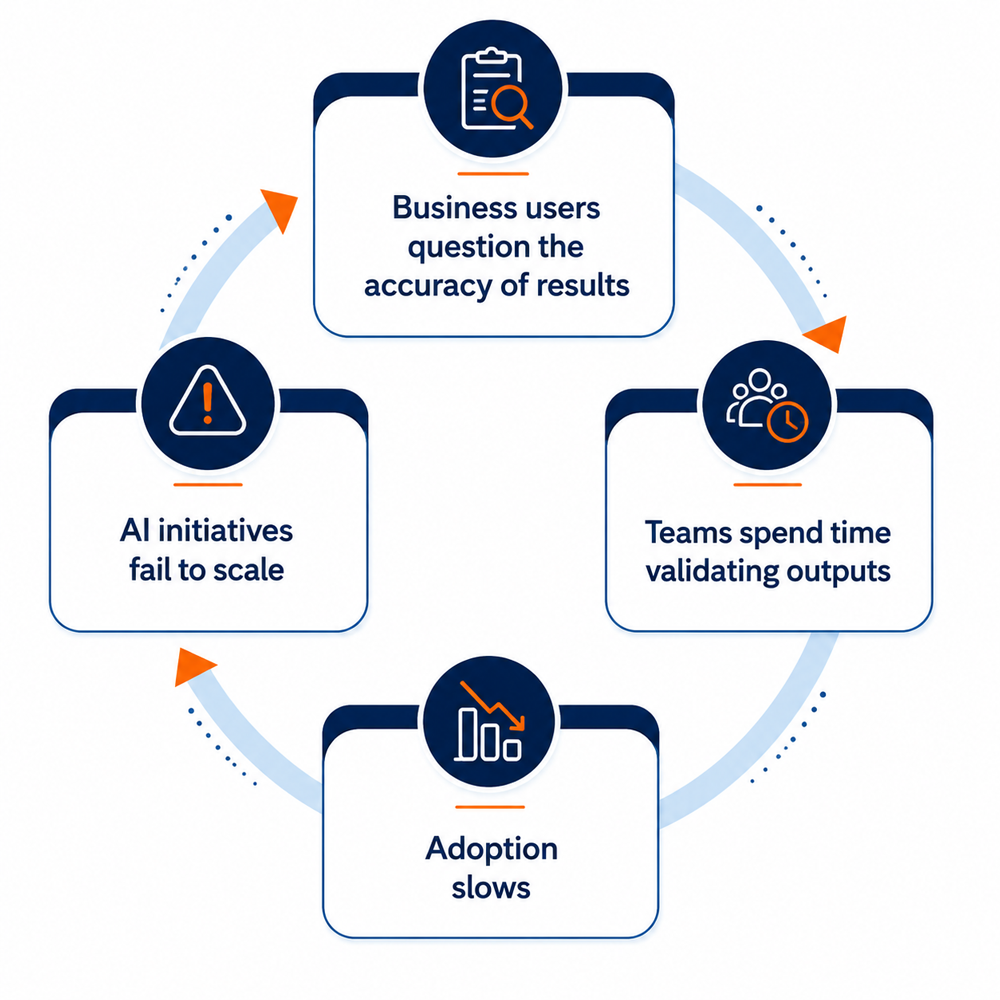
There is growing pressure on organizations to implement AI quickly. However, AI systems are only as effective as the data they can access. When data exists across disconnected systems, contains inconsistent definitions, or lacks governance, AI struggles to generate trusted outcomes.
This creates a familiar cycle:
Building an AI-Ready Data Estate: Three Critical Pillars
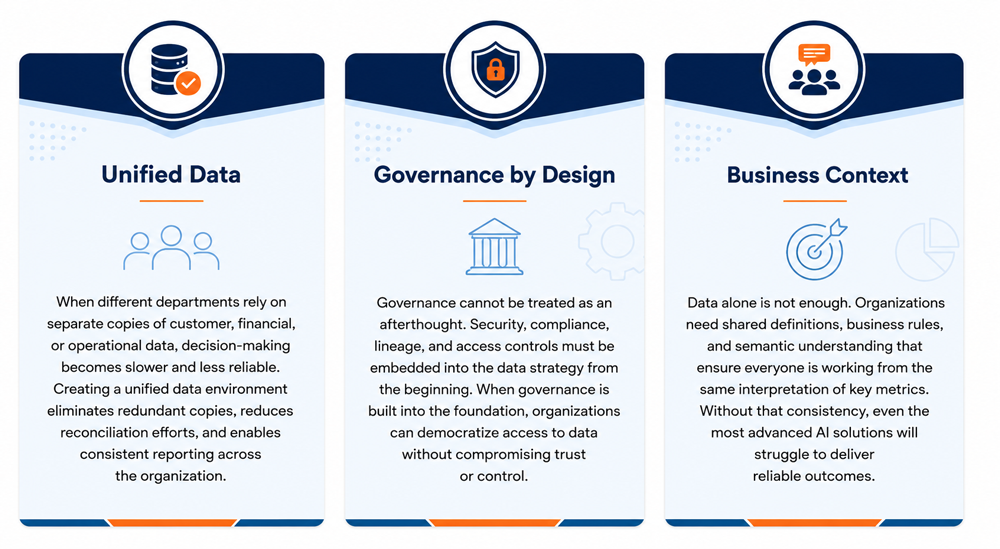
Before organizations can fully realize the benefits of AI, they must first establish a foundation capable of supporting it. A modern data foundation is about more than centralizing information. It is about creating a trusted environment where every team operates from the same source of truth.
To achieve this, organizations must focus on three critical areas:
Real-World Impact: Microsoft Fabric in Action: A Manufacturing Transformation Case Study
During a recent webinar, “Becoming a Frontier Firm with Microsoft AI”, Synoptek speakers shared a real transformation scenario involving a global manufacturing organization dealing with significant technical debt and a fragmented analytics ecosystem.
The manufacturer had accumulated complexity over time, including approximately 250 SSIS packages pulling data from multiple enterprise systems such as CRM, ERP, and SAP HANA environments. Every change introduced risk; every upgrade required coordination across systems. And reporting delays were becoming a major barrier to decision-making.
To address this, the modernization approach focused on building a Microsoft Fabric-based unified data foundation, including Lakehouse and Warehouse architecture, without disrupting ongoing business operations.
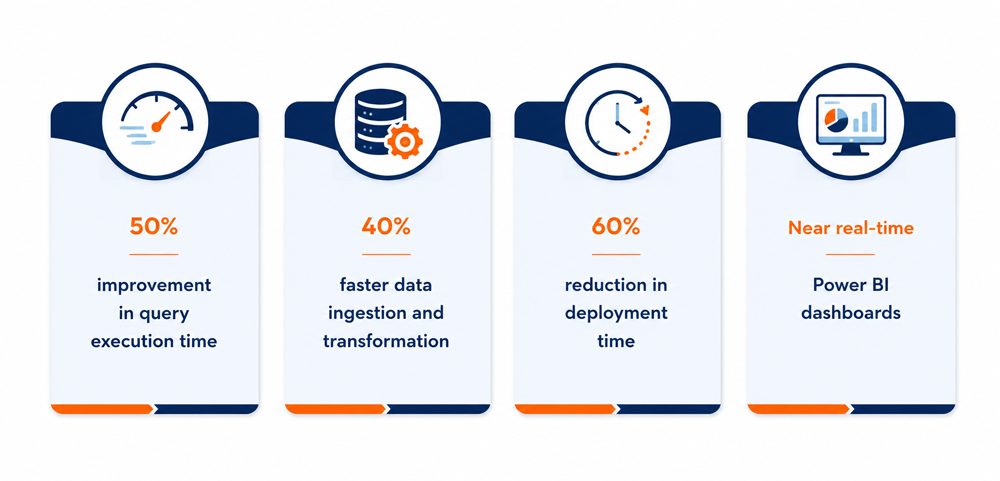
The transformation was executed in a way that ensured zero business downtime, which was critical for continuity. The results were measurable and significant:
The Shift From Data Management to Data Enablement
One of the most significant outcomes of a modernized data platform is the cultural transformation it creates. Traditionally, business users rely heavily on IT and analytics teams to answer questions. Requests are submitted, reports are generated, and decisions are delayed.
With a governed, AI-ready foundation, business users gain the ability to answer many of those questions themselves. This shift creates several advantages:
- Faster access to insights
- Reduced dependency on technical teams
- Improved business agility
- Greater confidence in decision-making
The Real Starting Point of Enterprise AI
With nearly $3 trillion of AI-related infrastructure investment expected to flow through the global economy by 2028, the conversation around AI continues to focus on models, agents, and successful pilots. While these innovations are important, they are not where transformation begins. Real transformation starts when you have a unified, governed, and business-ready data foundation, so you can move from isolated experimentation to scalable, enterprise-wide outcomes.
At Synoptek, we help enterprises build this foundation by modernizing their data ecosystems into unified platforms that are designed for AI readiness from the ground up. Through structured assessments, Microsoft Fabric-led modernization, and governance-first data strategies, we enable organizations to eliminate silos, strengthen trust in data, and create the single source of truth required for AI to operate effectively at scale.
Is Your Data Actually Ready for AI? Take the AI Data Readiness Assessment to evaluate your data maturity and get a clear roadmap.