
July 21, 2026 - by Miles Feinberg
Most tools being marketed as agentic AI are sophisticated task runners. The real difference is whether the agent is measurably better this week than it was last week without you doing anything to teach it.
I evaluated seven platforms against that question. Only one passed.
Once I learned that scheduled jobs won’t run when my laptop is off, I stepped back and took a broader look at agentic AI options.
Microsoft’s new Agent Framework is enterprise-grade. Google’s ADK is powerful. OpenClaw has genuine potential and the right philosophy. But most of these implementations didn’t meet every requirement on my list. Here’s what I look for in an agentic AI platform:
1. Runs Anywhere You Want
My agent runs on a $75 Raspberry Pi. I control where my data lives: I can move it to a VPS or my laptop, whatever, and I do not need a cloud provider to approve my deployment.
OpenClaw is the closest competitor here: it uses the same philosophy and the same local-first approach. However, the creator himself described it as a weekend hack that exploded faster than expected. It started as a quick WhatsApp relay and snowballed into massive GitHub stars. That origin story explains a lot. The potential is real, but the security holes (remote code execution, exposed instances, weak authentication), the unpredictable autonomous mode, and the config mess all scream “built fast, not built right.” There’s an entire industry of consultancies popping up, charging to properly set it up and secure it for clients.
2. Persistent Memory
When I tell my agent, “If you report an error, also suggest the fixes. If there is a straightforward low-risk fix, do it and don’t wait for me,” or “don’t post on Sundays” or “I prefer direct language, no fluff,” it remembers that next week, next month, and even next year. Every interaction builds on the last.
In addition to learning as you use it, you can write up a personality and code of conduct for it to follow.
Claude Cowork has project-based memory. But sessions start fresh outside those projects. Hermes has memory baked in from day one. OpenClaw does too, but there’s a difference between remembering and learning. Hermes doesn’t just store what you said. It connects the dots across sessions, builds behavioral models, and adapts. It automatically goes through the transcript of every interaction to extract permanent lessons and skills it should retain.
3. Autonomous Scheduling That Actually Runs When You’re Not Watching
This was the dealbreaker for me.
Claude Cowork can schedule tasks. But when I close my laptop, Hermes keeps working. When I travel, Hermes agents keep doing what I need them to do. When I’m asleep at 2 am, Hermes is scanning for security incidents and AI breakthroughs and drafting tomorrow’s content.
Claude Cowork’s schedule is tied to my laptop’s power button. Mine is tied to a Raspberry Pi that I never turn off. Cloud platforms are always-on, too, but they’re not mine. They run on their servers, their rules, their pricing model.
4. Multi-Model Flexibility
I use different LLMs for different jobs. Cheap models for background tasks, expensive ones for complex reasoning. Hermes lets me swap models per cron job, per conversation, abd per tool. OpenClaw does the same. Claude Cowork? Anthropic only. Period. Anthropic models are, in my opinion, the best, and I use them too, but on Cowork, I hit their usage limits.
Most enterprise frameworks support multi-model, but then you’re managing the orchestration layer yourself.
5. Goal-Oriented, Not Instruction-Oriented
Every other tool on this list expects you to tell it what to do, step by step. Hermes lets me state an outcome. I give it a goal, and it figures out the plan, the tools, the sequence, and the follow-up. When something changes mid-execution, it adapts without waiting for new instructions.
That’s the difference between a task runner and an agent. Most of these alternatives are sophisticated task runners. They’re fast and capable, but they’re still waiting for you to write the next step.
6. Learning From Its Own Mistakes
This is where Hermes pulls away from everything else, including OpenClaw.
When my agent fails a task, it doesn’t just log the error and move on. It extracts what went wrong, patches its own skills, adds guardrails, and never makes the same mistake twice. Every bug becomes a memory, and every failure a lesson. Every week, it’s measurably better than the week before.
This isn’t a feature bolted on. It’s the architecture. Hermes uses goal-oriented action planning with a supervised execution kernel, persistent memory across sessions, and a skill system that lets it author and refine its own procedural knowledge. I love it when we finish a major milestone, and it tells me it’s going to remember how to do that because the pattern could come up again in the future.
OpenClaw checks the same surface-level boxes (self-hosted, multi-messaging, cron, memory), but underneath, it’s a different generation. No goal-oriented reasoning, no closed-loop learning, and no skill system that improves itself. It remembers what you told it, but it doesn’t learn from what it did wrong. The agent I’m running today is not the same agent I was running three weeks ago.
OpenClaw doesn’t do that. Claude Cowork doesn’t either. It’s excellent at executing tasks, but it doesn’t get better at them over time. Google and Microsoft have memory backends, but memory isn’t learning, and remembering isn’t improving.
This is the quiet superpower nobody’s marketing yet. The agents that compound are the agents that learn.
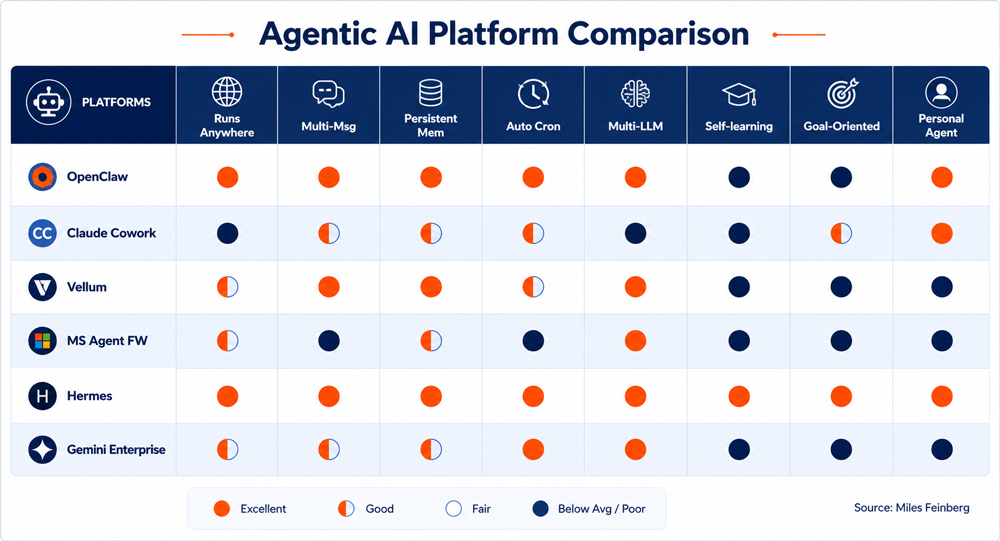
What I Chose and Why
I’m not saying these alternatives are bad. They’re not; they’re solving different problems. Your criteria might be different than mine.
Microsoft is building infrastructure for enterprise IT teams. Google is building platforms for AI strategies. Claude Cowork is excellent if your laptop is always open. OpenClaw has the right bones, but it’s buggy, insecure, and poorly architected.
Hermes’ setup and ongoing tuning are more technical than Claude Cowork, whose interface is second to none in ease of use. This isn’t the choice for everyone.
However, Hermes is the only tool that checked every box for me:
- Runs on hardware I already owned
- Reaches me on Telegram at 7 am with a daily briefing
- Remembers what I said last month
- Proactively tells me to draft my next LinkedIn post
- Is relatively low cost
- Works when I’m not watching
- Gets smarter every week without me teaching it
That last point is the key. This isn’t about automation; it’s about always-on delegation.
My agent isn’t a chatbot that does tasks. It’s a virtual team that owns outcomes. And it works whether my laptop is open, closed, or in another state.
This Is How We Think About Managed Services at Synoptek
That framing, a virtual team that owns outcomes rather than a tool that waits for instructions, is exactly how we approach managed services at Synoptek. The best managed services relationship isn’t one where you hand over a list of tasks. It’s one where you state a goal, set the guardrails, and trust your partner to figure out the path and adapt when things change. Agentic AI doesn’t replace that relationship. It makes it possible at a scale that wasn’t viable before.