
July 20, 2026 · by Synoptek Team 8 min read
An Experience Level Agreement (XLA) is a performance framework that measures whether enterprise technology is actually improving employee productivity and business outcomes, not just whether systems are technically available. Unlike traditional Service Level Agreements (SLAs), which track machine uptime and ticket resolution times, XLAs measure the quality of the human experience: how fast employees can complete real work, how much digital friction they encounter, and whether IT investments are translating into business results. In 2026, the shift from SLA-only measurement to XLA-led IT governance is moving from an emerging practice to an enterprise standard.
Behind green dashboards and standard monthly status reports, enterprise IT leadership has long relied on a comfortable assumption: if the network is up, IT is winning. A typical monthly status report might read, “99.9% uptime achieved, infrastructure performing within target.” signaling that everything is running smoothly. On paper, that is a success.
However, when you walk down to the operational floor, talk to your product managers, or examine adoption rates closely on your latest cloud deployment, the picture often looks different. Employees are fighting disjointed workflows, applications lag during peak processing hours, and digital friction quietly chips away at the bottom line.
This gap between “the systems are up” and “the business is working well” is exactly why traditional Service Level Agreements are no longer enough on their own to support corporate growth, and why the XLA vs SLA enterprise conversation has moved from IT circles into the boardroom. In today’s digital economy, deploying the XLA experience-level agreement as a new standard IT model is no longer an experimental strategy; it is quickly becoming the defining line between businesses that scale effectively and those that stall under the weight of their own technical debt.
The Flaw of Traditional Metrics: The Watermelon Effect
To understand why traditional tracking methods fall short, it helps to picture what practitioners call the Watermelon Effect.
Imagine an enterprise IT dashboard where every line item is flashing green. Server uptime is perfect, ticket response times are within target, and the network is technically functional. On the outside, everything looks healthy.
Cut beneath the surface, though, and you find red.
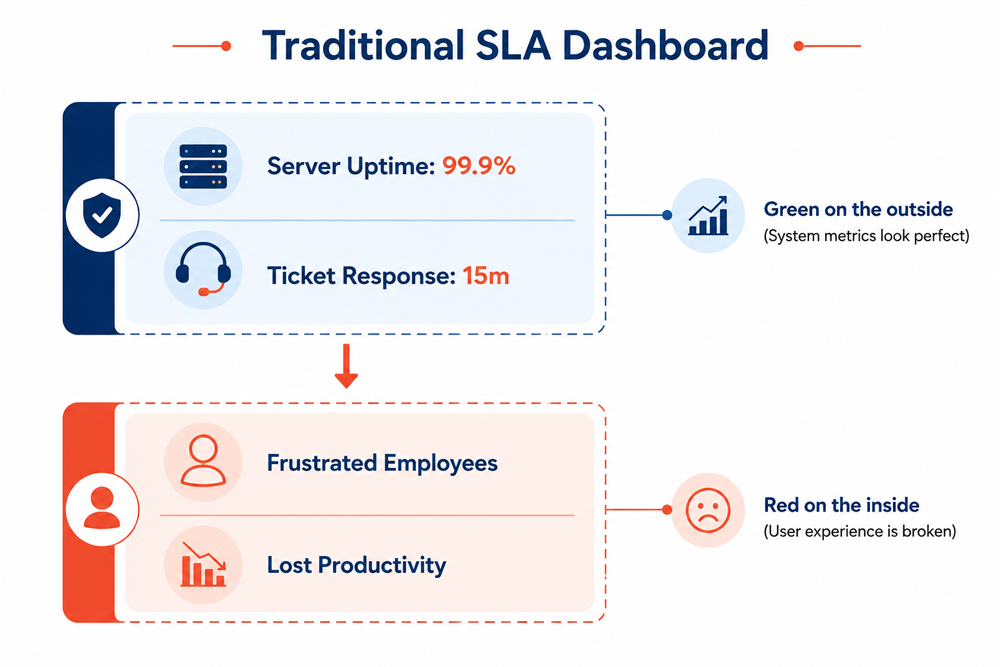
The green exterior hides real user frustration. A laptop that takes twenty minutes to boot every morning never technically “crashes,” so it still registers as 100% available on an SLA report. A platform riddled with micro-latencies that turn a simple data-entry task into an hour-long ordeal is still, technically, “up.”
Traditional SLAs measure the performance of individual components, not the journey of the person interacting with them. That distinction is the center of the XLA vs SLA enterprise debate, reshaping how CIOs think about operational stability. While an SLA counts the hours a machine stays powered on, an Experience Level Agreement (XLA) measures the friction-free productivity of the person operating it. If a service desk resolves a ticket in ten minutes but leaves an employee without a working laptop for three days due to poor logistics, a traditional SLA marks that as a win. An XLA marks it as a failure.
This isn’t a fringe idea. Gartner has been tracking XLA adoption among IT and sourcing leaders for several years now, publishing dedicated guidance for organizations that want to build experience-based terms into their provider contracts.
The Cost of Getting This Wrong
Digital friction, the everyday technology roadblocks that interrupt focus and complicate routine work, acts as a quiet tax on productivity, and enterprises are spending more than ever on technology meant to prevent it.
Gartner’s most recent worldwide IT spending forecast puts total spend at $6.31 trillion in 2026, a 13.5% increase over 2025, driven largely by AI infrastructure, data center investment, and advanced memory. When that much capital is flowing into technology, the difference between systems that are merely available and systems that actually work for people becomes a material business question, not just an IT one, and it’s exactly the kind of question a modern IT success metrics 2026 framework is built to answer.
Forrester’s research points to the same gap from the employee side. In its 2025 Digital Workplace and Employee Technology Survey, Forrester found that ownership of digital employee experience is fragmented: 54% of business and IT leaders say DEX lives inside IT, while only 20% report having a dedicated DEX team, with the rest scattered across HR, communications, and workplace groups. Meanwhile, 26% of business and IT leaders say implementing a digital experience monitoring strategy is a top priority this year. In other words, leaders increasingly know experience matters, but most organizations aren’t yet structured to manage it well, which is exactly the gap a well-built XLA program needs to address.
Re-Engineering Corporate Performance
Transitioning to an experience-led operational environment does not mean discarding your existing SLAs. It means restructuring how they work together: SLAs form the technical foundation, and XLAs act as the business validator on top of them.
| Operational Lens | Traditional SLA Focus | Modern XLA Focus |
|---|---|---|
| Primary Perspective | Machine and system-centric | Human and user-centric |
| Measurement Subject | Inputs and technical capacity | Outcomes and sentiment quality |
| Data Collection | Automated telemetry monitoring | Mixed telemetry and sentiment pulses |
| Goal Orientation | Defending baseline contract minimums | Optimizing long-term user productivity |
Think of the SLA as the floor and the XLA as the ceiling: the SLA ensures the technical machinery is sound, while the XLA ensures that the machinery is actually helping the business move forward. This is precisely the operating model behind the XLA experience level agreements new standard IT approach that leading enterprises are adopting.
Evolution of Enterprise IT Success Metrics
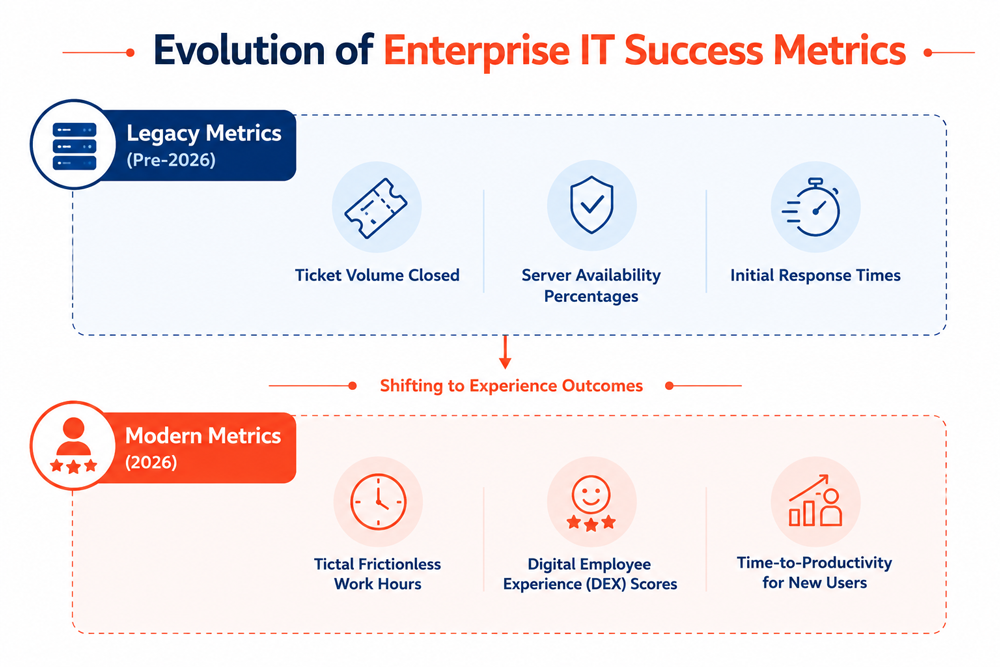
As the nature of work evolves, IT success metrics for 2026 must evolve with it. Success can no longer be defined by ticket volume closed or uptime percentages alone; enterprise value increasingly gets measured by how much friction has been removed from the employee’s day.
The question worth asking of any IT service provider is no longer just “can you keep the infrastructure running?” It’s “Can you actively improve the daily working lives of our people?” That standard is why XLA experience level agreements are reshaping enterprise procurement and vendor evaluation criteria across the industry.
Implementing the Framework: Your Experience Level Agreement Guide
Building an infrastructure that prioritizes employee and customer experience takes a structured approach. A workable experience level agreement guide rests on four pillars:
1. Digital Employee Experience (DEX) Telemetry
Modern IT management calls for continuous background observation rather than reactive ticketing. Endpoint telemetry can measure application load times, device health, and micro-crashes directly on the user’s device, often catching a slowdown before the employee notices it.
2. Continuous Sentiment Mapping
Technical data tells you what’s happening; sentiment data tells you how it feels. Rather than an annual survey, a well-run XLA program asks short, context-specific questions right after a major system upgrade or platform transition.
3. Business Outcome Alignment
An effective experience metric has to be tied to a real business goal. For a logistics company, that might be the time it takes an associate to process an order on a handheld device; for a financial services firm, the speed and clarity of a client onboarding portal.
4. Proactive Problem Management
Rather than waiting for a ticket, an experience-driven model looks for patterns of friction across departments and triggers fixes before they spread, reducing help-desk load while freeing IT for more strategic work.
How Synoptek Approaches the Outdated Status Quo
At Synoptek, we believe the traditional IT outsourcing model, with rigid SLAs used as a shield while clients deal with unoptimized processes and frustrated employees, no longer holds up.
As a Managed Experience Provider (MxP™), Synoptek doesn’t just monitor hardware; we take responsibility for the overall digital experience. We weave the principles of this experience level agreement guide directly into how we operate: deploying digital experience telemetry to catch friction points in real time and pairing that technical data with ongoing sentiment analysis so the IT environment stays genuinely supportive, intuitive, and efficient.
This human-centric approach is reflected in Synoptek’s Global Aircraft Leasing IT Transformation with MxP Services Success Story, where the focus moved away from legacy, component-only monitoring toward optimizing daily user workflows across distributed international teams, helping professionals execute complex leasing transactions without system lag.
When you partner with Synoptek, you move past “watermelon metrics,” systems that look green on the outside but mask operational frustration underneath, toward technical delivery that’s explicitly aligned with your actual business goals.
Where This is Headed
The era of judging IT purely by component uptime is closing. Organizations that keep measuring success through infrastructure-only metrics risk missing the hidden costs of digital friction and lost productivity, even while their dashboards stay green.
Transitioning to an experience-led model is as much a mindset shift as a metrics one. Choosing the XLA experience level agreements approach gives an organization a clearer way to remove internal roadblocks, get more value out of existing technology investments, and build a more engaged, resilient workforce.
Tracking IT success metrics for 2026, and beyond, means staying ahead of a market that’s rapidly moving past the assumptions traditional SLAs were built on.