
August 10, 2026 · by Synoptek Team 7 min read
Metadata-driven pipelines are transforming enterprise data engineering by replacing hard-coded, manually managed workflows with intelligent, configurable pipelines that automatically adapt to changing business rules, data sources, and governance requirements. As organizations expand across cloud platforms, AI initiatives, and real-time analytics, metadata becomes the control layer that enables faster delivery, stronger governance, lower maintenance costs, and scalable data operations. Combined with modern DataOps practices, metadata-driven pipelines create the AI-ready data foundation enterprises need to support continuous innovation.
Enterprise data environments have undergone significant evolution over the past decade. Organizations are no longer moving data between a handful of databases and reporting tools. They are orchestrating information across cloud platforms, SaaS applications, IoT devices, streaming services, operational systems, data lakes, warehouses, and AI platforms, all while meeting increasingly stringent governance and compliance requirements. As this complexity grows, conventional ETL pipelines that rely on manually coded transformations and static workflows become progressively more expensive to maintain and increasingly difficult to scale.
Metadata-driven pipelines solve this challenge by separating business logic from pipeline execution. Instead of hard-coding transformation rules and workflows, organizations manage them as reusable metadata, making pipelines easier to scale, maintain, and adapt. This blog explores how metadata-driven pipelines support modern data engineering, accelerate AI initiatives, and create a more scalable, governed data foundation.
What are Metadata-Driven Pipelines?
Metadata-driven pipelines use centrally managed metadata to control how data is ingested, transformed, validated, governed, and delivered throughout the data lifecycle. Instead of creating individual pipelines for every source system, engineering teams develop reusable frameworks that interpret metadata definitions and execute the appropriate processing logic automatically.
The result is a data engineering environment that is significantly more flexible, maintainable, and resilient as enterprise data volumes and business requirements continue to grow.
Typical metadata definitions include:
- Source and destination mappings: Define how data moves between operational systems, cloud platforms, and analytical environments without requiring custom code for every integration.
- Transformation rules: Store business logic, validation requirements, and calculation rules centrally so they can be reused consistently across multiple pipelines.
- Data quality policies: Apply standardized validation, completeness checks, and anomaly detection before data reaches downstream reporting or AI models.
- Security and governance controls: Manage permissions, classification, lineage, and retention policies through centralized metadata rather than individual pipeline configurations.
- Pipeline orchestration rules: Configure dependencies, scheduling, retries, notifications, and execution priorities without modifying production code.
Why Traditional Pipelines Become Difficult to Scale
As organizations modernize legacy environments and adopt cloud-native architectures, data engineering teams often inherit hundreds or even thousands of independently developed pipelines. While these pipelines may solve immediate business problems, they frequently create operational complexity that slows future innovation.
Common challenges include:
- Duplicated engineering effort: Similar transformation logic is recreated across multiple projects, increasing maintenance costs and introducing inconsistencies.
- Limited adaptability: Even minor schema or business rule changes often require development work, testing, and production deployments.
- Growing governance risk: Data lineage, ownership, and quality controls become increasingly difficult to track across disconnected workflows.
- Operational complexity: Monitoring hundreds of custom pipelines makes troubleshooting and root-cause analysis significantly more time-consuming.
- AI readiness challenges: Poor metadata management limits data discoverability, quality, and consistency, reducing the effectiveness of machine learning and generative AI initiatives.
Creating the Foundation for AI-Ready Data Platforms
Every successful AI initiative depends on trusted, governed, and consistently available data. Whether organizations are deploying predictive analytics, machine learning, intelligent automation, or generative AI, model performance ultimately reflects the quality of the underlying data ecosystem.
Metadata-driven Architecture for Fabric Modern Data Warehouse
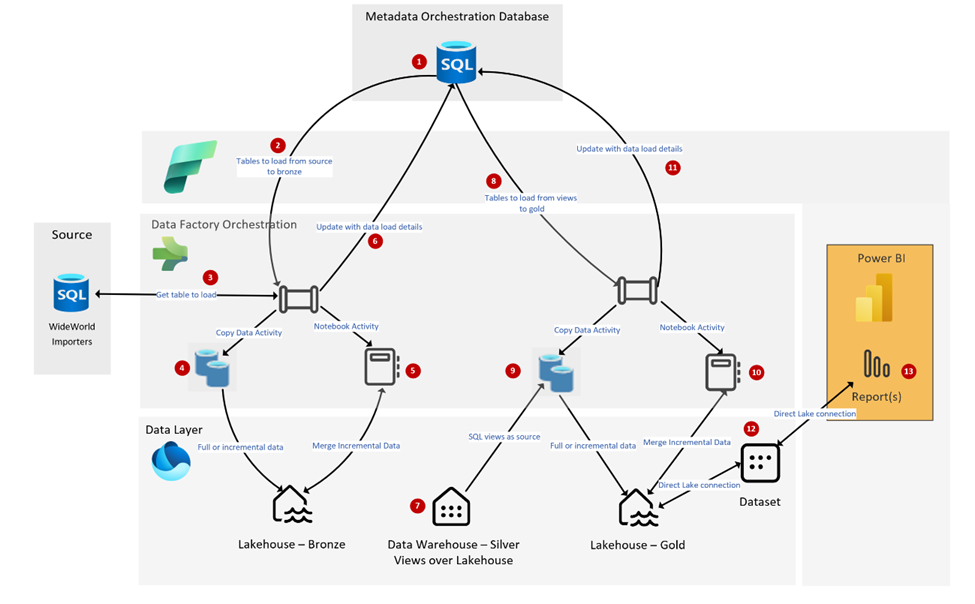
Source: Microsoft
Metadata-driven pipelines strengthen AI readiness by enabling:
- Consistent data quality: Automated validation rules ensure AI models consume complete, accurate, and trusted datasets.
- End-to-end data lineage: Complete visibility into data movement improves explainability, governance, and regulatory compliance.
- Feature engineering consistency: Standardized transformation logic supports reproducible machine learning workflows across multiple environments.
- Automated governance: Classification, access controls, and retention policies remain consistent regardless of where data originates.
- Faster AI deployment: Reusable pipeline frameworks reduce the engineering effort required to onboard new data sources and AI workloads.
Combining Metadata-Driven Pipelines with DataOps
Metadata alone does not create scalable data engineering. Organizations also need disciplined operational practices that allow pipelines to evolve rapidly without compromising reliability. When combined with DataOps, metadata-driven architectures enable engineering teams to deliver new capabilities with the same discipline applied to modern software development.
Key DataOps capabilities include:
- Version control: Pipeline definitions, metadata, and transformation logic remain fully traceable throughout development.
- Automated testing: Data quality, schema validation, and transformation testing occur before production deployment.
- CI/CD automation: Pipeline updates move through development, testing, and production using automated deployment workflows.
- Continuous monitoring: Performance, failures, latency, and data quality metrics are monitored in real time.
- Rapid rollback: Engineering teams can quickly restore previous pipeline versions if unexpected issues arise.
Building Metadata-Driven Pipelines Across Multi-Cloud Environments
Modern enterprises rarely operate within a single cloud ecosystem. Business acquisitions, departmental technology choices, regulatory requirements, and evolving workloads often result in data environments spanning Microsoft Azure, AWS, Google Cloud, SaaS platforms, and on-premises systems.
Creating Metadata-driven Data Pipelines in Microsoft Fabric
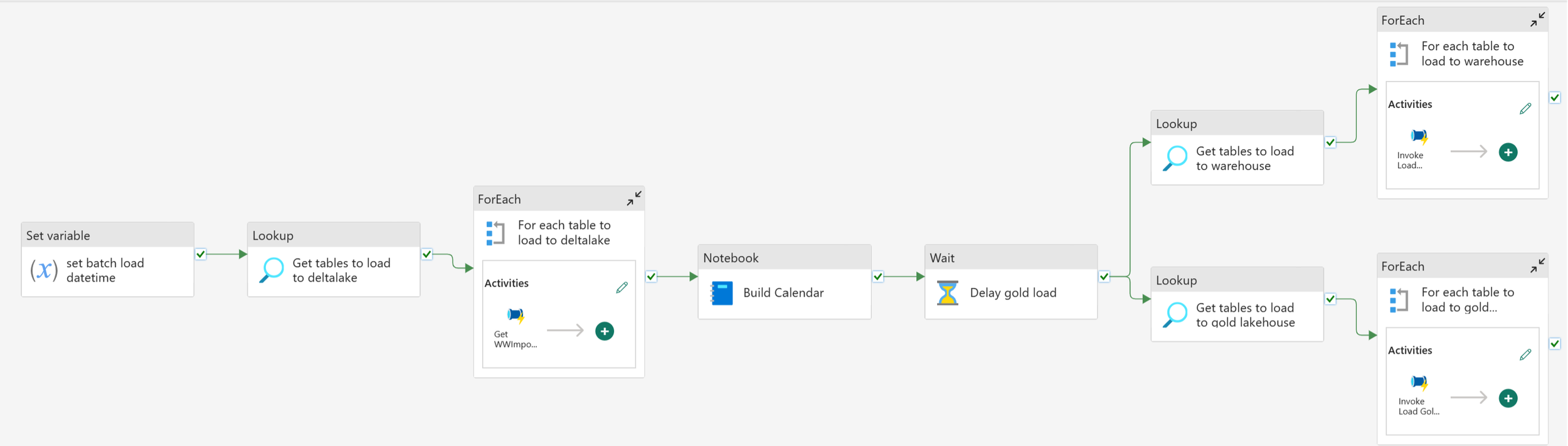
Source: Microsoft
Without a consistent engineering approach, each platform introduces its own integration methods, governance models, and operational processes. Metadata-driven architectures provide a common control layer across these environments, enabling organizations to:
- Standardize ingestion across cloud and on-premises systems.
- Maintain consistent governance policies regardless of platform.
- Simplify migration between cloud services.
- Improve visibility into enterprise-wide data movement.
- Support lakehouse, warehouse, and streaming architectures simultaneously.
How Synoptek Delivers Metadata-Driven Data Engineering
At Synoptek, data engineering extends far beyond building pipelines. We help organizations design modern, AI-ready data platforms that combine scalable architecture, governance, automation, and operational excellence into a unified engineering strategy.
Our cloud data engineering services help enterprises modernize fragmented environments while accelerating analytics and AI adoption across Microsoft Fabric, Azure Databricks, Snowflake, AWS, and Google Cloud.
Our approach includes:
- Modern lakehouse architecture: Designing unified data platforms that support analytics, AI, and enterprise reporting through scalable lakehouse-first architectures.
- Metadata-driven pipeline engineering: Building configurable ETL and ELT frameworks that simplify maintenance while improving consistency and scalability.
- Enterprise DataOps: Implementing version control, automated testing, CI/CD pipelines, and operational monitoring to improve reliability and accelerate delivery.
- AI-ready data foundations: Embedding governance, lineage, observability, and automated quality controls into every stage of the data lifecycle.
- Multi-cloud integration: Connecting Azure, AWS, GCP, SaaS applications, and on-premises environments through secure, governed orchestration.
- Migration without disruption: Modernizing legacy platforms using automated validation, reconciliation, and phased migration strategies that minimize operational risk.
Carving the Future of Enterprise Data Engineering
As enterprise data ecosystems continue to expand, scalability will depend less on writing additional pipeline code and more on building intelligent engineering frameworks that can adapt as technologies, business priorities, and regulatory requirements change. Metadata-driven pipelines represent a significant evolution in enterprise data engineering because they enable organizations to automate complexity instead of continually managing it through manual development effort.
Combined with cloud-native architectures, DataOps practices, and AI-ready governance, metadata-driven pipelines help organizations accelerate analytics, improve operational efficiency, strengthen data quality, and create a resilient foundation for future innovation. Enterprises that invest in these capabilities today will be better positioned to support advanced analytics, real-time decision-making, and enterprise AI initiatives without continually rebuilding their data engineering environments.
Synoptek helps organizations design and modernize cloud-native data platforms with metadata-driven pipelines, DataOps automation, and AI-ready architectures built on Microsoft Fabric, Azure Databricks, Snowflake, AWS, and Google Cloud.
Ready to modernize your data engineering strategy? Connect with our data engineering experts to build scalable, metadata-driven pipelines that accelerate analytics, strengthen governance, and unlock the full value of your enterprise data.