September 2, 2026 · by Synoptek Team 8 min read
Executive Summary
CIOs often struggle to win board approval for technology investments because IT reporting has not kept pace with what boards now expect: dollar-denominated answers, not status updates. Synoptek’s Eric Codorniz and Jay Cann explain why phrases like “technical debt” fail in the boardroom and introduce a three-tranche funding model that lets CIOs sequence IT budget requests instead of one large ask. They also cover a governance framework for evaluating vendors against employees on contractual accountability, and Experience Level Agreements (XLAs) as a replacement for uptime-based reporting.
Most CIOs can build a solid technology plan. Far fewer can translate that plan into a technology investment case a board will actually fund. That gap, between a good plan and a good board decision, was the entire subject of Episode 3 of Synoptek’s CIO Boardroom Series, “How CIOs Turn Technology Investments into Board-Level Wins.”
Eric Codorniz, Co-Founder of Synoptek, and Jay Cann, Chief Technology Officer at Synoptek, spent the hour walking through what changed in the boardroom, why technical debt no longer earns a hearing, and how the most effective CIOs are repositioning themselves as orchestrators of enterprise value rather than operators of infrastructure.
Here is a debrief of the key ideas from the session, covering technical debt, vendor management, and AI governance, the building blocks of any digital transformation effort- in a single board-ready framework CIOs can put to work right away.
Boards Did Not Get Harder. The Questions Changed.
Codorniz opened with a simple but important reframe. Boards, he argued, have not become more demanding of IT. The old yes-or-no questions about uptime and delivery have been replaced by questions with a dollar figure attached. That shift matters because a number invites scrutiny in a way an assumption never does.
The data backs this up. Gartner’s research across 2,500 CIOs found that only 48 percent of digital initiatives hit their business targets, a number that has stayed flat year over year. Codorniz’s read on that statistic was blunt: this is not a delivery failure. It is a translation failure. CIOs are doing the work. They are not consistently connecting that work to the five outcomes boards already care about: revenue growth, operational resilience, workforce productivity, risk reduction, and competitive advantage.
Retire the Phrase “Technical Debt” When Presenting Technology Investments
One of the more memorable moments of the session was Cann’s argument to retire the phrase “technical debt” entirely, at least in front of a board. His point was not about the underlying problem. It was about vocabulary. Board members have approved deferred maintenance on a building. They have written down an impaired asset. They have priced a going concern risk. Technical debt is functionally the same thing, just described in language that does not connect to anything the board has decided on before.
The numbers he shared painted a sobering picture of why this reframe matters now. Fifty-five percent of CIOs and CTOs say most of their core applications are not AI-ready, and 63 percent do not have, or are not sure they have, the data practices AI actually requires. Read together, those two figures say something important: every AI conversation happening in the boardroom right now sits on top of an estate that cannot support it. The constraint is not the AI strategy. It is the estate.
Fund Technology Investments in Three Tranches, Not One Number
A recurring theme of the webinar was that CIOs sabotage their own case for board approval by presenting a single number. Walk in with “36 months, 7 million dollars,” and the only response a board can reasonably give is “can we do it cheaper.” That single number invites negotiation against yourself before the conversation even starts.
Instead, Codorniz laid out a three-tranche funding model for structuring technology investments:
- Tranche one: Retire (months zero to six). Redundant applications, orphaned licenses, and end-of-life hardware still on contract. The ask here is zero dollars. It is self-funding and generates the capacity that helps pay for the next two tranches.
- Tranche two: Contain (months six to eighteen). Systems too risky to replace right now but that still need to persist. The ask is a risk framing, not a rebuild. Cann added a hard-won piece of advice here: the discipline nobody keeps is the dependency freeze. If new work keeps attaching itself to a system you have already decided not to rebuild, that tranche never closes.
- Tranche three: Rebuild (months twelve to thirty-six). Only what carries revenue, sequenced behind the capacity the retire tranche released and tied to a named growth thesis.
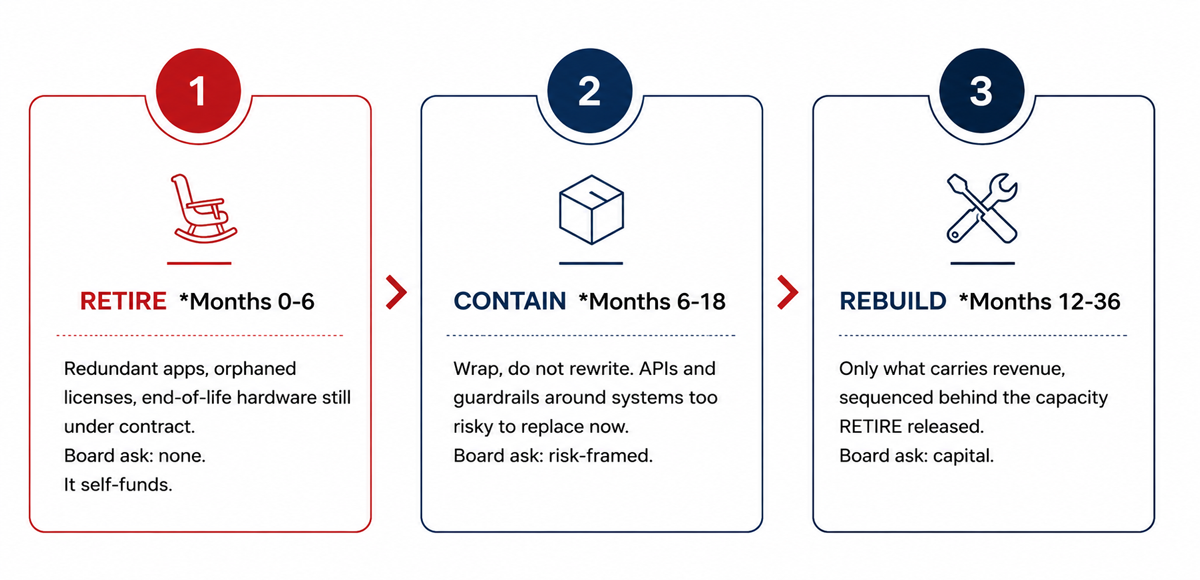
The mechanism is the point. A 36-month ask becomes a sequence the board can approve one step at a time, without writing a single large check up front. This approach gives CIOs a way to sequence technology investments instead of asking for one large allocation upfront, which makes each step easier for the board to approve.
The Real Operating Model Question: Employee or Vendor
The second section of the webinar tackled what Cann called the most consequential decision on the call: how CIOs think about their own operating model. His argument was that IT is not underfunded and IT teams are not underperforming. The real problem is that four disciplines, run, secure, innovate, and govern, all became critical at the same moment, and one team cannot go deep in all four simultaneously.
ISC2 survey data on 16,000 practitioners showed skill gaps rising from 44 percent to 59 percent in a single year, even as staffing shortages improved. That combination tells a specific story: this is not a headcount problem. It is a depth problem, and depth problems do not get solved by hiring more people.
Cann then posed a genuinely uncomfortable question to the audience: why do organizations believe they have more control over an employee than a vendor? At-will employment is the legal default in 49 states, which means that relationship contains, by construction, zero continuity obligation. A vendor relationship, by contrast, can be built with substitution and continuity terms, a named lead, a named backup, and service credits tied to coverage lapses. Cann illustrated the point with a real example: two similar personnel departures at the same organization, one from an internal team with no documentation and no backup, one from a vendor with continuity terms in the contract. The internal loss took three months to recover from. The vendor loss barely registered.
He was careful to acknowledge the obvious conflict of interest: Synoptek is a managed services firm, and pointed out that everything in this argument was sourced from peer-reviewed research rather than client anecdotes.
He also gave real airtime to the counterargument: Deloitte’s research shows 70% of organizations have pulled work back in-house in the last five years. But that same survey found that 70% also admit their vendor management function is not mature. The conclusion both speakers landed on was that outsourcing does not fail because vendors underperform. It fails because organizations never build the governance function needed to manage the vendor relationship in the first place.
AI Governance Needs Levels, Not a Policy Memo
Cann introduced four autonomy levels as a practical AI governance model: observe (read-only), advise (human executes), act with approval (explicit human sign-off), and act autonomously inside guardrails. The critical discipline of AI governance is setting the level on a per use case basis rather than applying one blanket policy. Gartner predicts that by 2027, 40 percent of enterprises will demote or decommission autonomous agents due to governance gaps identified only after production incidents occurred- after, not before.
The session also offered five questions every board will ask about AI technology investments, along with the artifact needed to answer each one credibly: total spend across licenses, tokens, and embedded per-seat fees; which use cases have paid back and how that is measured with a pre-launch baseline; who is the named accountable executive when something goes wrong; a data flow inventory covering what left the building and through which vendor; and what stops once the new capability works, since a board hears unmeasured savings as theoretical.
Measure Experience Level Agreements (XLAs), Not Uptime
The final section addressed how to measure the return on technology investments directly. Codorniz’s core argument was that eight vendors can each report a green dashboard while the business still lives through the outage. The fix is establishing Experience Level Agreements, or XLAs, tied to the same five board-level outcomes discussed earlier, each with a real baseline captured before any change is made. Without a before, a metric is an assertion, not a measurement, and boards can tell the difference.
He closed the operational advice with a simple one-page framework: report on the five outcome measures, be specific about the one decision the board needs to make, and then report the same measure again next quarter. Three quarters running of the same two numbers is what builds the board trust that makes future board approval easier to earn, compounding instead of resetting every meeting. This is the discipline that makes Experience Level Agreements credible rather than aspirational.
The 90-Day Plan
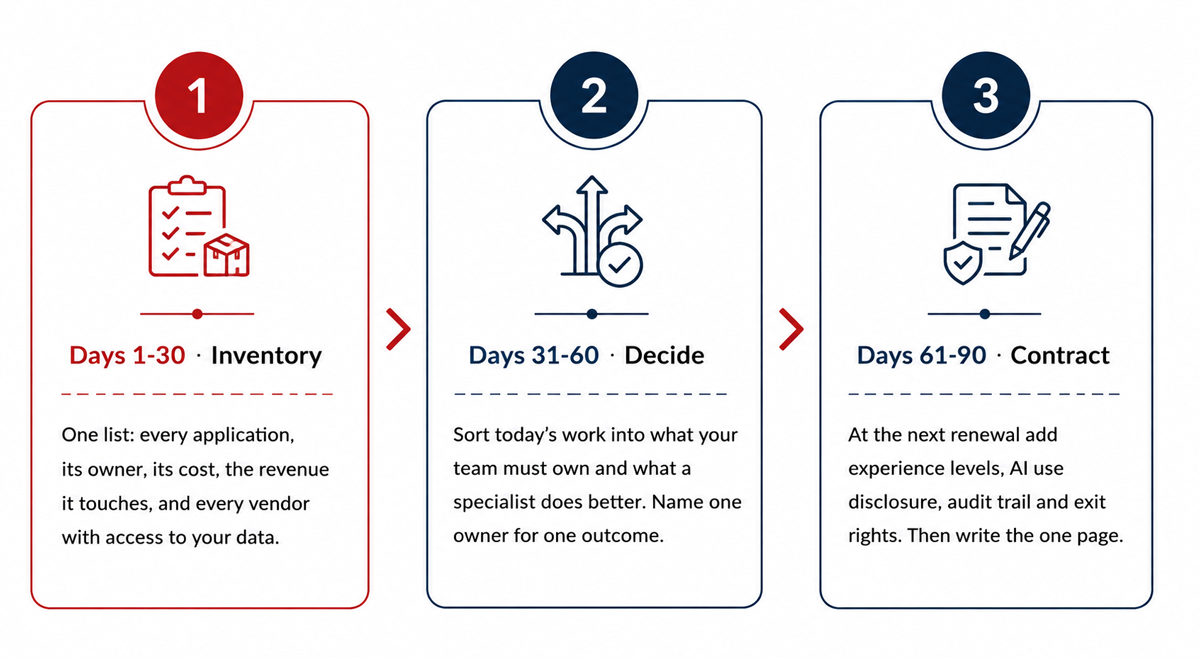
The session ended with a concrete sequence any CIO can start on immediately. In the first 30 days, sort existing work into what only your team should own versus what a specialist could do better, no budget or new vendor required. In days 31 to 60, apply that sort to one business outcome first, not the whole department, and prove the model on something contained like quote turnaround. In the final 30 days, review upcoming vendor renewals, since renewal is the only moment continuity and substitution terms can be added without reopening the entire agreement.