
September 21, 2026 · by Synoptek Team 7 min read
Snowflake data warehouse modernization helps businesses move beyond legacy infrastructure with a scalable, cloud-native data platform. From migration and architecture to governance, optimization, and AI readiness, this blog covers the key considerations for building a modern, future-ready data environment.
As data environments become more complex, legacy data warehouses can make it difficult to scale data and analytics, manage growing workloads, and deliver timely insights. Snowflake offers a cloud-native approach to modernizing these environments, helping businesses improve performance, flexibility, and data management while reducing the constraints of traditional warehouse infrastructure.
But modernization requires thoughtful planning across architecture, migration, governance, security, integration, and ongoing optimization. In this blog, we explore how Snowflake data warehouse modernization can help build a scalable, flexible, and future-ready data environment, along with the key steps and best practices for a successful modernization journey.
What is Snowflake Data Warehouse Modernization?
Snowflake data warehouse modernization is the process of transforming legacy data warehouse environments into a modern, cloud-based data architecture using Snowflake. The objective is to improve how organizations store, process, govern, access and analyze data.
Legacy environments can involve expensive infrastructure, complex maintenance requirements, limited scalability, and slow provisioning. Snowflake provides a cloud-native alternative that separates storage and compute, allowing organizations to scale resources based on workload requirements.
Modernization can include:
- Migrating legacy databases and workloads to Snowflake
- Redesigning data warehouse architecture
- Modernizing ETL and ELT pipelines
- Integrating structured and semi-structured data
- Improving data governance and security
- Optimizing analytics performance
- Enabling self-service business intelligence
- Establishing a foundation for advanced analytics and AI
Why Snowflake Data Warehouse Modernization Matters
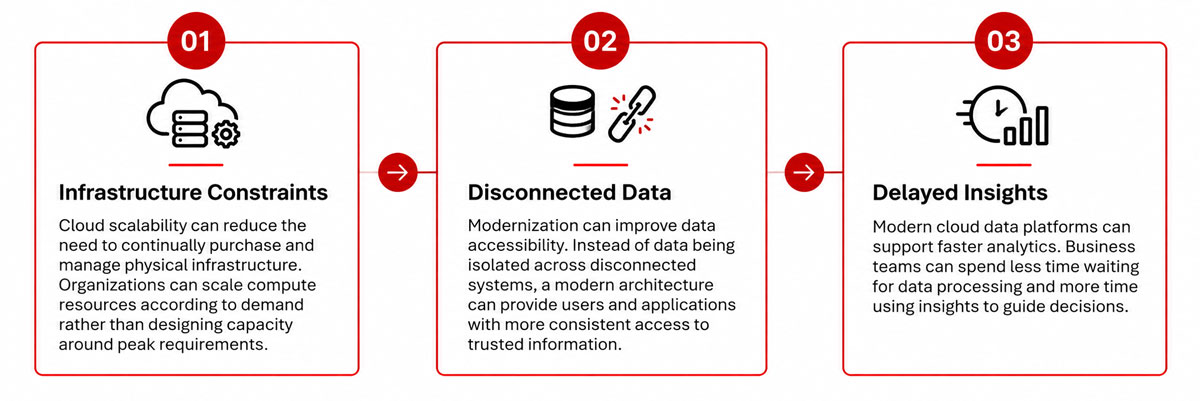
Organizations are generating more data across applications, customers, devices, and digital channels than ever before. Traditional warehouses may not have been designed to handle this level of scale and complexity efficiently. 38% of organizations identified data modernization as an important area of data-related focus and investment, according to IDC’s Future Enterprise Resiliency & Spending Survey.
Modern enterprise data warehouses can help organizations address several common challenges.
Snowflake Data Warehouse Modernization Steps
A successful Snowflake data warehouse migration requires careful planning. Moving workloads without understanding dependencies, data quality, performance requirements, and business priorities can create unnecessary risks.
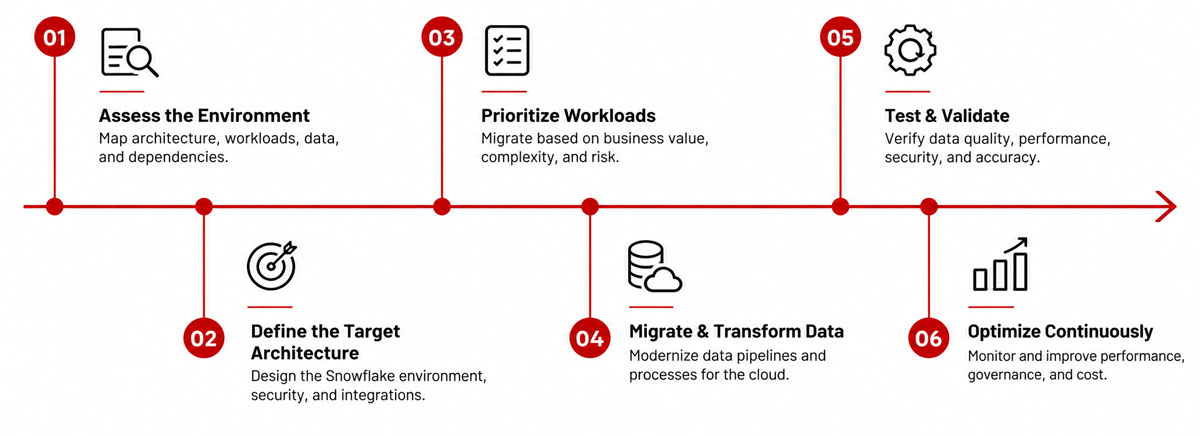
A structured migration strategy typically begins with an assessment of the current environment. Organizations should identify data sources, workloads, integrations, applications, users, dependencies, and existing pain points.
The migration process can then be organized into several stages:
Snowflake Data Warehouse Architecture for Modern Analytics
Organizations should design a modern Snowflake architecture around their business and analytical requirements. Snowflake separates storage and compute, allowing organizations to scale processing resources independently based on workload requirements. This can help different teams support concurrent workloads without competing for the same compute resources.
For example, finance may run scheduled reporting while data science teams execute resource-intensive analytical workloads. A properly designed architecture can help support these use cases without requiring every workload to share the same compute resources.
A modern architecture may incorporate:
- Enterprise data warehouses
- Data lakes and lakehouse patterns
- ELT pipelines
- Business intelligence platforms
- Data integration tools
- Data governance frameworks
- Machine learning and AI workloads
- APIs and operational applications
The target Snowflake data warehouse architecture should ultimately reflect workload requirements, integration needs, governance policies, scalability objectives, and the organization’s long-term analytics strategy.
Snowflake Data Warehouse Modernization Best Practices
Technology alone does not guarantee modernization success. Organizations should establish a disciplined approach that combines technical design with governance and business alignment.
Important Snowflake modernization best practices include:
- Start with business objectives: Define the business outcomes modernization is expected to deliver.
- Assess before migrating: Understand legacy workloads and dependencies before making architectural decisions.
- Modernize rather than replicate: Avoid carrying unnecessary legacy processes into the cloud.
- Use automation: Automate testing, deployment, monitoring, and data pipeline processes where possible.
- Build governance into the architecture: Establish security, access, quality, and compliance controls from the beginning.
- Monitor consumption: Track compute usage and workloads to identify optimization opportunities.
- Prioritize data quality: Establish validation processes to ensure users can trust modernized data.
- Adopt an incremental approach: Phased modernization can reduce risk and provide opportunities to demonstrate value early.
These Snowflake data warehouse modernization best practices can help organizations reduce migration risk while creating an environment that is easier to scale, govern, optimize, and adapt to changing analytics requirements.
Snowflake Data Warehouse Optimization
After implementation, Snowflake data warehouse optimization becomes an ongoing priority. A cloud platform can provide scalability, but organizations still need to manage workloads efficiently.
Optimization should consider query performance, compute utilization, data architecture, workload patterns, and data lifecycle policies.
Organizations can focus on:
- Identifying inefficient or frequently executed queries
- Monitoring warehouse utilization
- Matching compute resources to workload requirements
- Reviewing data storage and retention policies
- Improving transformation processes
- Eliminating unnecessary workloads
- Establishing appropriate resource-management practices
- Regularly reviewing performance and consumption trends
Continuous Snowflake data warehouse optimization can help organizations achieve the intended business value of modernization while maintaining greater control over operational costs.
Snowflake Data Warehouse Modernization and Data Governance
Modernization also creates an opportunity to strengthen Snowflake data governance. As organizations bring more data into a centralized cloud environment, they need clear policies for who can access data, how it should be classified, and how it should be protected.
Governance should address:
- Data ownership
- Access controls
- Data classification
- Privacy requirements
- Data quality
- Metadata management
- Auditing
- Retention policies
Organizations should not treat security as an afterthought, they should build it into the architecture and migration strategy from the beginning.
A strong Snowflake data governance framework can help organizations provide broader access to data while maintaining appropriate controls around sensitive information.
Roadblocks to Data Warehouse Modernization
While Snowflake can simplify and modernize data infrastructure, the data warehouse modernization journey can involve technical, operational, and organizational challenges.
- Legacy Complexity: Years of accumulated transformations, reports, integrations, and undocumented dependencies can make migration complex and time-consuming.
- Data Quality Issues: Moving poor-quality or inconsistent data to Snowflake does not resolve underlying problems, making data assessment and cleansing essential.
- Cost Management: Cloud flexibility can lead to unnecessary consumption when organizations don’t properly monitor and optimize workloads, compute resources, and usage patterns.
- Skills Gaps: Teams with limited experience in Snowflake, cloud data architecture, modern data engineering, or governance may require additional expertise and support.
For organizations considering a legacy data warehouse to Snowflake migration, addressing these challenges before migration can help reduce disruption and improve the likelihood of a successful modernization program.
Here’s how you can address these challenges:
- Conduct a detailed discovery and assessment to understand existing workloads, dependencies, data quality, and technical requirements before migration.
- Develop a structured migration plan that prioritizes workloads based on business value, complexity, risk, and readiness.
- Align technical and business stakeholders to ensure modernization goals, timelines, and expected outcomes are clearly defined.
- Establish governance and security early to address data access, quality, privacy, compliance, and ownership throughout the modernization journey.
- Automate testing and validation to improve data accuracy, reporting reliability, performance, and migration confidence.
- Continuously optimize the Snowflake environment by monitoring workloads, compute usage, performance, and costs after migration.
- Leverage experienced modernization expertise when internal teams need support with Snowflake architecture, migration, integration, governance, or optimization.
Build a Future-Ready Data Foundation with Snowflake Data Warehouse Modernization
Snowflake data warehouse modernization offers an opportunity to move beyond the limitations of legacy data environments and build a more scalable, flexible, and analytics-ready foundation. With Gartner forecasting worldwide AI spending to reach $2.59 trillion in 2026, organizations need modern, governed data environments that can scale with growing AI and analytics demands.
Success depends on strategy as much as technology. Organizations need to assess their current environment, prioritize workloads, design the right architecture, address governance and security, and continuously optimize the platform.
With the right approach, Snowflake can become more than a replacement for a legacy warehouse. It can provide a foundation for faster analytics, better decision-making, advanced data initiatives, and Snowflake AI readiness.
Synoptek can help organizations navigate this journey, from modernization strategy and architecture through migration, optimization, and ongoing transformation. Speak to our experts to develop a Snowflake modernization roadmap aligned with your business goals.