
September 22, 2026 · by Synoptek Team 6 min read
Executive Summary
Executive leadership teams frequently view IT infrastructure as an operational expense rather than a driver of top-line expansion. However, digital friction, system latency, and unplanned downtime drain enterprise capital through lost productivity, customer churn, and missed revenue opportunities. By connecting system health to financial balance sheets, evaluating the ROI of IT efficiency allows leaders to translate technical performance into board-level value. Modern infrastructure optimization unlocks hidden capital, accelerates time to market, and protects employee retention. Through targeted investments in automation, observability, and digital employee experience, C-suite leaders turn everyday technical operations into a primary catalyst for sustainable corporate growth.
Many Chief Financial Officers (CFOs) and Chief Executive Officers (CEOs) treat IT operations as a cost center. Boardroom conversations routinely scrutinize server costs, software licensing, and support headcounts while overlooking how system performance directly shapes top-line financial success. When digital workflows falter, enterprises lose value through abandoned shopping carts, degraded employee output, and delayed product releases.
Progressive executive teams reject this legacy perspective. By adopting the approach of a Managed Experience Provider (MxP), enterprises connect day-to-day IT operations directly to business performance. Understanding the direct link between the ROI of IT efficiency and commercial success transforms IT from a line-item expense into an agile growth engine.
Moving Beyond Cost Centers: The Boardroom Business Case
Enterprise executives must align technology metrics with financial statements. Rather than executing arbitrary budget reductions that risk operational stability, forward-thinking leaders implement strategic IT cost optimization frameworks to eliminate redundant spend while reinvesting in high-impact initiatives. Traditional Key Performance Indicators (KPIs) like server availability fail to assist executives in measuring IT business value across commercial touchpoints. Calculating the true ROI of IT efficiency requires connecting technical execution directly with cash flow, gross margin, and corporate valuation.
According to the 2024 ITIC Hourly Cost of Downtime Survey, more than 90% of mid-sized and large enterprises report an average hourly downtime cost exceeding $300,000, while 41% report costs of $1 million to more than $5 million per hour. Furthermore, research from Oxford Economics demonstrates that Global 2000 companies lose a collective $400 billion annually to unplanned outages, which equals roughly 9% of their annual profits.
Translating standard IT efficiency metrics into boardroom impact, clarifies where technical speed generates monetary return.
| Operational IT Metric | Financial Translation | Boardroom Impact |
|---|---|---|
| System Latency | Checkout abandonment and lost conversions | Lower gross revenue and higher customer acquisition costs |
| Application Downtime | Idle labor hours and transaction bottlenecks | Reduced operating margin and wasted payroll expense |
| Service Desk Backlog | Employee context switching and task disruption | Suppressed workforce productivity and project delays |
| Infrastructure Sprawl | Redundant tooling and unoptimized cloud compute | Inflated operational expenditures (OpEx) |
Three Financial Vectors of Operational Performance
To articulate the strategic value of technology investments, business leaders track three core channels where technical speed generates monetary return.
1. Direct Revenue Velocity and Conversion Optimization
In modern commerce and enterprise software, milliseconds dictate conversion rates. Slow database queries, sluggish API calls, and congested networks delay user journeys. When an e-commerce catalog or client portal runs without latency, completion rates climb. A streamlined technical foundation accelerates digital transaction volumes, preserves margins, and maximizes customer lifetime value.
2. Workforce Productivity and Employee Retention
Workplace friction quietly destroys operating margins. When employees spend hours wrestling with unresponsive Virtual Desktop Infrastructure (VDI), broken VPN connections, and crashing collaboration suites, operational throughput drops.
Strategic market analysis published in Gartner’s Digital Employee Experience Research projects that 50% of digital workplace leaders will implement formal DEX strategies by 2026, up from 30% in 2024, to systematically eliminate digital friction and protect workforce retention. Modernizing digital experience management boosts employee morale, cuts unwanted attrition, and preserves institutional knowledge.
3. Accelerated Time to Market
Engineering teams deliver greater strategic value when they deploy stable code rather than troubleshoot infrastructure, managing incidents, or handling uncontrolled churn. While building a high-performing tech culture remains vital, the latest McKinsey & Company benchmarks prove that increased coding activity does not automatically boost revenue growth, profit, or operating margins. In fact, the recent boom in autonomous AI tooling has sparked a “vibe coding” phenomenon. Coding activity skyrocketed by 180 percent, yet actual software releases rose by only 30 percent. Without structural discipline, this unmanaged tool adoption has caused productivity to decline in nearly 30 percent of companies. True IT operational efficiency ROI is achieved not through higher volumes of unverified code, but by empowering developers with the rigorous infrastructure and governance needed to ship stable features quickly, test reliably, and outpace competitors.
Translating Technical Signals into Executive Financial Metrics
To bridge the gap between technical operations and executive priorities, technology leaders must track IT efficiency metrics that resonate in executive committee meetings. The table below outlines how to convert technical achievements into financial value.
| Traditional IT KPI | Financial Translation Metric | Strategic Value |
|---|---|---|
| Mean Time to Resolution (MTTR) | Recovered Productive Payroll Hours | Recaptures lost worker capacity and accelerates output |
| API Response Latency | Digital Cart Completion Rate | Increases top-line digital revenue per session |
| Incident Ticket Volume | Cost per Resolution Avoidance | Decreases Tier-1 and Tier-2 support labor costs |
| Compute Utilization Efficiency | Cloud Unit Cost per Transaction | Expands gross profit margins on software services |
Bridging the Executive Divide: IT Business Outcomes for the Modern CIO
Bridging technical data and executive consensus requires a shared analytical framework. Highlighting proven frameworks for measuring IT business value enables technology leaders to frame modernization around business expansion rather than defensive maintenance.
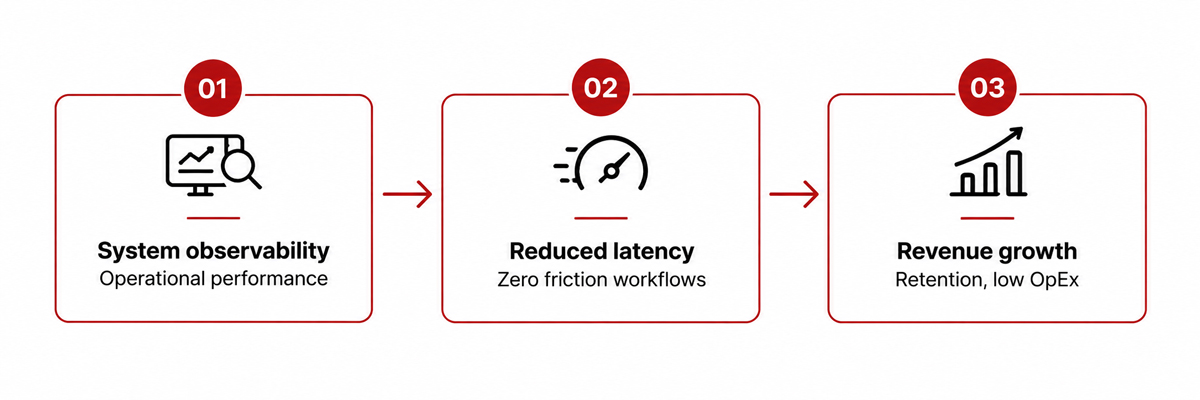
When communicating with the board of directors, executive teams focus on three strategic drivers:
- Calculate the True Cost of Friction: Audit total weekly hours lost to slow boot times, broken authentication paths, and cloud application delays.
- Prioritize Proactive Automation: Deploy automated remediation to resolve technical incidents before they impact customer-facing transactions.
- Align Technology Upgrades with Revenue Milestones: Tie every infrastructure modernization project directly to customer acquisition, pipeline velocity, or cost reduction.
Unlocking Enterprise Capital Through Modern IT Operations
Enterprise technology no longer functions merely as backstage plumbing; it represents the operational core of the entire business. Executive teams that optimize backend performance generate compound returns across their balance sheets. When companies eliminate system bottlenecks, their staff works faster, their software converts better, and their overall operations scale efficiently.
A rigorous focus on IT operational efficiency ROI positions organizations to outperform competitors who still view IT as a cost center. To capture these gains, forward-thinking enterprises are moving beyond conventional managed services and partnering with a Managed Experience Provider (MxP™) to unify infrastructure stability, proactive automation, and end-user productivity. Prioritizing operational stability, unified visibility, and automated remediation maximizes the ROI of IT efficiency across core digital touchpoints.