
October 14, 2026 - by Sreeni Pitchala
AI-ready ERP starts with trusted data. Strong data governance, quality controls, and shared business definitions help AI deliver reliable insights and decisions. Connecting ERP with other business systems provides the context AI needs, while modern integration architectures ensure secure, timely access to information. With the right data foundation, organizations can improve AI adoption, operational efficiency, and business outcomes.
Every major ERP platform now ships with AI built in: Copilot in Microsoft Dynamics 365, Joule in SAP, and embedded AI agents in Oracle Fusion Cloud ERP. They promise sharper forecasts, smarter recommendations, and processes that run themselves. But none of them can compensate for poor underlying data.
AI Moves Fast, So Do Its Mistakes
AI can process information and act on it at a speed and scale no team can match. That is a gift when your master data is sound. It amplifies the quality of the underlying enterprise data, making data accuracy and consistency critical to reliable outcomes. But AI moves fast, and so do its mistakes. When records are inaccurate, duplicated, incomplete, or outdated, the same speed spreads errors across decisions and processes before anyone notices.
The Trust Deficit
Fragmented supplier records, stale inventory balances, inconsistent customer information, and conflicting product hierarchies produce recommendations that look credible but are operationally wrong. This results in:
- Incorrect demand and inventory forecasts
- Duplicate or inappropriate supplier recommendations
- Misleading customer profitability analysis
- Inaccurate cash-flow and working-capital predictions
- Automated actions based on outdated business information
The damage does not stop at bad decisions. When employees repeatedly question what the AI tells them, they quietly return to manual analysis. Adoption falls, productivity gains stall, and the return on your AI investment shrinks.
Trust in enterprise AI begins with trust in enterprise data.
Building the Foundation of Trust
Three data disciplines make ERP information accurate, understandable, traceable, and usable by AI.
1. Master Data Management and Data Quality
Start with governed, authoritative records for customers, suppliers, products, employees, assets, and financial dimensions. That means:
- Entity matching and deduplication
- Data-quality validation and monitoring
- Standardized identifiers and classifications
- Defined ownership and stewardship
- Continuous synchronization across systems
One clarification worth making: AI applications typically use this governed information for grounding and decision support, not necessarily for training the underlying model. The point is that the answers it gives are anchored in records you trust.
2. Metadata and Data Lineage
Metadata explains what the data represents. Lineage shows where it came from, how it was transformed, and when it was last updated. Together, they let both AI and people judge whether a piece of data is relevant, fresh, and reliable.
3. Semantic Models and Business Vocabulary
Semantic models translate technical data structures into consistent business concepts, so AI understands that different system terms may describe the same customer, product, revenue measure, or business event. The payoff:
- Consistent KPI interpretation
- Natural-language interaction with enterprise data
- More accurate cross-system analysis
- Traceable, explainable AI responses
Accurate data tells AI what happened. Metadata and semantics help it understand what the data means.
Beyond ERP: The Context AI Needs
An intelligent ERP cannot operate in isolation. ERP provides the essential transactional record, but many decisions depend on information from outside the core platform: CRM pipelines and customer interactions, warehouse and supply-chain telemetry, commerce and point-of-sale activity, supplier and logistics platforms, contracts, emails and service records, and economic, weather, market and geopolitical signals.
Connecting financial, customer, product, supply-chain, workforce and external data gives AI a 360-degree view of the business, rather than one isolated transaction.
Take inventory risk. An AI agent predicting a shortage may need to combine five kinds of information:
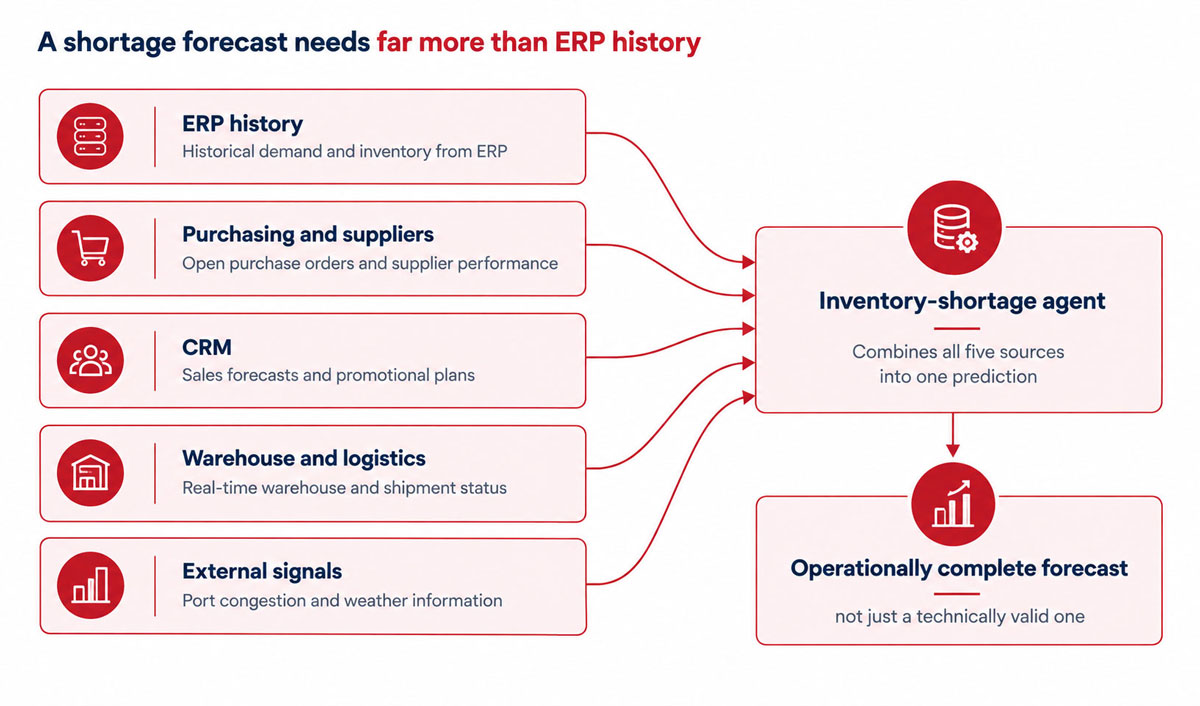
Without the full picture, the agent can produce a forecast that is technically valid but operationally incomplete.
ERP supplies the transactional core; connected data supplies the decision context.
An Architecture that Delivers Data at the Point of Decision
The goal is to connect ERP and surrounding data without adding complexity, latency, or uncontrolled duplication. That means moving from brittle legacy pipelines toward event-driven data fabrics, where systems are decoupled, and AI applications and business users can securely reach high-quality data in real time.
- Beyond batch and point-to-point. Traditional ETL and point-to-point interfaces still suit some workloads. Relying on them exclusively, though, creates latency, brittle dependencies, duplicated data, and heavy maintenance, especially for real-time AI use cases.
- Lakehouse and data fabric. A lakehouse brings structured ERP data together with contracts, documents, emails, sensor data, and logs. A data-fabric approach adds consistent discovery, access, integration, security, lineage, and governance across distributed and hybrid environments.
- Event-driven, real-time data. Event-driven integration lets AI react to an order cancellation, inventory movement, equipment alert, or delayed shipment without waiting for the next batch cycle.
- Zero-copy and reduced-copy patterns. These let systems securely access data without repeatedly moving and storing it, which means:
- More current information for AI
- Reduced replication and storage
- Fewer synchronization failures
- Improved governance over distributed copies
- Faster access to cross-platform data
Choose these patterns based on performance, security, sovereignty, resilience, and workload needs. They are not a universal replacement for data movement.
The objective is not simply to centralize data. It is to make trusted data securely accessible when and where intelligence is needed.
How Ready Are You? A Practical Assessment
Use these seven factors to evaluate whether your organization can support trusted AI within ERP and operational processes.
| Readiness Factor | Traditional State | AI-Ready Target | Immediate Action |
|---|---|---|---|
| Data quality and MDM | Siloed, duplicated records; manual correction | Governed golden records with continuous quality monitoring | Measure duplicate, incomplete, and inaccurate records across critical entities |
| Business context | ERP data analyzed apart from customer, supply-chain, and external data | Connected operational data organized around business domains and decisions | Identify the additional data needed for three priority AI use cases |
| Metadata and semantics | Technical field names; inconsistent KPI definitions | Shared business vocabulary, semantic models, and standardized metrics | Reconcile terminology and KPI definitions across ERP, CRM, and analytics |
| Integration architecture | Point-to-point interfaces, batch ETL, and redundant copies | API-led, event-driven, lakehouse-enabled, reduced-copy architecture | Assess latency, replication costs, and failure points in current integrations |
| Governance and lineage | Periodic cleansing; limited accountability or traceability | Continuous governance, named ownership, lineage, and policy-based access | Assign data owners and stewards for critical business domains |
| AI grounding and controls | Broad or inconsistent access to unverified information | AI grounded in approved, current, access-controlled data | Define approved data sources, access boundaries, and freshness requirements |
| Measurement and adoption | Pilots measured by technical completion | Adoption, trust, accuracy, business value, and risk measured continuously | Establish baselines for accuracy, user trust, process time, and business outcomes |
Where Do You Stand? Five Readiness Levels
Beyond the factor-by-factor view, you can place your organization on one of five measurement levels:
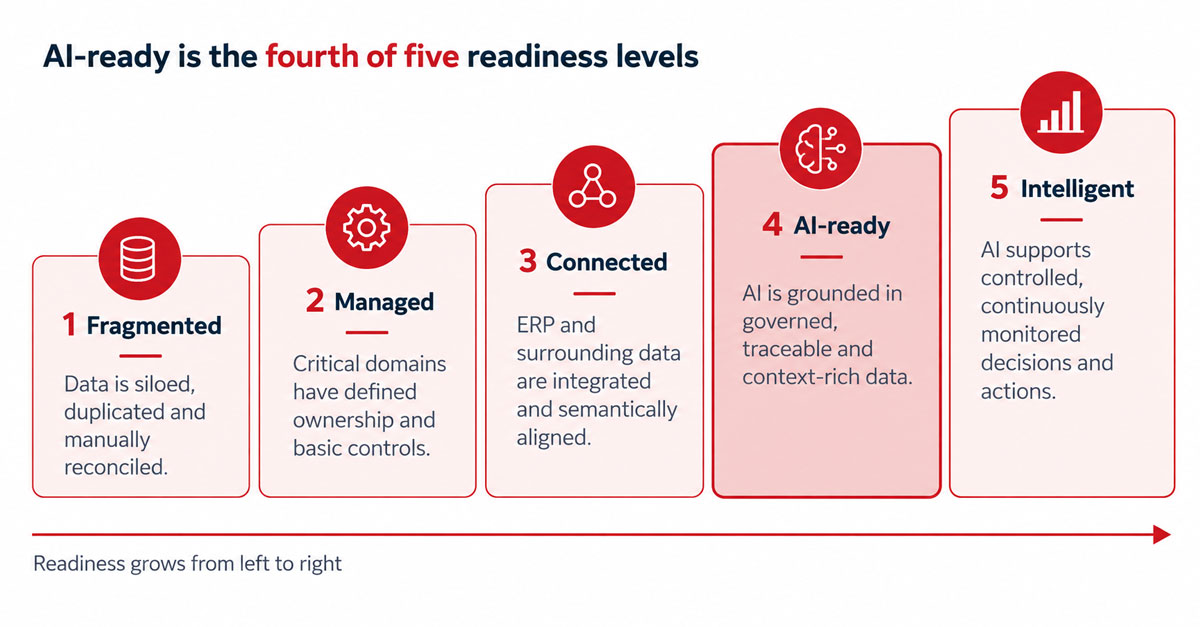
At level four, AI is grounded in governed, traceable, context-rich data. Level five adds controlled, continuously monitored operational decisions and actions.
The Takeaway
AI-ready ERP is not achieved by adding an AI layer to existing systems. It takes four things working together:
- A trusted data core: governed master data and continuous quality
- Shared business meaning: metadata, lineage and semantic models
- Connected operational context: ERP plus the data around it
- An architecture that delivers governed information at the point of decision
A good first step is small: measure the duplicate and incomplete records in your most critical entities, name their owners, and pick three AI use cases to connect first. Trusted data comes before intelligent operations.
About the Author

Sreeni Pitchala is the Senior Practice Director of Digital Enterprise at Synoptek. He brings more than three decades of experience across enterprise technology and digital transformation, spanning ERP modernization, cloud transformation, enterprise data platforms, and AI-driven solutions. At Synoptek, he leads strategic initiatives to expand the portfolio, accelerate client value, and strengthen global partnerships, advising organizations on leveraging technology to drive innovation, operational excellence, and sustainable growth.