
September 30, 2026 · by Synoptek Team 8 min read
Executive Summary
- Most PE-backed portfolio companies still price a deal before anyone seriously reviews the technology, and the cost shows up later as margin erosion nobody traces back to its source.
- Technology due diligence should give the deal team a priced, sequenced work product they can act on, with clear priorities and costs.
- Most of the risk emerges during execution, making Day 1 governance one of the highest-leverage decisions in the hold period.
- Firms that treat IT as a value creation discipline, not a one-time integration task, are the ones closing the gap between entry multiple and exit multiple.
Every deal carries a technology decision buried inside it, whether anyone names it out loud or not. For years, that decision could wait—not anymore.
This session, “Managing IT Value, Risk, and Spend Across the Deal Lifecycle”, hosted by ACG and sponsored by Synoptek, brought together operating partners, portfolio company CFOs, and corporate development leaders for a live conversation on where technology moves a deal forward and where it quietly works against it.
In the session, Eric Codorniz, Miguel Sanchez, and Manan Thakkar walked the full deal cycle stage by stage. Their central argument: the mistakes compound over time. A problem missed early does not stay contained. It resurfaces later as an unplanned cost, and then as a harder conversation at exit.
This debrief highlights the key practical takeaways for anyone who couldn’t attend the live session.
The Diligence Gap that Costs Sponsors After Close
Eric opened with a number that reframed the entire conversation: most sponsors still price a deal before anyone has seriously looked at the technology underneath it. Everything that follows from that gap, he argued, is predictable. It shows up as unplanned integration costs, timelines that slip by a quarter or two, and a first-year result that quietly undershoots the thesis the deal team underwrote.
Miguel Sanchez made the case for moving the review earlier, to the indication of interest rather than the letter of intent. His ask at that stage is intentionally light: technology spend as a percentage of revenue against sector norms, carve-out and transition service exposure, and a basic cyber indicator covering recent incidents and insurance standing. That review takes 48 hours and a few thousand dollars. It doesn’t slow the process down, but it does change the amount a firm is willing to put in the letter.
Turning Diligence into a Priced Work Product
A generic technology assessment produces an inventory and a traffic-light dashboard. It confirms nothing is currently on fire. It does not tell a deal team what to pay, what to fix, or what to model into the exit.
Miguel outlined what separates a checklist from a defensible work product. Every material finding should have a dollar figure attached to it. Findings need to be sequenced across Day 1, the first 100 days, year one, and the multi-year horizon, so the CFO knows which quarter each item hits. And the diligence must argue with the thesis directly. If the deal underwrites 6% organic growth, the technology stack needs to support that growth for the thesis to hold.
Manan Thakkar extended the same logic to cybersecurity. A generic cyber assessment gives a CFO a score, while FAIR-based risk modeling puts a dollar value on the top loss scenarios, a calculated return on each proposed control, and an underwriting input insurers respond to. In one scenario Manan walked through, a modest investment in backup architecture cut the largest loss scenario by more than three-quarters. That gives the CFO a number they can take directly into a board meeting.
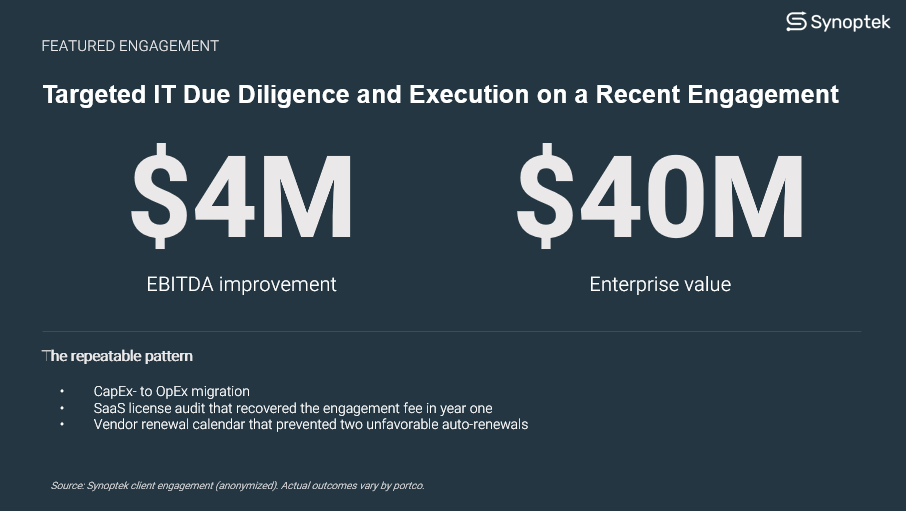
The panel also pointed to a live Synoptek engagement where targeted diligence and execution work identified $4 million in annualized EBITDA improvement, worth roughly 40 million dollars in enterprise value at exit. None of the three moves behind it was exotic: a capital-to-operating expense shift, a software license audit, and a forward-looking renewal calendar. What stood out was how often these same opportunities are already present across many portfolios.
Day 1 Governance Sets the Trajectory for the Hold
After closing, execution risk becomes the central concern. Most deals that come apart, Miguel noted, do so during execution rather than because of the thesis itself.
Miguel argued that the single highest-leverage decision in the first 100 days is naming who has the authority to say no on technology, before Day 1, so the role is established from the outset. Without that owner, decisions fragment across whichever function has the loudest problem that month. By Day 30, a company has often committed to vendor renewals and cloud architecture choices that never went through a real review.
That responsibility can sit with a fractional technology leader, an operating partner advisor, or a CFO with structured advisory support, if they hold real decision rights and a regular cadence with the board.
Manan added the fastest-returning move available in that window: a software license audit. Most mid-market portfolio companies are running far more applications than anyone realizes, and a meaningful number of those licenses go unused. That turns projected savings into cash the CFO can bring to the board within the first quarter.
Making the Hold Period Pay
The hold period is where the thesis either turns into earnings or turns into a story a fund must explain to its limited partners.
On AI, Manan was direct about where the money is going. Investment is up across nearly every portfolio, yet only about 5% of those investments are running in production at meaningful scale. The gap comes down to three conditions: clean, queryable data, use cases ranked by profit impact rather than novelty, and a delivery model that does not depend on a data science team a $50 million company cannot realistically staff. Buying an enterprise AI platform before the data is clean, he noted, is one of the most common and most expensive mistakes on this list.
On governance, Miguel pointed out that most PE-backed CFOs run lean without a CIO, which is common in this operating model.
A fractional technology leader can provide the needed ownership of the roadmap, vendor relationships, and cyber posture, reporting monthly to finance and quarterly to the board on one page with three metrics: posture index, renewal exposure, and spend per employee. Manan added that none of those metrics matter without a named owner, a review cadence, and a documented action threshold attached to each one.

Why the Third Add-On Exposes the Playbook
For firms running a buy-and-build strategy, Miguel offered a pattern worth remembering. The first and second add-ons usually get absorbed by whatever infrastructure already exists. The third acquisition often reveals whether a real integration playbook exists.
For a tuck-in below one-quarter of platform revenue, the approach is to standardize identity, financial systems, and security tooling inside 90 days, then leave operational systems alone for six months. For a transformative add-on, the deal must be treated like a merger: an architecture review before the letter of intent, named leads on both sides, and a genuine willingness to migrate onto the acquired company’s stack if it is the better one. Firms can reduce the risk of an expensive scramble by documenting the integration playbook after the first deal and pressure-testing it on the second.
Preparing for Exit Starts Long Before the Data Room Opens
Miguel framed exit as the point when a buyer’s diligence process turns its attention to your technology estate. On the cyber side alone, a single cyber incident can cost a portfolio company eight figures, putting that exposure squarely in the sights of a buyer’s diligence team.
An exit-ready technology estate is documented and defensible across three dimensions: financial visibility, with technology spend mapped to the earnings it supports rather than buried in shared services; current security posture, with a documented security history and no unresolved material incidents; and dependency clarity, with no system that only one person understands. Work started 12 months before a sale can contribute to earnings, while the same work started three months out is more likely to surface during diligence.
One Decision Every Firm Should Make in the Next 90 Days
Closing the session, Eric made the point that the spread between top- and bottom quartile funds has never been wider, and that the gap is no longer explained by financial engineering. The difference increasingly comes down to execution, with technology sitting at the center of that gap more often than most deal teams admit.
The panel’s shared recommendation for the next 90 days was consistent across all three speakers: fund the data foundation, name a technology decision owner, and start using IT as a value-creation lever.