
December 15, 2025 · by Synoptek Team 6 min read
Why Experience-centric IT Is the Next Frontier
Organizations often rely on Managed Service Providers (MSPs) to keep their IT infrastructure and services on track by applying service benchmarks and user expectation to SLAs. Things like uptime, ticket response, time to resolution don’t always contribute to meaningful outcomes. The way success is gauged has fundamentally changed. IT is no longer measured based on the the availability of a service; it is measured by how meaningful that metric is to the business. SLAs ensure that technologies are meeting expectation but fall short of helping drive the business forward.
Today’s organizations demand more than uptime from their technology teams and providers, they need a trusted advisor that helps them define a path forward who can then execute against key business imperatives. This partner needs to speak the language of outcomes and serve as a broker for continuous IT transformation. This is the foundation of the Managed Experience Provider (MxP™)—a modern model that blends advisory expertise, AI-enabled operations, and experience-led outcomes to unlock productivity, agility, and innovation at scale.
What Contributes to a Successful Experience?
Ensuring a positive experience has three fundamental components that bridge the gap between the business and the technologies that serve them.
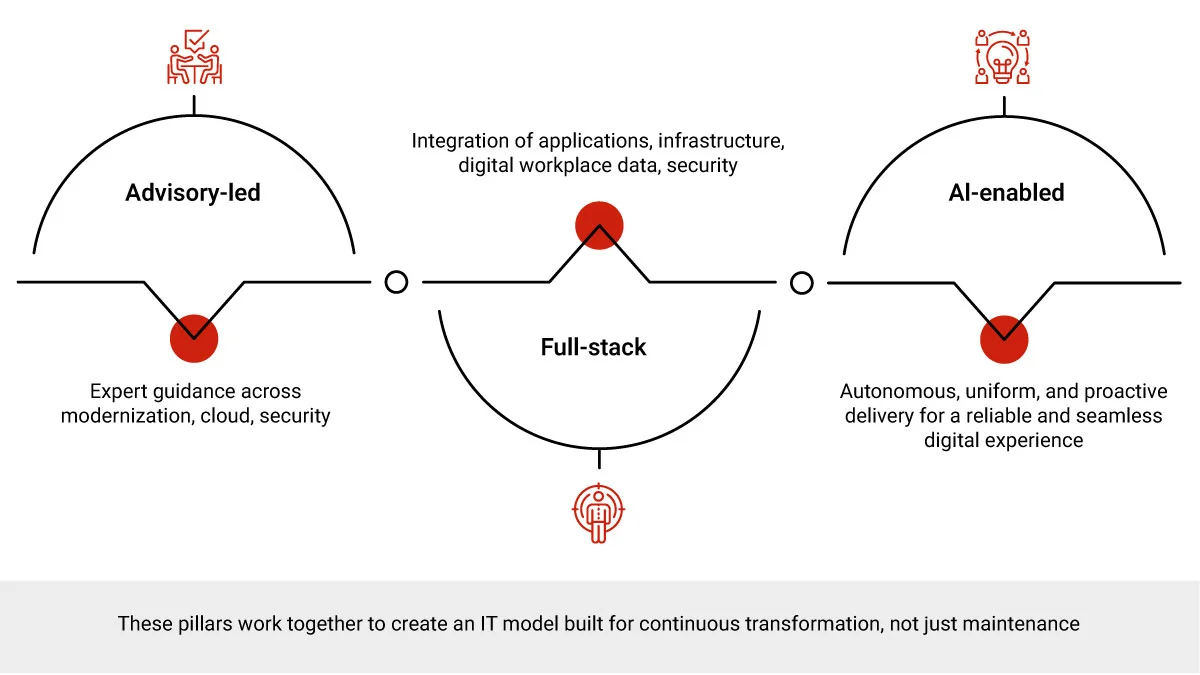
1. An advisory led partner-first approach. Teams need to be structured to deliver against immediate and long-term goals. Internal teams must be in lock step with strategic imperatives and the same is the case with external vendors, consultants, and service providers. Having a trusted relationship and focusing on partnership is the key to success whoever happens to be engaged in a technology project.
2. Full stack/full journey. It’s no mystery that systems and technology are increasing in complexity. They must work together seamlessly or risk business disruption. Managing one service in isolation does not ensure the right level of alignment needed. Outcomes and experience goals need to be mapped out from the offset of any project to ensure that the full tech stack is solutioned with the right level of focus on holistic use cases.
3. AI enabled service experience. AI is the new superpower and organizations that don’t tap into its tactical and strategic value are getting left behind. AI when used properly accelerates outcomes and provides a uniform experience. It’s an imperative to exploit AI to get the most out of any of your tech services and to accelerate transformation.
Why the Shift from MSP to MxP Is Happening Now
1. The Volume and Complexity of Tech services has Exploded
Enterprises once managed a small collection of core systems. Today, technology ecosystems span hundreds of SaaS apps, cloud platforms, and digital tools that employees adopt on their own. Gartner predicts that 75% of employees will acquire, modify, or create technology outside IT’s visibility by 2027, significantly accelerating SaaS sprawl and increasing integration risk. In this environment, every service affects another: identity impacts access, networks affect cloud performance, and even minor SaaS misconfigurations can disrupt entire workflows.
Managing this level of complexity requires more than monitoring. It demands intelligent managed services that provide full-stack visibility, observability, an understanding of system interactions. The MxP model starts with the end in mind, putting experience first breaking through the complexity of today’s IT environment to deliver results that make sense.
2. Experience Drives Measurable Business Value
Digital experience has become a primary pillar to a company’s success. It is no longer about just uptime and maintaining operations — it is about being a catalyst for innovation, agility, and exceptional experiences.
Focusing on experience extends beyond keeping servers up or resolving tickets in a timely fashion, it monitors other more qualitative measures of success including
- Customer Sentiment
- Application and IT Adoption
- Application Performance
- Workflow Efficiency
The better the experience and metrics like adoption, the higher engagement technologies and the companies that use them enjoy. MxP contributes directly to employee engagement and business success which in turn drives better business outcomes.
3. AI and Automation are Transforming the IT Operating Model
AI managed services are pivoting from reactive to predictive and self-healing. The future of IT lies in automation that fixes issues before users even knew they existed! Gartner projects that by 2026, 60% of large enterprises will automate at 30% of their IT operations, — up from under 10% today.
AI-enabled managed services are central to the MxP approach and contribute to success through:
- Identification of patterns before incidents occur,
- Automation of resolutions of recurring issues,
- Ticket volume reduction
- Improvement of response times
- Delivery of consistent, high-quality digital experience
A smoother, more reliable digital experience.
MSP vs. MxP — What’s the Difference?
| Dimension | Traditional MSP | Managed Experience Provider (MxP) |
|---|---|---|
| Primary Focus | Systems uptime, ticket resolution, cost control | Employee experience, productivity, and business outcomes |
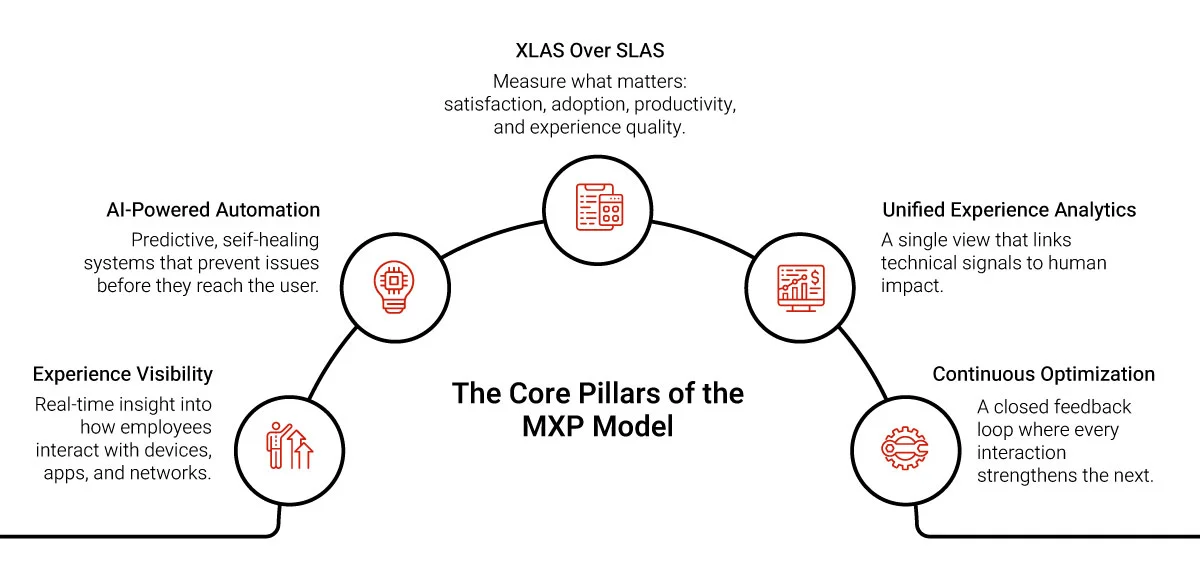
| Measurement | SLAs – response time, uptime, MTTR | XLAs – user satisfaction, adoption, experience quality |
| Approach | Reactive – fix when broken | Proactive – predict, prevent, and optimize |
| Technology Lens | Infrastructure and devices | Integrated view of apps, devices, and user experience |
| Business Value | Operational efficiency | Experience-led transformation and agility |
The MxP connects technology performance to business outcomes. This shift is what enables IT to transition from a cost-center to a strategic driver of value.
Why Experience-led IT Is the Future
Business demands that all services such as identity management, apps, networks, cloud platforms, and security work seamlessly together. When these services are integrated and interoperable, issues surface less often, performance improves, employees stay productive, and businesses experience more success.
Experience-led IT ensures all of these capabilities are contributing to the right outcomes and that they work cohesively. By unifying services and managing experience across the full stack, organizations reduce friction, strengthen adoption, and create measurable business impact.
Final Takeaway
The shift from MSP to MxP is more than an operational upgrade. It reflects fundamental shift in the contribution that technology makes from tactical to integral to an organizations’ goals. It is centered around experience, intelligence and measurable business value.
The way organizations view, and leverage technology is undergoing a seismic shift from simply being viewed as a tool to an enabler of growth and agility. An MxP leads the way for organizations to create more empowered employees, resilient systems, contributing to long term business success.
The future of managed IT services is experience-driven, and the journey begins with redefining how success is measured.
Are you ready? Connect with us to discuss how Managed Experience Providers are redefining the value of IT.