
November 18, 2026 · by Synoptek Team 6 min read
Contact center AI agent orchestration coordinates specialized AI agents, enterprise systems, and human employees to automate customer interactions and improve service delivery. Unlike traditional chatbots and rule-based automation, agentic AI for customer experience automation can interpret customer intent, route requests to the appropriate agents, retrieve information from connected business applications, execute approved tasks, and escalate complex interactions to human employees while preserving conversation context. Enterprises can implement AI agent orchestration in contact centers by identifying high-volume use cases, defining agent permissions, integrating CRM and operational systems, designing intelligent handoffs, and piloting one queue before scaling.
Customer expectations are changing. People want faster answers, consistent support across channels, and the ability to resolve routine issues without waiting for an agent. At the same time, contact centers face increasing interaction volumes, staffing constraints, rising operating costs, and growing pressure to deliver better customer experiences.
Traditional contact center automation has helped organizations address some of these challenges through interactive voice response (IVR), chatbots, and predefined workflows. However, these tools often operate independently. When a customer request becomes more complex, the interaction may require multiple transfers, repeated explanations, or manual intervention.
Contact center AI agent orchestration offers a more connected approach. It coordinates specialized AI agents, enterprise systems, business workflows, and human agents to manage customer interactions from beginning to end. Instead of relying on isolated automation tools, organizations can create a coordinated service environment in which AI customer service agents understand requests, retrieve information, complete appropriate tasks, and bring in human expertise when needed.
Read on to learn how contact center AI agent orchestration can improve service responsiveness while maintaining the oversight, accuracy, and accountability your customers expect.
What is Contact Center AI Agent Orchestration?
Contact center AI agent orchestration coordinates multiple AI agents, tools, data sources, and human agents to manage customer service interactions and complete tasks across the contact center.
Organizations can assign each AI agent a specialized responsibility. This division of labor, often called multi-agent orchestration, lets different agents work together to resolve customer requests more efficiently. For example, one agent may identify customer intent, another may retrieve account information, and another may handle a specific service request. An orchestration layer determines which agent or workflow should act, manages the exchange of information, and ensures that the interaction progresses toward resolution.
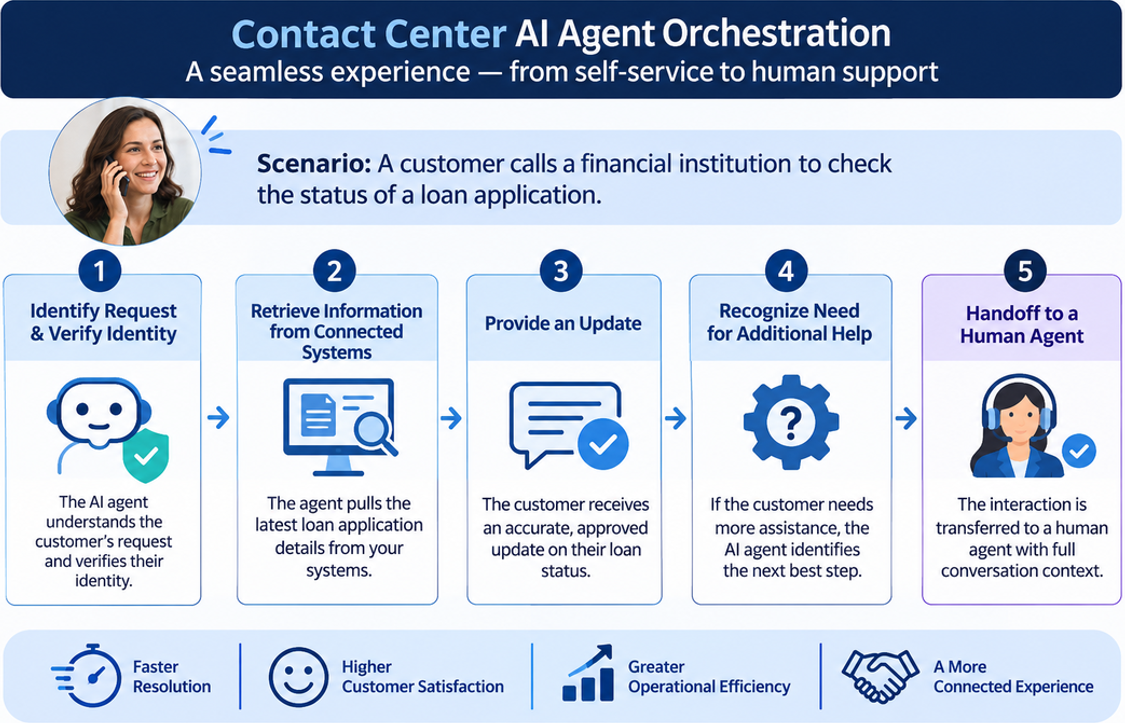
How Does AI Agent Orchestration Work in a Contact Center?
AI agent orchestration connects the different components involved in resolving a customer interaction. Although implementations vary, the process typically involves five stages.
1. Understand customer intent
The interaction begins when a customer contacts the organization through voice, chat, email, or another supported channel. Conversational AI in the contact center interprets the request, identifies the customer’s intent, and gathers the information needed to proceed. It may also use authentication workflows to verify identity before accessing sensitive account information.
2. Select the appropriate AI agent
Based on the customer’s request, the orchestration layer determines which specialized agent or workflow should handle the next step.
For example:
- A billing agent can address payment-related questions.
- A scheduling agent can help arrange or modify appointments.
- An account service agent can retrieve approved customer information.
- A knowledge agent can locate relevant product or service information.
This division of responsibilities allows organizations to automate specific tasks without expecting one general-purpose AI agent to handle every scenario.
3. Connect to enterprise systems
For enterprise AI agents to be useful, they need access to business information. Through approved integrations and APIs, they can interact with CRM platforms, knowledge bases, appointment systems, ERP applications, and other enterprise tools. That access must be governed by permissions, data security policies, and clearly defined boundaries. Agents should retrieve or modify only the information they are authorized to handle.
4. Coordinate actions and manage handoffs
Some requests require multiple steps or specialized expertise. The orchestration layer coordinates these activities and determines when an interaction should move from one agent to another. If the request involves an exception, a sensitive issue, or a decision outside the AI agent’s authority, it can be escalated to a human agent. A well-designed handoff preserves the conversation history, relevant customer information, completed actions, and the reason for escalation.
5. Monitor outcomes and improve workflows
Organizations can evaluate how interactions are handled using performance data, quality monitoring, and customer feedback. These insights help identify recurring issues, improve agent instructions, refine workflows, and determine which additional interactions are suitable for agentic AI for customer experience automation.
How to Implement AI Agent Orchestration in Contact Center
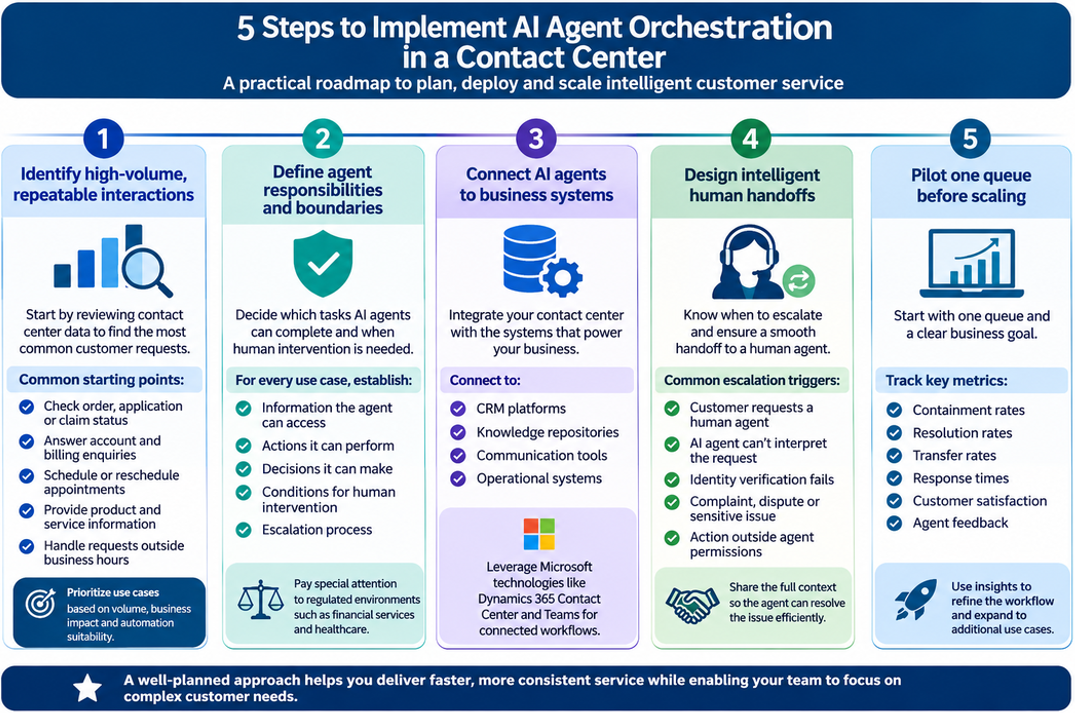
Implementing AI agent orchestration in contact center requires organizations to identify the right use cases, establish clear operational boundaries, connect enterprise systems, and define how AI and human agents will work together.
A phased approach can help reduce implementation complexity and demonstrate value before expanding agentic AI for customer experience automation. A typical rollout follows five steps:
What is the ROI of Contact Center AI Automation?
The business case for contact center AI automation extends beyond reducing the number of calls handled by human agents. Organizations should evaluate how orchestration affects service capacity, operating efficiency, customer experience, and the cost of resolving interactions.
| ROI Metric | What it Measures |
|---|---|
| Cost per interaction | Whether automation reduces the average cost of handling customer requests. |
| Average handling time | Whether AI assistance reduces the time agents spend resolving inquiries. |
| First-contact resolution | Whether customers receive complete answers without repeated interactions. |
| Self-service containment | The percentage of eligible interactions resolved without human intervention. |
| Escalation and transfer rates | Whether interactions reach the appropriate agent without unnecessary transfers. |
| Customer satisfaction | Whether faster, more consistent service improves customer experience. |
| Agent productivity | Whether employees can focus more time on complex interactions and customer needs. |
How to Evaluate Enterprise Contact Center AI Vendors in 2026/2027
When comparing AI agent orchestration platforms, look beyond conversational capabilities to understand how well each solution coordinates AI agents, connects to existing business systems, and supports operational governance.
Consider the following criteria when comparing vendors:
| Evaluation Area | What to Look for |
|---|---|
| Agent orchestration | Ability to coordinate specialized agents and multi-step workflows. |
| Enterprise integration | Connectivity with CRM, ERP, knowledge bases, and communication platforms. |
| Human handoffs | Context preservation, escalation controls, and intelligent routing. |
| Security and compliance | Identity controls, permissions, auditability, and support for applicable regulatory requirements. |
| AI governance | Monitoring, testing, traceability, and controls over agent actions. |
| Scalability | Ability to expand from an initial pilot to additional queues, channels, and business processes. |
| Commercial model | Transparency around licensing, usage charges, implementation, and ongoing operating costs. |
Build a Connected Contact Center Organization with Synoptek
Contact center AI agent orchestration offers enterprises an opportunity to move beyond isolated chatbots and basic automation toward coordinated customer service workflows.
By connecting specialized AI agents with enterprise data, business applications, and human employees, organizations can address routine inquiries more efficiently while retaining human oversight where it matters.
The best starting point is not necessarily a complete contact center transformation. It is identifying one high-volume interaction, understanding the process, and determining how AI can improve its resolution.
Synoptek helps organizations evaluate and modernize their customer service environments with Microsoft business applications and AI capabilities. Our AI-driven Contact Center as a Service offering helps organizations turn every customer interaction into a growth opportunity.
Start with a focused contact center readiness assessment to identify suitable automation opportunities, integration requirements, and a practical pilot plan.