
February 6, 2026 - by Synoptek
Enterprise applications like Dynamics 365 Business Central cannot be deployed and left alone. These cloud ERP systems evolve continuously, – through monthly updates, embedded AI, expanding integrations, and shifting business requirements. As complexity increases, so does the gap between deployment success and sustained business value.
Traditional application support models focus on keeping systems running. But uptime alone does not ensure productivity, adoption, or return on investment. Without continuous optimization, automation, and governance, ERP platforms risk becoming operational bottlenecks instead of engines for growth.
This is where modern Application Managed Services (AMS) become essential.
Moving Beyond Reactive Support to Continuous Optimization
SMBs often turn to Dynamics 365 Business Central to modernize operations, improve financial performance, enhance customer engagement, and optimize supply chain management. Yet even after a successful implementation, many organizations struggle with the ongoing monitoring, optimization, and governance required to extract long-term value from their ERP investment.
Application managed services help bridge this gap by shifting ERP management from reactive issue resolution to proactive, experience-led optimization, ensuring the system continues to support evolving business needs.
1. Timely User Support
As users transition from legacy tools to a modern, intelligent platform like Dynamics 365 Business Central, they often encounter challenges navigating the system, locating relevant information, and making timely decisions. Addressing these issues internally can be difficult for teams with limited application expertise.
Beyond issue resolution, organizations also face challenges in establishing standard operating procedures, defining best practices, and consistently onboarding and enabling users as the platform evolves. This highlights the need for application managed services that provide not just support, but structured guidance and experience-led enablement.
2. Functionality and Experience Gaps
Post–Dynamics 365 Business Central deployment, many SMBs encounter functionality-related challenges. While out-of-the-box implementations accelerate go-live, configurations are not always optimized to support evolving business processes.
Over time, organizations realize they are underutilizing intelligent workflows, embedded automation, and AI-enabled capabilities within the platform. Without continuous review and optimization, user experience suffers, and the ERP system delivers less value than it can provide.
3. Continuous Improvement and Platform Evaluation
Microsoft continuously enhances Dynamics 365 Business Central with new features, updates, and AI-driven capabilities. For SMBs, keeping pace with these changes can be challenging. Limited visibility into the Microsoft roadmap and ecosystem often makes it difficult to assess which enhancements are relevant and how they align with future business goals.
Without a structured approach to continuous improvement, ERP platforms risk falling out of sync with organizational maturity and growth objectives—reducing the long-term impact of the investment.
4. System Management and Ongoing Maintenance
Maintaining in-house expertise to manage system updates, security patches, integrations, and administrative tasks is an ongoing challenge for many organizations. Teams often lack the time and skillset required to perform thorough testing before updates or to proactively improve system performance over time.
Application managed services help bridge this gap by providing consistent system management, proactive monitoring, and ongoing optimization—ensuring Business Central remains stable, secure, and adaptable as business needs change.
Transforming Costs to Value
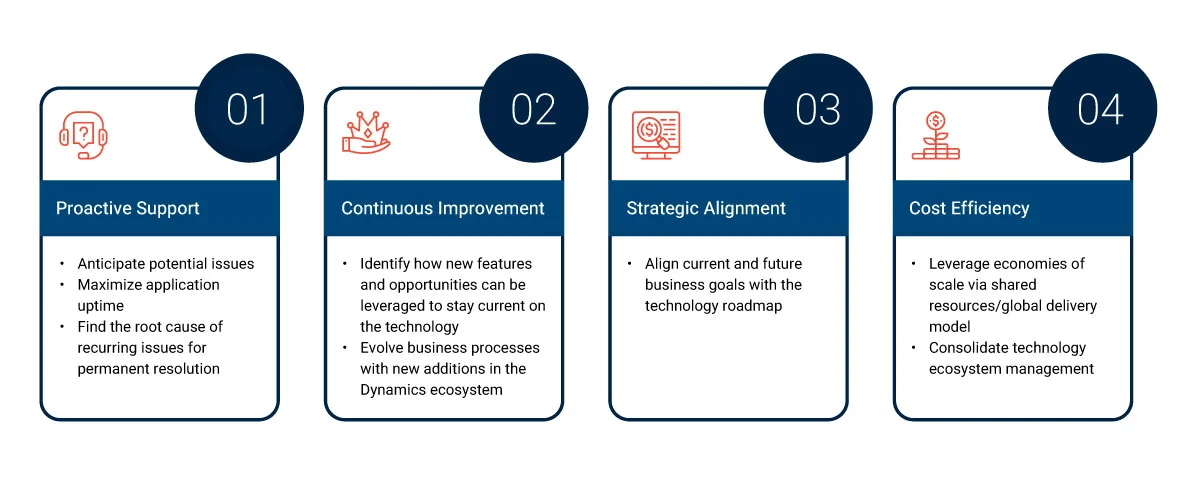
The challenges in running and optimizing any Microsoft Dynamics 365 Business Central deployment often diminish the ROI. Organizations looking to transform costs into value must rethink their support model. Here are the four key components that hold the key to maximizing Business Central returns:
1. Proactive Support
For any Business Central deployment to function correctly, proactive support is vital. Anticipating potential performance, security, or user experience issues is critical to maintaining user satisfaction. Support teams must also be capable of finding the root cause of recurring issues for permanent resolution and maximizing application uptime and availability.
2. Continuous Improvement
Organizations using Dynamics 365 Business Central must also have a mechanism to stay updated with new features and opportunities, and how they can be leveraged to keep up with technology innovations. Evolving business processes with new additions in the Dynamics ecosystem are also essential for staying relevant.
3. Strategic Alignment
With business needs and market trends constantly evolving, organizations must align current and future business goals with the Business Central roadmap. From adding new functionality to removing those that don’t make sense, organizations must put in effort to ensure strategic alignment of business and technology objectives.
4. Cost Efficiency
Running and optimizing Microsoft Dynamics 365 Business Central requires organizations to uncover ways to maximize cost efficiency. One way to do this is by leveraging economies of scale via shared resources/global delivery model. They can also consolidate their technology ecosystem and bring in partners who can run the system’s day-to-day operations.
The Role of Business Central Application Managed Services
Keeping pace with emerging technologies, particularly AI-enabled ERP capabilities, while aligning systems to evolving business needs is increasingly complex. With internal teams focused on core priorities, dedicating time and resources to day-to-day Dynamics 365 Business Central support services can be challenging.
Many organizations also struggle with:
- Hiring and retaining skilled Business Central talent
- Supporting 24×7 operations and global users
- Preparing ERP environments for AI-driven automation and analytics
- Scaling the system to support integrations, acquisitions, or new business models
Application Managed Services address these challenges by providing continuity, expertise, and a structured approach to ERP management. A well-aligned AMS model enables organizations to:
- Focus on core business objectives while experienced teams manage daily Business Central operations
- Maintain platform currency through regular updates and upgrades
- Improve productivity through timely issue resolution and experience-led support
- Scale ERP capabilities on demand while maintaining cost control
A Modern Approach to Business Central Managed Services
As ERP platforms continue to evolve, support models must evolve with them. Application managed services, especially when guided by outcome-led governance and experience-focused metrics, help organizations move from maintaining ERP systems to continuously optimizing them.
By adopting a modern AMS approach, businesses can ensure their Dynamics 365 Business Central environment remains resilient, efficient, and ready to support future growth.
Engage with our Business Central experts to to centralize application support, optimization, and governance across your ERP landscape—through a single, outcome-driven engagement model.
