
January 27, 2026 - by Synoptek
CFOs today face a paradox: IT is more critical than ever to business performance, yet IT spend is often one of the least transparent areas of the budget. Technology investments are intended to fuel growth, enhance resilience, and improve service delivery; however, they often result in cost overruns, inefficiencies, or stalled innovation.
The question every finance leader must now ask is: Is our IT spend delivering measurable business value, or silently working against us?
Why IT Spend Deserves CFO Oversight
Global IT investments are projected to exceed $5.74 trillion by the end of 2025, with cloud, AI, and cybersecurity driving the majority of the increase. Yet, studies show that global IT investments will surpass $5.74 trillion in 2025 , but most of it is still consumed by “keeping the lights on”— maintaining legacy systems, licenses, and infrastructure.
For CFOs, this creates a troubling imbalance. Instead of acting as a growth enabler, IT spend often becomes a sunk cost that erodes margins. Shadow IT, decentralized decision-making, and redundant vendor contracts exacerbate the problem, leaving finance leaders without the visibility and control needed to optimize returns.
Red Flags That Your IT Spend is Working Against You
CFOs should look for these warning signs:
- Budget unpredictability: Recurring cost overruns from underutilized software, cloud sprawl, or overlapping services.
- Low ROI visibility: Technology projects that consume significant investment but struggle to show impact on EBITDA, productivity, or time-to-market.
- Imbalanced allocation: The majority of IT dollars are funneled into operations, leaving little room for innovation or transformation.
- Scaling headaches: Expanding IT environments that add complexity, security risks, and costs rather than delivering efficiencies.
- Overdependence on scarce talent: Rising costs of in-house IT expertise or reliance on expensive consultants without long-term capability building.
If left unchecked, these issues can strain cash flow, reduce productivity, and weaken a company’s competitive advantage. In extreme cases, they lead to obsolescence and operational disruptions—directly impacting financial performance.
Turning IT from a Cost Burden into a Strategic Asset
The most progressive CFOs are reframing IT governance using the same rigor they apply to other capital allocations. Instead of focusing only on cost containment, they are asking: How can we ensure every technology dollar advances strategic objectives?
Practical steps include:
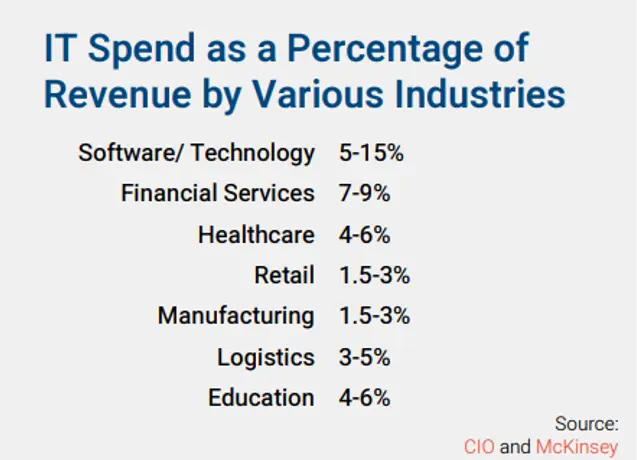
- Benchmarking IT spend against industry peers to uncover inefficiencies and reset baselines.
- Categorizing investments into operational vs. strategic, ensuring growth-driven initiatives like automation, cloud optimization, and analytics receive adequate funding.
- Applying ROI discipline to IT projects, with defined KPIs such as EBITDA improvement, cost-to-revenue ratio, and service-level adherence. This is where IT cost optimization becomes critical for CFOs seeking measurable value from every investment.
- Rationalizing applications and infrastructure to eliminate redundancies and improve scalability.
- Leveraging external partnerships for managed services or cloud governance to access expertise without ballooning headcount.
Organizations that adopt this structured approach regularly report reductions of 25–45% in IT costs, along with measurable improvements in service reliability, productivity, and innovation readiness. Implementing a clear IT strategy ensures technology investments align with business objectives and drive sustainable growth.
Service Excellence: The Often Overlooked Cost Lever
Many CFOs focus solely on reducing spend, but cost optimization without maintaining service quality can be just as damaging. Poor service performance increases downtime, lowers productivity, and creates hidden costs that outweigh any savings.
The most effective IT spending strategies strike a balance between financial discipline and service excellence. By measuring and enforcing SLAs, automating issue resolution, and aligning IT operations with business-critical priorities, organizations not only reduce waste but also strengthen resilience and agility.
Simply put, efficient IT spend is not about doing more with less; it’s about doing better with less. IT cost optimization is most effective when paired with a comprehensive IT strategy.
The CFO’s Roadmap Forward
Technology should never be a black box in the financial plan. CFOs who establish transparent governance and adopt data-driven IT investment frameworks can turn IT into a predictable, value-generating function of the business. A well-defined IT strategy ensures CFOs can drive growth while maintaining operational efficiency.
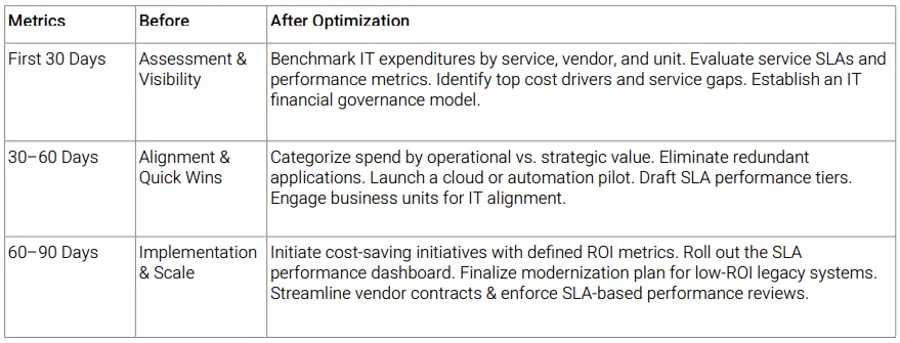
Our whitepaper, Strategic IT Spending: A Blueprint for Efficiency, Growth, and Service Excellence, provides finance leaders with:
- A framework for benchmarking and evaluating IT spend.
- A 30-60-90 day roadmap to cost and service optimization.
- Real-world case studies of organizations that reduced costs while improving innovation and service delivery.

Frequently Asked Questions
Begin by benchmarking your IT expenditures against those of your peers and industry averages. Look at ratios of OpEx vs. CapEx and how much of your budget goes toward innovation versus operations. If 70–80% of spend is tied to “keeping the lights on,” you’re likely underfunding growth and competitive initiatives.
Shadow IT purchases, redundant software licenses, underutilized cloud resources, and legacy systems often create significant leakage. These hidden costs drain budgets without delivering measurable ROI, making them prime areas for CFOs to target.
Apply the same rigor used in financial investments. Define clear KPIs such as EBITDA margin improvement, cost-to-revenue ratios, SLA adherence, and productivity gains. Every IT initiative should have measurable financial and operational outcomes tied to business strategy.
Yes—if done without considering service excellence. Poorly managed cost-cutting measures can lead to downtime, reduced employee productivity, and increased operational risks. The most effective strategies focus on achieving more with less, striking a balance between financial discipline and service reliability.
Begin with a structured assessment: benchmark current IT spend, categorize investments as operational vs. strategic, and identify opportunities for consolidation or automation. From there, build a 30-60-90 day roadmap to capture quick wins and create long-term alignment between IT and business objectives.