
October 14, 2026 · by Synoptek Team 8 min read
Key Takeaways
- Modern commerce depends on the integration between the customer-facing storefront and the enterprise systems operating behind it.
- Disconnected e-commerce, ERP, inventory, CRM, and fulfillment systems can create data inconsistencies, manual processes, and customer experience gaps.
- E-commerce integration with ERP provides a foundation for accurate product, pricing, inventory, customer, and order information.
- An omnichannel retail strategy requires connected inventory, order, and fulfillment systems across digital and physical channels.
- AI and commerce analytics can improve product discovery, personalization, merchandising, customer service, and decision-making.
- Ongoing managed commerce support helps businesses monitor, maintain, optimize, and evolve their commerce ecosystem after launch.
The Technology Challenges Behind Modern Commerce
For a customer, buying something online can appear remarkably straightforward: search for a product, review the available options, add an item to the cart, complete checkout, and receive an order confirmation. However, behind that seemingly simple journey, multiple technology systems may need to exchange information in real time, including the B2B e-commerce platform, ERP, payment gateway, inventory system, CRM, order management system, warehouse management system, fulfillment platforms, and AI chatbots.
That complexity creates a fundamental challenge for retailers, manufacturers, and distributors: how do you make a fragmented technology environment feel like one seamless commerce experience? Here’s what makes modern commerce a challenge for many today:
- Disconnected e-commerce and ERP systems: E-commerce integration with ERP is critical. When ERP and storefront systems operate in silos, product, pricing, inventory, customer, and order information may require manual intervention or periodic synchronization, increasing the risk of inconsistencies and delays.
- Inaccurate or fragmented data: Customers expect to see whether a product is available and when they can receive it. When inventory information is spread across stores, warehouses, distribution centers, and digital channels, maintaining accurate availability can become difficult.
- Complex omnichannel experiences: Effective omnichannel fulfillment requires businesses to coordinate product information, pricing, inventory, orders, and fulfillment across websites, mobile commerce, marketplaces, and physical stores while maintaining a consistent customer experience.
- Manual order and fulfillment processes: Orders often pass through an order management system and several other systems after checkout. If those systems do not communicate effectively, teams may need to re-enter information, manually track orders, or resolve fulfillment issues, adding unnecessary operational effort.
- Legacy integrations and growing technology complexity: Commerce ecosystems often combine modern platforms with older enterprise applications and custom integrations. Maintaining these connections as platforms, APIs, and business requirements change can become increasingly challenging.
- Limited visibility across the commerce lifecycle: Businesses need visibility from product discovery and checkout through inventory, fulfillment, delivery, returns, and customer service. Data trapped within individual systems can make it difficult to understand what is happening across the complete journey.
- Increasing pressure to adopt AI: AI in e-commerce is increasingly being used for search, recommendations, personalization, merchandising, customer service, and commerce operations. However, AI initiatives depend on reliable data, connected systems, and an architecture capable of providing the right context.
- Ongoing performance and support requirements: A B2B e-commerce platform can operate as a 24/7 revenue channel. Performance issues, failed integrations, payment problems, synchronization errors, and security vulnerabilities require ongoing monitoring and support rather than attention only during implementation.
What a Connected Digital Commerce Ecosystem Looks Like
A modern e-commerce experience depends on much more than the storefront. Customers expect easy product discovery, fast checkout, accurate pricing and availability, personalized recommendations, and flexible delivery and returns. Meeting these expectations requires B2B e-commerce platforms to work seamlessly with the enterprise systems and data that power commerce operations.
For organizations serving business buyers, a B2B e-commerce platform must also connect seamlessly with ERP, CRM, inventory, pricing, and order management systems. B2B e-commerce ERP integration can help synchronize these processes while supporting customer-specific pricing, catalogs, purchasing rules, and account structures.
Here’s what defines a connected digital commerce ecosystem:
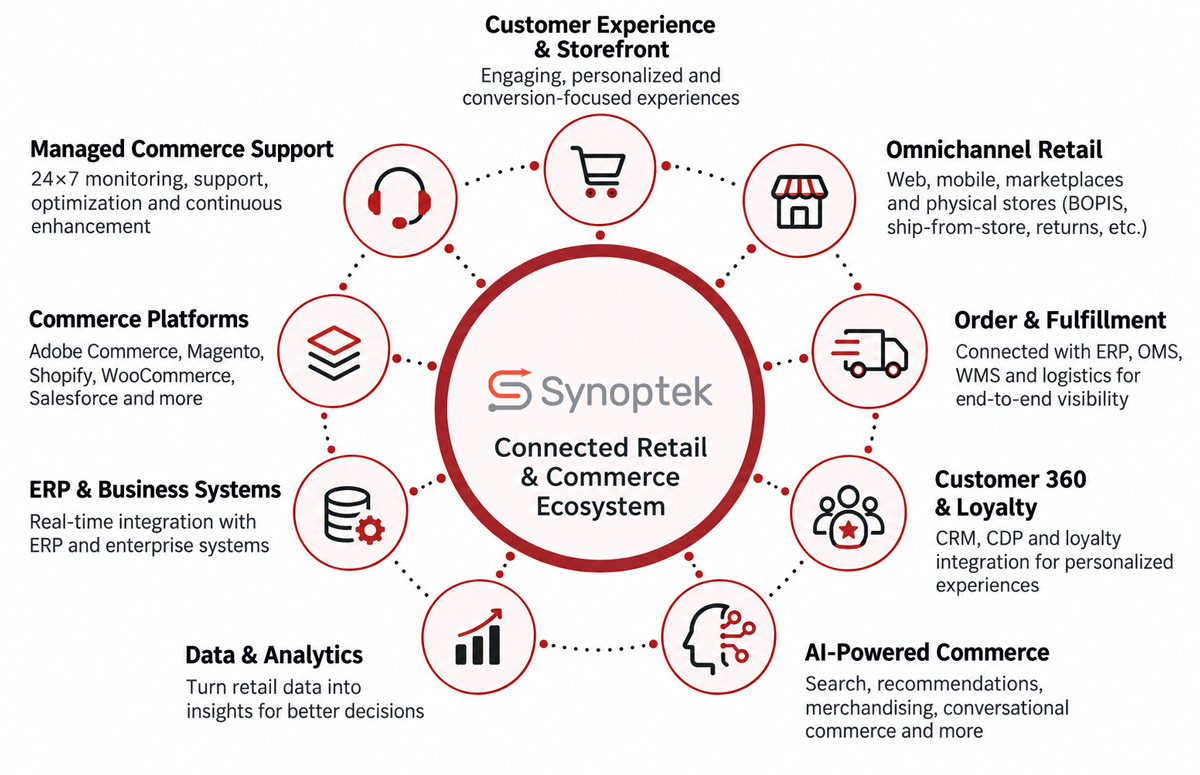
- Seamless Customer Experiences: Platforms such as Adobe Commerce, Magento, Shopify, WooCommerce, and Salesforce Commerce Cloud provide the foundation for digital storefronts, but customer experience depends on how effectively these platforms connect with ERP, CRM, inventory, payment, marketplace, and fulfillment systems. The goal is to make this underlying complexity invisible to customers while delivering consistent, convenient, and relevant B2C and B2B buying experiences.
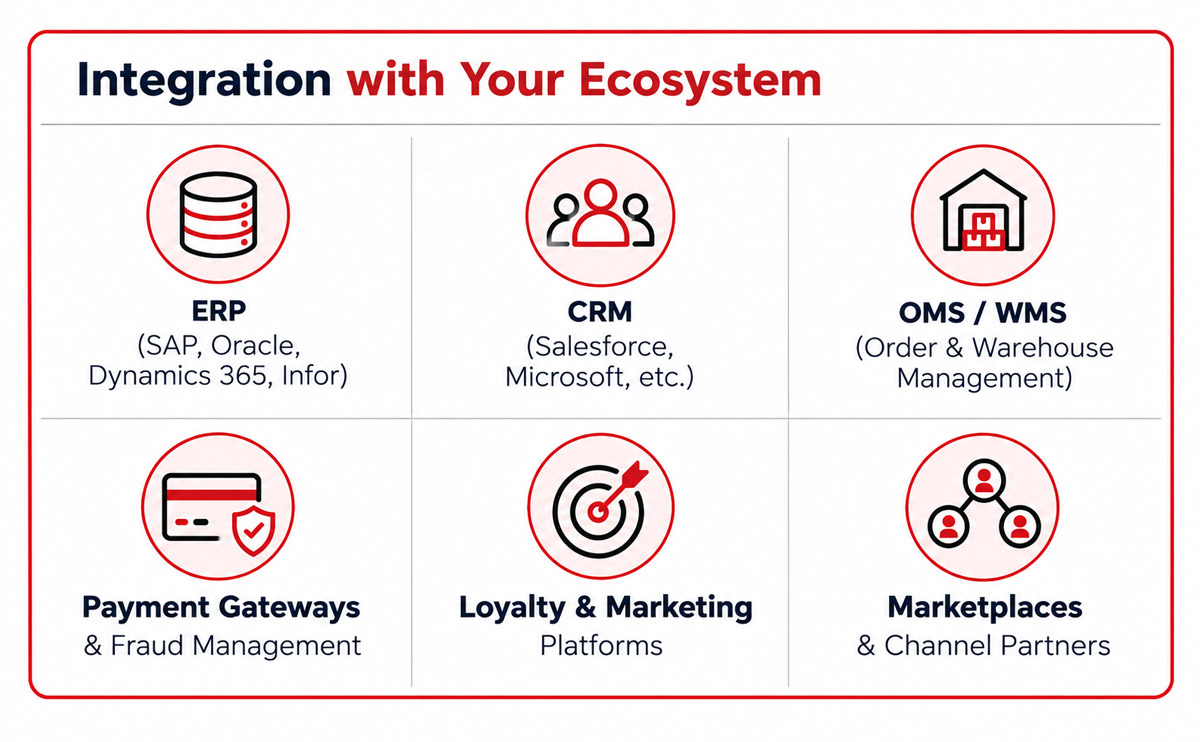
- E-commerce ERP Integration: E-commerce ERP integration connects the storefront with critical business data, including products, catalogs, pricing, promotions, customer accounts, inventory, orders, fulfillment status, and complex product structures such as bills of material. Automated data flows can reduce manual entry, minimize discrepancies, and ensure customers and employees have access to more consistent information. Choosing the right ERP for e-commerce helps businesses create reliable connections between their commerce platforms and core business operations while supporting scalable data and order flows.
- Connected Omnichannel Fulfillment: Customers increasingly move between websites, mobile devices, marketplaces, and physical stores as part of the same buying journey. According to PWC, 89% of customers are retained by businesses that have a strong omnichannel retail strategy. Enabling unified commerce can deliver real-time inventory visibility, Buy Online, Pick Up In Store (BOPIS), Click and Collect, ship-from-store, Buy Online, Return In Store, and consistent product, pricing, and promotion experiences across channels.
- Unified Customer Data: Connecting e-commerce transactions with CRM, customer data, and loyalty platforms can create a more complete view of customer interactions and purchase history. This digital commerce platform integration can support Customer 360 initiatives, personalized promotions, loyalty programs, relevant recommendations, and more targeted B2B and B2C engagement across channels.
- Intelligent AI in E-Commerce: AI in digital commerce can enhance product search, recommendations, personalization, conversational commerce, merchandising, product content, customer service, and cross-sell opportunities. Its potential extends beyond the storefront: when AI can access relevant product, customer, inventory, behavioral, and transaction data, it can support more intelligent commerce experiences and operations.
- Actionable Commerce Analytics: Connecting e-commerce, ERP, inventory, customer, order, and fulfillment data creates a stronger foundation for commerce analytics. With 67% of online shoppers abandoning their carts because delivery is too expensive, slow, or unclear, commerce analytics can help businesses identify where customers drop off and why. They can analyze cart abandonment, conversion rates, product and category performance, buying behavior, inventory movement, fulfillment performance, and channel trends, turning fragmented data into actionable insights for better customer experiences and more informed decisions.
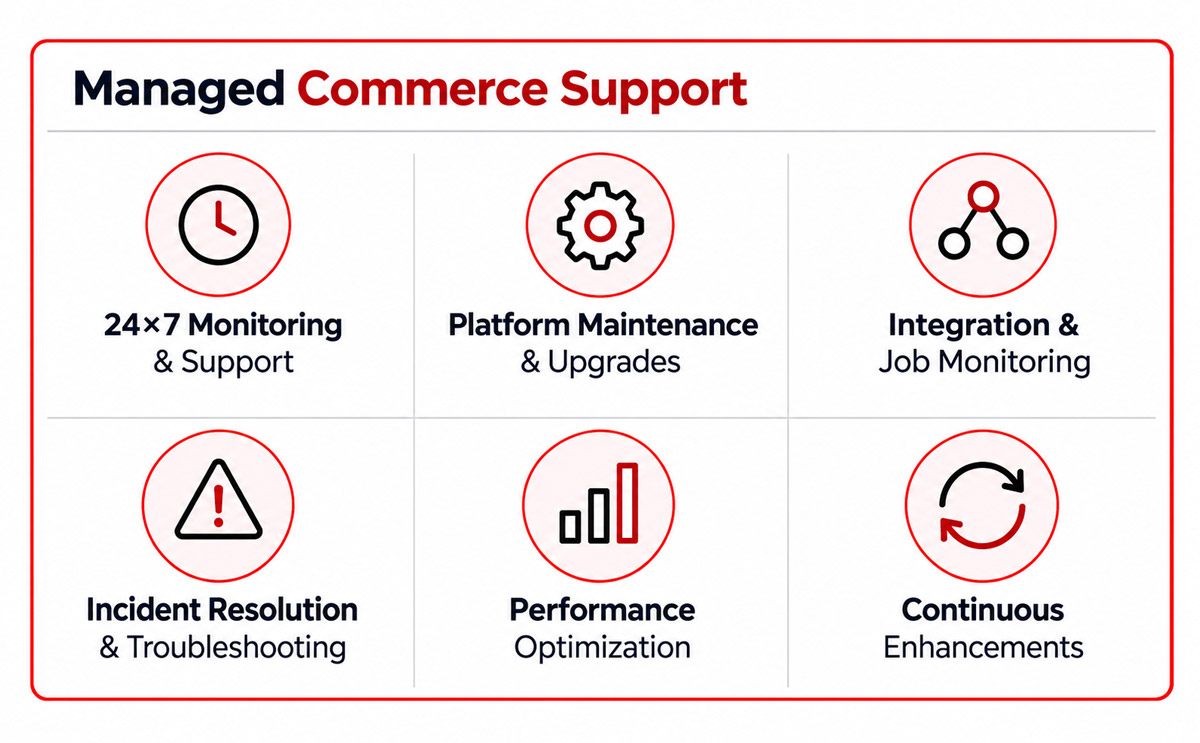
- Managed Commerce Support: Digital commerce requires ongoing monitoring and optimization after go-live to keep platforms, integrations, data flows, and customer-facing experiences running reliably. Managed commerce support can help businesses monitor platform performance, APIs, ERP integrations, inventory and order synchronization, checkout and payments, while providing troubleshooting, incident resolution, upgrades, security updates, performance optimization, and continuous improvements as commerce needs evolve.
How Synoptek Streamlines E-commerce ERP Integration
Synoptek works with retailers, manufacturers, and distributors to build, integrate, modernize, manage, and continuously optimize digital commerce ecosystems across B2C and B2B environments. Our approach brings together unified commerce technology, enterprise systems, data, integrations, automation, and AI to create a more connected and scalable commerce environment.
We connect the storefront with the enterprise systems, data, processes, and technologies that support every stage of the customer and commerce journey. Our capabilities span commerce platforms, e-commerce ERP integration, omnichannel retail strategy, CRM, order and fulfillment integration, data and analytics, automation, AI, and managed commerce support. Depending on business requirements, this can include modernizing an existing commerce environment, integrating new capabilities, improving omnichannel fulfillment, or developing and optimizing digital commerce operations across technologies such as Adobe Commerce, Magento, Shopify, WooCommerce, and Salesforce Commerce Cloud.
Through Managed Commerce Support, Synoptek can monitor platforms, integrations, APIs, scheduled jobs, data synchronization, checkout, and payments while supporting troubleshooting, upgrades, security updates, performance optimization, scalability, incident resolution, and ongoing feature development.
Synoptek Digital Commerce Capabilities
Commerce Platforms
Adobe Commerce | Magento | Shopify | WooCommerce | Salesforce Commerce Cloud
Connected Enterprise
E-commerce + ERP | B2B E-Commerce | CRM | OMS/WMS | Inventory | Order & Fulfillment
Digital Intelligence
Data & Analytics | Automation | AI in E-Commerce | Personalization | Business Insights
Continuous Operations
Platform Monitoring | Integration Support | Performance Optimization | Security | Upgrades | Managed Commerce
Building a Connected, Intelligent, and Scalable Commerce Ecosystem
Modern commerce brings together far more technology than customers see. The storefront provides the visible experience, but ERP, CRM, inventory, order management, fulfillment, analytics, integrations, automation, and AI all influence what happens behind every transaction.
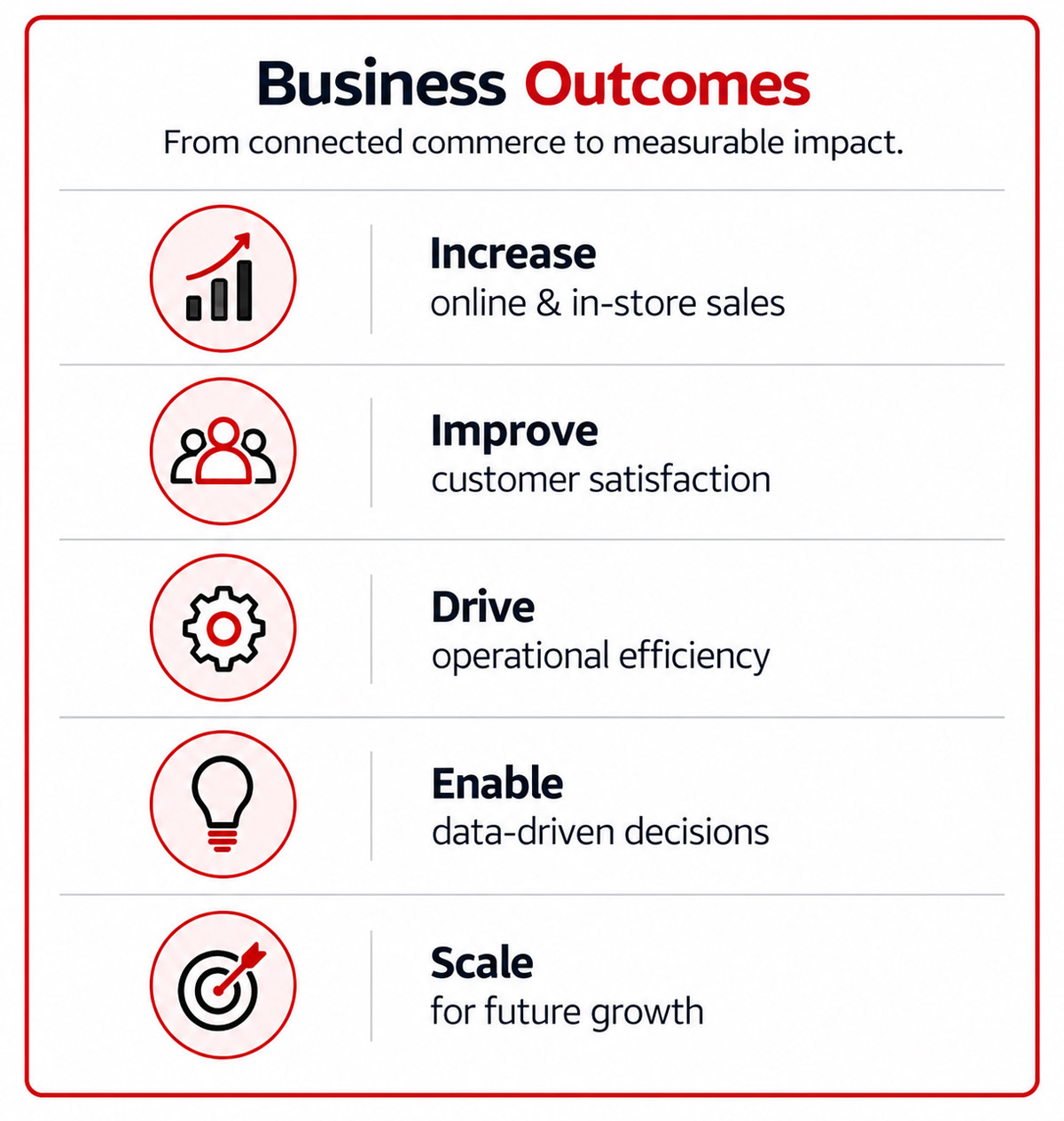
When these systems remain disconnected, businesses can encounter inconsistent data, manual processes, limited visibility, operational delays, and fragmented customer journeys. When they work together, organizations can create more consistent experiences while gaining greater visibility into the operations that support them.
For retailers, manufacturers, and distributors, the next phase of digital commerce is about connecting the technologies behind every channel and creating an ecosystem that can evolve with the business. Commerce platforms, ERP, CRM, OMS/WMS, data and analytics, integration, automation, AI, and managed support each play a role in building that foundation.
The storefront is what customers see. The connected technology ecosystem behind it is what makes modern commerce work. Together, these capabilities create a digital commerce ecosystem where customer experiences, enterprise operations, data, and technology work together rather than operating as disconnected systems.