
August 13, 2026 · by Synoptek Team 10 min read
Remote workforce security solutions in 2026 focus on zero trust architecture, which verifies every user and device before granting access, regardless of location. Effective programs combine zero trust network access (ZTNA), managed endpoint security, identity governance, and continuous compliance monitoring to reduce the risk introduced by distributed teams. Organizations evaluating these controls typically weigh in-house build-out against managed delivery based on internal security staffing and compliance obligations.
The office perimeter, as a security boundary, no longer describes how most organizations operate. Employees authenticate from home networks, co-working spaces, airports, and personal devices, often within the same workday. This shift has changed the composition of the attack surface: instead of a contained network with a defined edge, security teams now manage a distributed set of endpoints, connections, and identities that each carry independent risk.
This is the structural reason remote workforce security solutions have become a standing item on board and audit committee agendas rather than a discretionary IT initiative. A single unmanaged device or an over-permissioned account can be sufficient for an attacker to reach core systems. Perimeter-based defenses were not designed for this environment and extending them to cover hybrid teams tends to produce visibility gaps rather than closing them.
This analysis outlines how zero trust security for remote workforce 2026 environments is typically architected, what it means in practice to secure a hybrid workforce with zero trust, why zero trust network access (ZTNA) is displacing legacy VPN models, and where remote employee endpoint security and compliance requirements intersect with managed delivery models.
Why Perimeter-based Security Models Do Not Hold Up for Distributed Teams
Legacy security architecture assumed a defined boundary: a corporate network on one side, an untrusted internet on the other, with a firewall in between. Once a user authenticated inside that perimeter, they were largely trusted by default for the remainder of the session.
Remote and hybrid work undermines that model in three specific ways.
- The network edge is no longer singular: Home routers, public Wi-Fi, and mobile hotspots each function as an entry point, and none sit under direct IT control.
- Device standardization is harder to enforce: Bring-your-own-device policies and remote onboarding introduce wide variation in patch levels, configurations, and installed security software.
- Identity has effectively become the perimeter: With no physical network boundary to defend, credentials protecting an account are often the only control separating an attacker from sensitive data.
The net effect is a larger attack surface with reduced centralized visibility. Organizations that extend office-era controls, such as a VPN paired with a firewall, over a distributed workforce consistently encounter gaps that are difficult to detect until after they have been exploited.
What Zero Trust Security for Remote Workforce 2026 Means in Practice
Zero trust inverts the earlier assumption. Rather than trusting a user or device by default because it sits inside a familiar network, zero trust verifies every request each time, independent of where the connection originates.
The model is built on a small number of core principles.
- Never trust, always verify: No user or device receives implicit access based solely on network location.
- Least privilege access: Users and applications are granted only the access required for a specific task, nothing broader.
- Continuous verification: Authentication is treated as an ongoing state rather than a single event at login, with sessions monitored and access revocable in real time.
- Assume breach: The architecture is designed under the assumption that an intrusion will eventually occur, to limit lateral movement and contain impact.
For a distributed workforce, this framework carries specific weight because it does not depend on physical location. A login from a home office is verified under the same conditions as a login from headquarters. That consistency is the underlying logic of most current remote workforce security solutions.
A Framework for Securing a Hybrid Workforce with Zero Trust
Zero trust is not a single product acquisition. It is a layered strategy spanning identity, devices, network access, and data governance. The following components are typically present in mature programs.
Identity and Access Management
Since identity functions as the effective perimeter, most zero trust programs begin here. Multi-factor authentication (MFA) is applied across all users, not only administrators. Conditional access policies incorporate device health, location, and behavioral signals before granting access. Privileged accounts require ongoing governance and periodic access review, since standing permissions tend to accumulate risk quietly over time if left unmanaged.
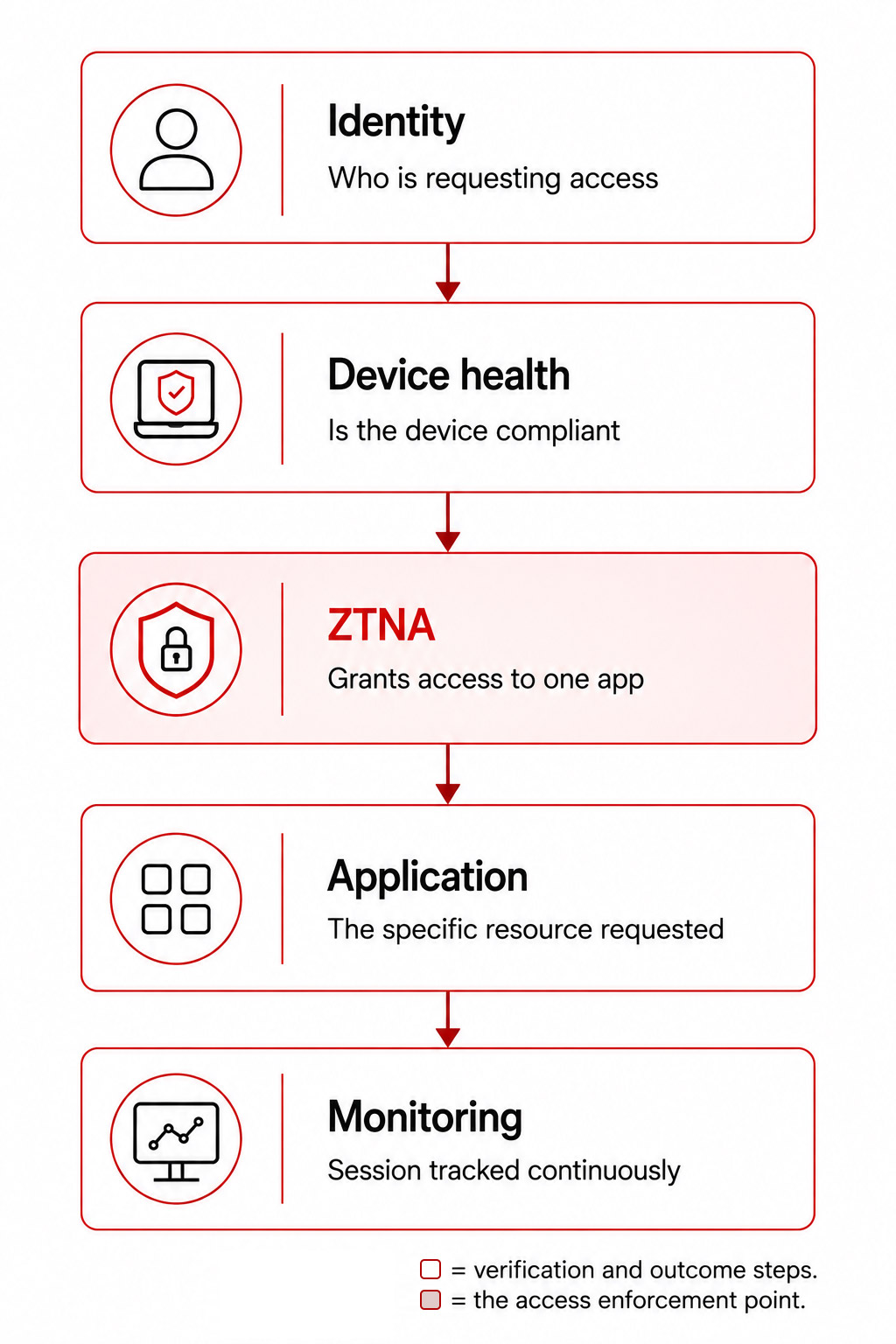
Remote Employee Endpoint Security
Every laptop, tablet, or phone used for work functions as a potential entry point, which makes endpoint protection a structural requirement rather than an optional layer. Remote employee endpoint security managed services typically combine endpoint detection and response (EDR), automated patch management, and continuous device compliance checks. Managed delivery is relevant here because incidents frequently occur outside standard business hours, when internal teams may have limited coverage.
Zero Trust Network Access (ZTNA)
Traditional VPNs grant broad network access once a connection is established, which reintroduces the implicit trust that zero trust is designed to eliminate. Zero trust network access (ZTNA) for hybrid teams instead grants access to specific applications, verified individually, without placing the user on the internal network. This limits what is reachable even if one set of credentials is compromised, and it generally performs better for remote users than routing all traffic through a central VPN gateway.
The structural difference is straightforward to summarize:
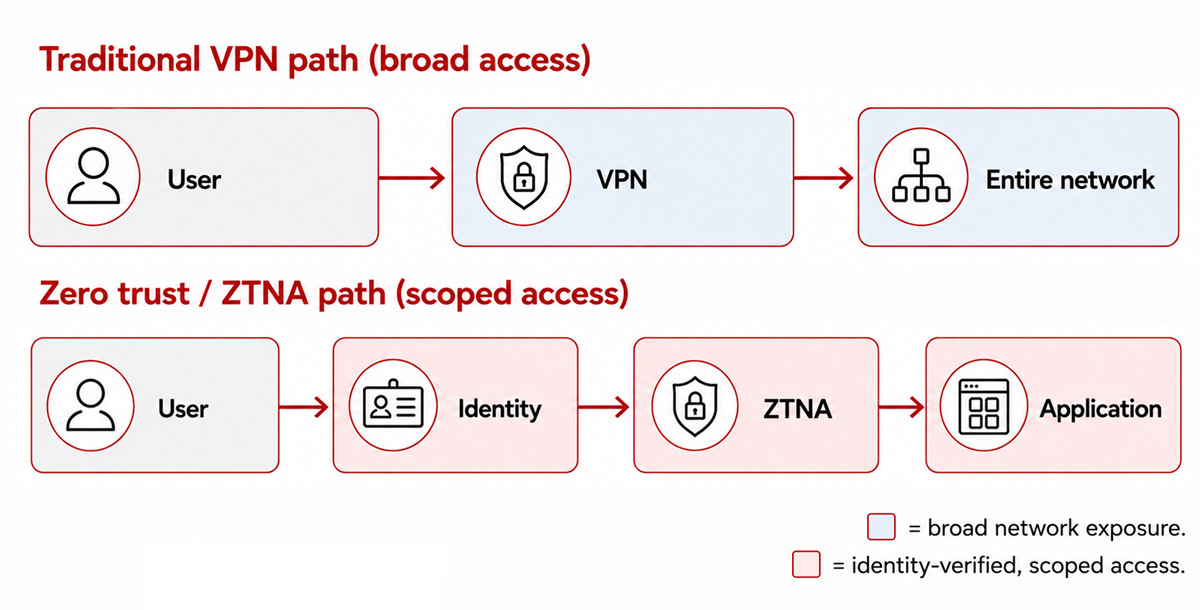
The VPN path exposes the full network once a session is authenticated. The ZTNA path exposes only the single application a verified user is authorized to reach.
Network Segmentation and Monitoring
Micro-segmentation divides the network into smaller zones so that a compromise in one area does not propagate freely. Combined with continuous monitoring and centralized logging, this gives security teams the visibility to identify anomalous behavior, such as an unexpected login location or an unusual data access pattern, before it develops into a broader incident.
Compliance Integration
For regulated industries, managed security for distributed workforce compliance is not a secondary consideration. Frameworks including SOC 2, HIPAA, PCI-DSS, and ISO 27001 increasingly require organizations to demonstrate control over remote access, device security, and data handling regardless of employee location. Embedding compliance reporting into the security architecture itself, rather than reconstructing it after an audit request, reduces both administrative burden and risk.
A Practical Implementation Sequence
For organizations translating this framework into an actual rollout, the order of operations generally matters as much as the components themselves.
- Inventory identities and devices, including service accounts and contractor access.
- Require multi-factor authentication across all users before layering on additional controls.
- Replace VPN access with ZTNA, starting with the applications carrying the highest risk.
- Deploy endpoint detection and response (EDR) to every managed and unmanaged device in use.
- Segment network access around the most sensitive applications and data stores.
- Establish continuous identity and access monitoring in place of periodic reviews alone.
This sequence reflects where risk concentrates first. Identity and endpoints typically carry more exposure than network architecture, which is why organizations that segment the network before securing identity often see limited improvement in their actual risk posture.
Emerging Risk Factors Shaping 2026 Remote Workforce Security
A small set of newer risk factors is now shaping which controls deserve the earliest attention. AI-assisted phishing and deepfake voice impersonation have made social engineering considerably harder to detect, particularly against helpdesk and account recovery workflows that rely on voice or written verification.
SaaS sprawl and unmanaged, or “shadow,” AI tools have expanded the set of applications handling company data outside centralized governance. On the defensive side, password-less authentication and passkeys are reducing the value of stolen credentials as an attack path, and continuous authentication, which evaluates device and behavioral signals throughout a session rather than only at login, is becoming a standard complement to conditional access policies. None of this changes the underlying zero trust framework, but it does change where the earliest investment should go.
In-house Buildout Versus Managed Delivery
Operating a full zero trust program internally requires specialized capability across identity management, endpoint security, network architecture, and compliance, a combination that exceeds the bandwidth of many internal IT teams, particularly at mid-market scale. This is the primary reason managed security delivery is common for this category of work.
Managed delivery models typically provide:
- Continuous monitoring and threat detection across remote and hybrid endpoints
- Faster incident response, given dedicated monitoring already in place
- Consolidated compliance reporting spanning identity, endpoint, and network controls
- A scaling model that does not require new internal hires for every additional tool
This is also tied to a broader structural issue: IT operations and security are increasingly difficult to manage as separate functions. As detailed in an analysis of why integrated MSP and MSSP models have become standard practice, the gap between IT management and security monitoring is where a significant share of breaches originate, a risk that compounds as a workforce becomes more distributed.
A consumer services organization operating in a hybrid Microsoft environment had limited visibility into privileged access and inconsistent governance across users and applications. A cloud security assessment across Microsoft 365 and Entra ID identified specific gaps in identity governance and endpoint configuration. The resulting program gave the organization full visibility into its identity landscape and strengthened endpoint security and policy enforcement, an applied instance of zero trust principles implemented in a live hybrid environment.
Security and compliance requirements also persist through major organizational transitions. A long-term care insurance administrator required full operational independence following a private equity acquisition, which meant rebuilding security and compliance controls in parallel with a complete infrastructure separation and cloud migration.
The resulting AWS-based operating environment strengthened the organization’s security and compliance posture alongside a broader technology transformation, indicating that distributed workforce security requirements and larger business objectives can be addressed within a single program rather than treated as competing priorities.
Common Zero Trust Mistakes
A handful of implementation errors account for most of the gap between a documented zero trust strategy and its actual risk reduction.
- Deploying MFA broadly while leaving privileged and administrative access unreviewed.
- Running ZTNA alongside a legacy VPN that stays active as a fallback, preserving the exact broad access the architecture was meant to remove.
- Excluding contractor and third-party identities from the same governance applied to employees.
- Leaving unmanaged or personal devices unpatched because they fall outside standard endpoint management.
- Treating compliance documentation as a one-time project rather than an ongoing output of the architecture itself.
Evaluation Criteria for a Security Partner
Providers describing their offering as zero trust or remote workforce security vary considerably in depth. Relevant evaluation questions include:
- Does the offering reflect genuine zero trust architecture, or a VPN with additional access controls layered on top?
- What is the demonstrated response time for an incident originating from a remote endpoint?
- Is there direct experience with the compliance frameworks applicable to the organization in question?
- Is endpoint security managed as part of an integrated platform, or handled separately from identity and network controls?
- Is reporting consolidated across identity, endpoint, and network layers, or distributed across disconnected dashboards?
These distinctions generally separate providers with an architecturally coherent approach from those that have added remote-friendly features to an existing model without restructuring the underlying architecture.
Closing Assessment
Hybrid and remote work are now structural features of how organizations operate, and the security model applied to that work needs to reflect that permanence rather than treat it as temporary accommodation. Zero trust, supported by identity controls, managed endpoint security, ZTNA, and compliance reporting built into the architecture, addresses the risk profile of a distributed workforce without depending on a fixed network boundary that no longer exists in practice.
Organizations still operating primarily on a legacy VPN and a set of disconnected point tools are likely carrying visibility gaps that are difficult to quantify without a formal assessment. Additional detail on how these controls are structured is available through Synoptek’s cybersecurity services.